The End of Self Declared Expertise
For centuries, people proved their abilities through direct interaction. A blacksmith demonstrated craftsmanship by forging metal. A doctor earned trust through years of practice. A teacher showed knowledge inside the classroom. Reputation was built gradually through observation, recommendations, and consistent results.
The digital world changed that.
Today, millions of people claim expertise with a simple headline:
“AI Expert.”
“Blockchain Architect.”
“Cybersecurity Specialist.”
“Growth Hacker.”
Anyone can write these words on a profile. The problem is that titles are inexpensive, but trust is not.
As technology enables anyone to publish credentials instantly, the gap between claimed skills and proven skills continues to grow.
This is becoming one of the biggest challenges in the modern workforce.
A Skill Is Not a Statement
A skill is not something you declare.
A skill is something you repeatedly demonstrate.
Imagine hiring two software engineers.
The first says:
“I have ten years of experience.”
The second provides:
- Open source contributions.
- Production deployments.
- Verified code reviews.
- Performance benchmarks.
- Security audit history.
- Peer endorsements.
- Real project outcomes.
Both may have identical resumes.
Only one has evidence.
Which one would you trust?
The answer is obvious.
Evidence transforms confidence into certainty.
The Cost of Invisible Skills
Every day, organizations make decisions based on incomplete information.
Recruiters review resumes filled with buzzwords.
Universities issue degrees that may not reflect current abilities.
Companies conduct interviews that last less than an hour.
Managers evaluate employees based on subjective impressions.
Meanwhile, highly capable people remain overlooked because they cannot effectively prove what they know.
The result is a global mismatch between talent and opportunity.
Many professionals possess extraordinary abilities but lack a trusted way to demonstrate them.
At the same time, others successfully market themselves despite limited practical experience.
This imbalance creates inefficiency across the entire economy.
Credentials Are Not Enough
A certificate answers only one question:
“Did someone complete a course?”
It rarely answers the questions that truly matter.
Can this person solve complex problems?
Can they work under pressure?
Can they collaborate with teams?
Can they adapt to new technologies?
Can they consistently produce high quality work?
Real capability is dynamic.
Traditional credentials are static.
The future demands systems that capture continuous proof of learning and performance instead of isolated achievements.
Evidence Builds Trust
Evidence changes conversations.
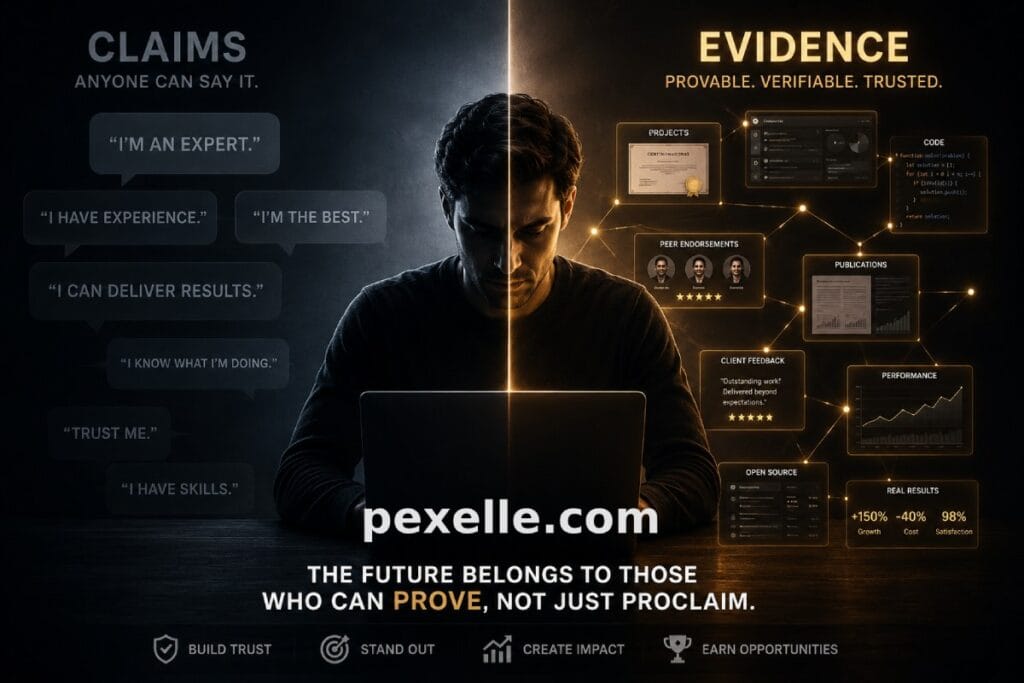
Instead of saying:
“I’m good at machine learning.”
You can show:
- Published research.
- Model accuracy metrics.
- Git repositories.
- Kaggle rankings.
- Production deployments.
- Independent evaluations.
- Client success stories.
Instead of saying:
“I’m a great designer.”
You provide:
- Design systems.
- Usability testing results.
- Accessibility reports.
- Before and after comparisons.
- User satisfaction improvements.
Instead of saying:
“I’m an excellent project manager.”
You demonstrate:
- Delivery timelines.
- Budget performance.
- Risk management history.
- Team feedback.
- Stakeholder satisfaction.
Evidence removes uncertainty.
AI Makes Verification More Important
Artificial Intelligence is dramatically increasing content production.
Resumes can be generated in minutes.
Cover letters can be written instantly.
Portfolios can be polished automatically.
Interview answers can be rehearsed endlessly.
Even recommendation letters can be generated with AI assistance.
As synthetic content becomes easier to create, authentic evidence becomes more valuable.
The more convincing AI becomes, the more important verification becomes.
This is not a contradiction.
It is a natural evolution.
The Rise of Verifiable Skills
Future hiring will rely less on descriptions and more on proof.
Imagine a professional profile where every skill is connected to verified evidence.
Programming skills linked to accepted pull requests.
Leadership skills linked to measurable project outcomes.
Communication skills supported by presentations, publications, and peer reviews.
Problem solving validated through successful challenges.
Every claim becomes traceable.
Every achievement becomes auditable.
Every skill becomes measurable.
This transforms professional identity from a static resume into a living record of capability.
Beyond Recruitment
Evidence based skills benefit far more than hiring.
Education
Students build portfolios instead of collecting certificates.
Companies
Managers identify hidden talent more accurately.
Governments
Workforce development programs become measurable.
Freelancers
Trust is established before the first project begins.
Investors
Founders can demonstrate execution rather than simply presenting ambitious ideas.
AI Systems
Intelligent agents can make better recommendations using verified capabilities instead of self reported information.
Evidence improves every decision that depends on trust.
Digital Trust Infrastructure
The next generation of professional identity will not rely on isolated documents.
It will rely on interconnected evidence.
Projects.
Certifications.
Code.
Publications.
Assessments.
Work history.
Peer validation.
Performance metrics.
Learning records.
Community contributions.
Together, these create a trustworthy representation of human capability.
Not because someone claims it.
Because reality supports it.
The Human Advantage
Technology will automate many tasks.
AI will generate content.
Robots will execute repetitive work.
Algorithms will analyze enormous datasets.
But one thing will remain invaluable:
Proven human capability.
People who consistently demonstrate their skills will stand apart from those who simply describe them.
Evidence becomes the strongest competitive advantage.
Not because machines cannot generate claims.
Because machines cannot fabricate authentic histories of meaningful contribution.
The Future Is Proof, Not Promises
The professional world is moving toward a new standard.
Resumes will become less important.
Evidence will become the primary currency of trust.
The question will no longer be:
“What skills do you say you have?”
Instead, it will become:
“What evidence supports those skills?”
This shift will reshape hiring, education, professional networking, and digital identity.
In a world where anyone can claim expertise, the people who can prove it will define the future.
Because trust is never created by words alone.
Trust is earned through evidence.
And in the digital age, evidence is the language of credibility.
Source : Medium.com