
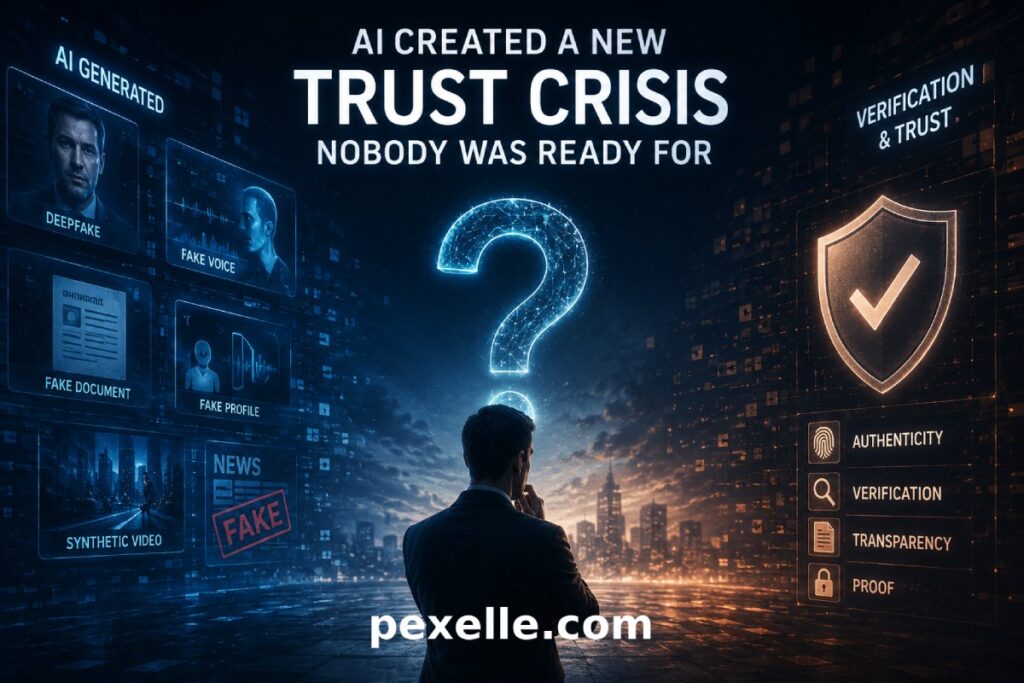
Artificial Intelligence is transforming the world faster than any technology in modern history. It writes code, creates artwork, answers complex questions, generates realistic videos, and even imitates human voices with remarkable accuracy. Productivity has increased, costs have fallen, and innovation has accelerated across nearly every industry.
Yet behind this extraordinary progress lies a problem that few people anticipated.
AI has made it dramatically easier to create convincing content, but it has also made it dramatically harder to know what is real.
For the first time in history, humanity is entering an era where seeing is no longer believing.
This is not simply a technological challenge.
It is a trust crisis.
The Cost of Infinite Intelligence
The internet solved the problem of information distribution.
AI has solved the problem of information creation.
Today, anyone can generate thousands of articles, professional images, marketing campaigns, software applications, legal documents, resumes, educational certificates, voice recordings, and realistic videos within minutes.
The barrier to creating convincing digital content has nearly disappeared.
While this democratization is powerful, it also creates an uncomfortable reality:
The cost of producing fake evidence is approaching zero.
When fake content becomes inexpensive and authentic content becomes difficult to distinguish, trust begins to disappear.
Reality Is Becoming Optional
For decades, digital fraud required specialized knowledge.
Creating fake videos required professional editing.
Forging documents required significant effort.
Impersonating someone convincingly was difficult.
AI changed all of that.
Today we have:
- Deepfake videos
- Synthetic voices
- AI generated identity photos
- Fabricated employment histories
- AI written academic papers
- Fake customer reviews
- Automated phishing messages
- AI generated social media accounts
Many of these can already fool ordinary users.
Soon, many will fool professionals as well.
The question is no longer whether AI can generate convincing content.
The question is whether humans can reliably verify it.
The Death of “Trust Me”
Throughout history, trust has relied on reputation.
People trusted employers.
Companies trusted universities.
Customers trusted brands.
Banks trusted paperwork.
Governments trusted identification documents.
Most of these systems assumed that creating convincing fake evidence was expensive.
AI destroyed that assumption.
If anyone can generate:
- a professional resume,
- an impressive portfolio,
- recommendation letters,
- certificates,
- interviews,
- product reviews,
then reputation alone becomes insufficient.
Claims without verification lose value.
Verification Becomes More Valuable Than Creation
Ironically, AI is making creation abundant.
Abundance reduces value.
Verification becomes scarce.
Scarcity creates value.
The future competitive advantage will not belong to those who can create the most content.
It will belong to those who can prove authenticity.
This changes everything.
Instead of asking:
“Can this be created?”
Organizations will increasingly ask:
“Can this be verified?”
Every Industry Will Face the Same Problem
This challenge is not limited to cybersecurity.
Every industry depends on trust.
Hiring
How do employers know a candidate truly possesses the skills listed on their resume?
How can interview performance be trusted when AI assistants increasingly participate behind the scenes?
Education
How can universities distinguish genuine understanding from AI generated assignments?
How should certifications evolve when knowledge can be instantly synthesized?
Healthcare
Can medical records, prescriptions, and diagnostic recommendations be verified against manipulation?
Finance
Can identity documents, income statements, and transaction histories still be trusted without cryptographic proof?
Media
Which videos are authentic?
Which interviews actually happened?
Which eyewitness accounts are genuine?
Commerce
Which product reviews come from real customers?
Which ratings reflect actual experiences?
Every sector will eventually face the same fundamental question:
How do we verify reality in an AI generated world?
The Rise of Proof-Based Systems
The next generation of digital infrastructure will focus less on creating information and more on proving it.
We are already seeing the early foundations:
- Cryptographic signatures
- Digital identity frameworks
- Verifiable credentials
- Blockchain based attestations
- Trusted execution environments
- Content provenance standards
- Tamper evident audit logs
These technologies share a common purpose.
They provide evidence instead of promises.
Instead of asking people to trust a claim, they allow others to independently verify it.
That distinction is becoming increasingly important.
AI Needs a Trust Layer
Today’s AI systems are becoming more capable every month.
However, intelligence without trust creates new risks.
Future AI ecosystems will require an additional layer:
- Who created this content?
- When was it created?
- Which model generated it?
- Was it modified afterward?
- Can the source be independently verified?
- Is the identity behind the action authentic?
Without answers to these questions, AI systems may produce extraordinary outputs that no one fully trusts.
Capability alone is not enough.
Trust infrastructure must evolve alongside intelligence.
Trust Will Become an Economic Asset
Historically, trust was considered a social value.
In the AI era, trust becomes economic infrastructure.
Businesses with verifiable processes will attract more customers.
Employees with verifiable skills will become more valuable.
Creators who can prove originality will stand out.
Platforms with transparent verification systems will gain greater confidence from users.
Investors may eventually evaluate companies not only by revenue and growth, but also by the strength of their trust architecture.
Trust will become measurable.
And measurable trust becomes a competitive advantage.
The Organizations That Win
The companies that thrive over the next decade may not be the ones producing the most AI generated content.
They may be the ones that can reliably prove:
- who created it,
- where it originated,
- how it was produced,
- whether it has been altered,
- and why others should believe it.
This represents a profound shift.
For years, digital transformation focused on automation.
The next phase will focus on verification.
Final Thoughts
Artificial Intelligence did not intentionally create a trust crisis.
It simply exposed a weakness that had always existed.
For decades, society relied on assumptions because forgery was difficult and expensive.
AI removed those barriers almost overnight.
Now the digital world faces a new reality:
When anything can be generated, proof becomes priceless.
The future will not belong only to the smartest AI.
It will belong to the systems, organizations, and individuals that can demonstrate authenticity in a world where almost everything can be fabricated.
In the age of artificial intelligence, trust is no longer a soft skill.
It is becoming the most valuable infrastructure of the digital economy.
Source : Medium.com