
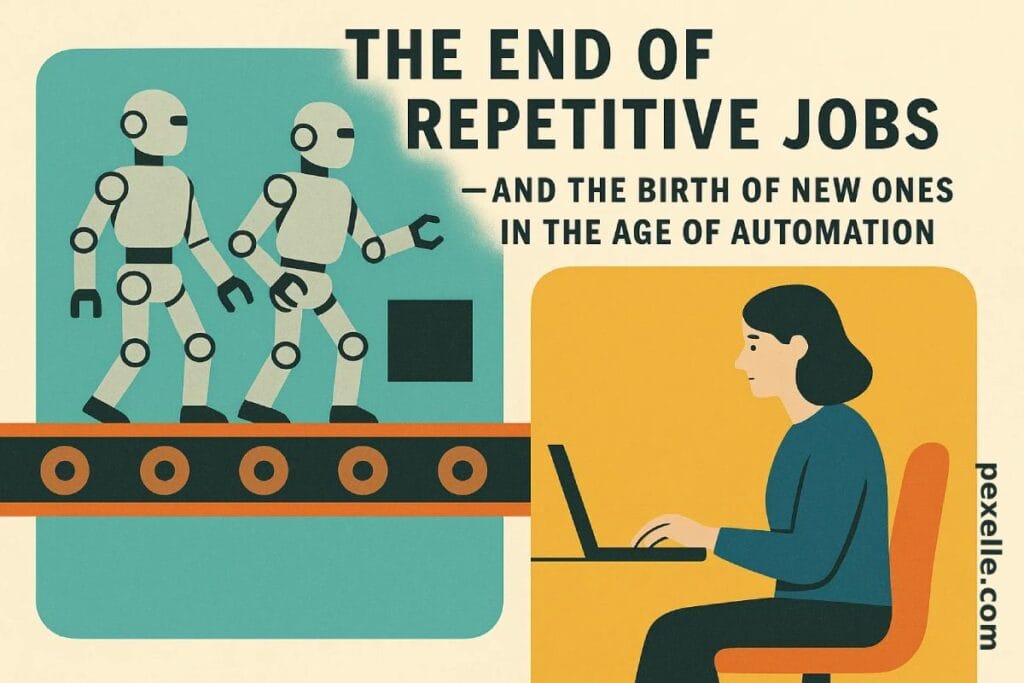
Automation used to be a distant concept — something that would “eventually” happen.
But in 2025, that future is already here.
From manufacturing floors to marketing departments, automation and AI have begun eliminating repetitive tasks at scale — while simultaneously creating entirely new types of work.
The challenge isn’t whether jobs will disappear.
It’s whether we will adapt fast enough to fill the new ones.
⚙️ The Disappearance of Repetitive Work
Automation thrives where tasks are:
- predictable,
- data-driven,
- and repeatable.
These tasks — once performed by humans — are now handled better, faster, and cheaper by machines.
💼 Examples of jobs being rapidly automated:
- Data entry and bookkeeping 🧾
- Assembly line and warehouse operations 🏭
- Routine customer support via chatbots 💬
- Scheduling, document processing, and logistics 📅
According to McKinsey & Company’s 2025 report, over 400 million jobs globally involve automatable activities. But that’s not a death sentence — it’s a massive workforce transformation.
🚀 The Birth of New Roles in the Automation Era
As machines take over repetitive work, new types of human work are emerging — jobs that didn’t even exist a decade ago.
💡 Examples of growing roles:
- 🤖 AI Operations Specialists — maintaining and fine-tuning automation systems.
- 🧠 Prompt Engineers — training and guiding generative AI models.
- 🧭 Automation Strategists — redesigning workflows for human–machine collaboration.
- 🧑💻 Data Ethics & Compliance Officers — ensuring fairness and accountability in AI.
- 🎨 Human Experience Designers — focusing on creativity and emotional engagement.
These are creative, strategic, and interdisciplinary roles that depend on human insight — not repetition.
🧭 The Human Edge: Adaptability and Learning
Automation doesn’t replace human intelligence — it redefines it.
The most valuable workers today are those who can adapt, learn quickly, and collaborate with AI systems.
🎯 Future-proof skills include:
- Critical thinking & decision-making 🔍
- Data literacy & digital fluency 💻
- Emotional intelligence & collaboration 🤝
- Problem-solving & creativity 💡
- Continuous learning 🔁
This is why the global focus on reskilling and upskilling has skyrocketed.
Platforms like Coursera, LinkedIn Learning, and Pexelle are empowering individuals to stay relevant as job roles evolve.
💼 What Companies Must Do
Organizations, too, must evolve — not just automate.
✅ Redesign roles to combine human creativity with machine precision.
✅ Invest in employee training to keep their workforce future-ready.
✅ Prioritize ethical automation, ensuring fairness and transparency.
✅ Embrace hybrid teams, where humans and AI collaborate efficiently.
Companies that treat automation as a tool — not a replacement — will build stronger, smarter, and more resilient workforces.
🪄 Final Thought
Automation isn’t destroying jobs — it’s reshaping them.
The roles disappearing are those that rely on repetition.
The roles emerging require imagination, empathy, and adaptability.
🎯 “The future won’t be man versus machine — it will be man with machine.”
Those who learn to work with automation, not against it, will define the next generation of success.
Source : Medium.com