Artificial Intelligence is transforming how we create, analyze, and automate information. Every week brings a new model, a new breakthrough, or a new application promising to reshape industries. Yet beneath the excitement lies a quieter revolution, one that may ultimately have a greater economic impact than AI itself.
That revolution is verification.
As AI makes it easier to generate content, write code, create artwork, imitate voices, and automate decisions, the world’s biggest challenge is no longer producing information. It is determining what, and who, can be trusted.
The next trillion-dollar digital economy will not be built solely on intelligence. It will be built on proof.
The World’s Scarcest Resource Is No Longer Information
For decades, information was scarce.
Today, information is infinite.
Anyone can generate:
- Articles
- Images
- Videos
- Software
- Business plans
- Marketing campaigns
- Academic essays
- Entire websites
Within minutes.
AI has dramatically reduced the cost of creation.
But while creation became nearly free, verification became dramatically more valuable.
Businesses are beginning to realize an uncomfortable truth:
If anyone can create anything, proof becomes the only competitive advantage.
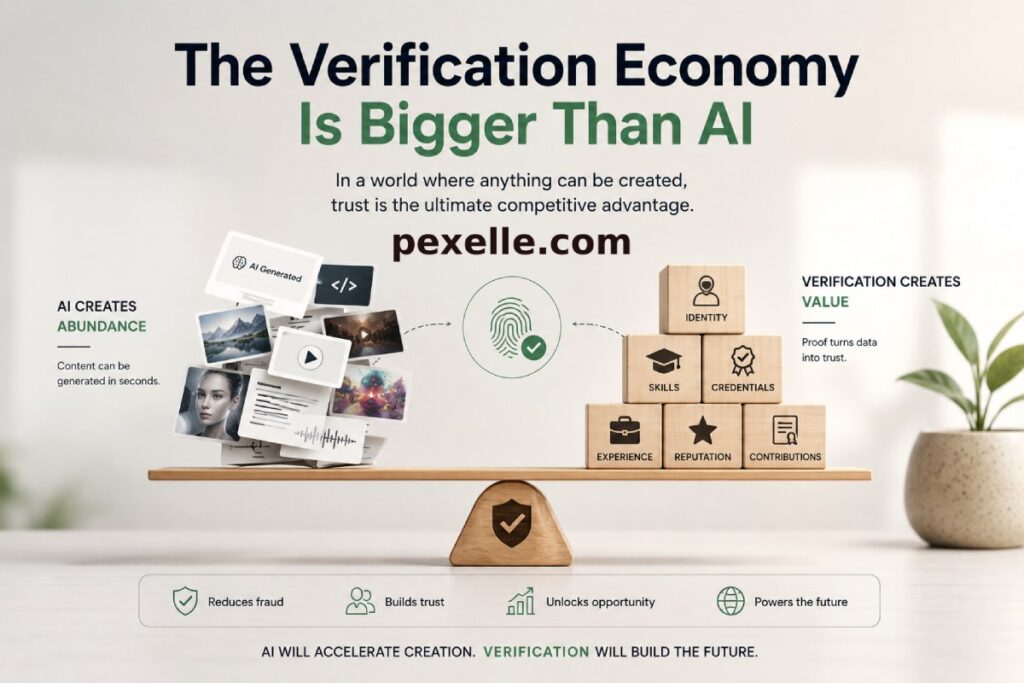
AI Creates Abundance. Verification Creates Value.
Throughout history, economic value shifted whenever abundance increased.
When manufacturing scaled, branding became valuable.
When the internet made information free, search engines became valuable.
When social media allowed everyone to publish, reputation became valuable.
AI is creating another shift.
Creation is becoming abundant.
Verification becomes scarce.
And scarcity is where markets assign value.
This is why verification isn’t simply another feature.
It is becoming an entirely new economic layer.
Every Industry Is Becoming a Verification Problem
Consider how many industries already depend on trust.
Hiring
Companies don’t simply need resumes.
They need proof that applicants possess the skills they claim.
Education
Degrees are no longer enough.
Employers increasingly seek demonstrable competencies, portfolios, certifications, and verified achievements.
Freelancing
Clients care less about promises.
They want evidence of successful work.
Healthcare
Credentials must be continuously verified.
Licenses must remain current.
Medical records require authenticity.
Finance
Banks verify identities before transactions.
Investment firms verify compliance.
Insurance companies verify claims.
E-commerce
Customers verify reviews.
Platforms verify sellers.
Payment providers verify transactions.
Social Networks
Platforms struggle to distinguish humans from bots.
Creators need proof of ownership.
Communities require authentic participation.
Across every sector, verification already exists.
The difference is that today it is fragmented, expensive, and largely manual.
AI Makes Verification More Urgent
Ironically, AI is accelerating demand for verification faster than any technology in history.
Deepfakes blur reality.
Synthetic voices imitate executives.
Generated resumes exaggerate expertise.
AI-produced portfolios appear convincing.
Automated bots simulate human behavior.
Fake identities multiply at unprecedented scale.
As synthetic content improves, traditional trust signals become unreliable.
Visual evidence is no longer sufficient.
Written claims lose credibility.
Even video can no longer be assumed authentic.
The question shifts from:
“Can this be generated?”
to
“Can this be verified?”
That distinction defines the Verification Economy.
Verification Is Infrastructure
Many people think verification means identity checks.
That is only the beginning.
Modern verification includes:
- Identity
- Skills
- Experience
- Ownership
- Reputation
- Credentials
- Contributions
- Transactions
- Digital assets
- Human authenticity
Verification becomes infrastructure when proof can travel with people across platforms.
Just as payment networks standardized digital commerce, verification networks will standardize digital trust.
Every application will eventually consume proof instead of collecting raw claims.
The Rise of Proof-Based Economies
Imagine a future where:
A software engineer carries verified coding achievements across employers.
A designer owns a globally recognized portfolio with immutable proof of authorship.
Freelancers build portable trust scores independent of marketplaces.
Students graduate with continuously verified skills instead of static diplomas.
Professionals update their credentials automatically throughout their careers.
Communities reward verified contribution rather than popularity.
In this world, trust becomes portable.
Proof becomes reusable.
Reputation becomes interoperable.
The economy shifts from credential-based hiring to evidence-based opportunity.
AI Needs Verification More Than Humans Do
This may sound surprising.
But AI systems themselves require verification.
Organizations need to know:
- Which datasets trained a model?
- Which outputs were human reviewed?
- Which decisions are auditable?
- Which AI agents performed specific tasks?
- Which actions were authorized?
- Which sources are trustworthy?
As AI agents begin collaborating with humans and other AI systems, verification becomes the coordination layer that keeps digital ecosystems reliable.
Without proof, autonomous systems become impossible to trust.
The Economic Opportunity
The Verification Economy extends far beyond identity verification.
It enables:
- Hiring platforms
- Education technology
- Digital credentials
- Professional networking
- Creator economies
- Financial compliance
- Enterprise security
- Government services
- AI governance
- Decentralized ecosystems
Every one of these markets depends on trusted data.
Verification reduces fraud.
- It lowers onboarding costs.
- It improves decision making.
- It accelerates hiring.
- It strengthens marketplaces.
- It protects digital assets.
Most importantly, it creates confidence.
Confidence fuels economic activity.
Why This Matters Now
The world spent decades building the infrastructure for information.
Search engines organized it.
Cloud computing stored it.
AI now generates it.
The next phase is proving it.
This transition is inevitable because every technological leap eventually creates a trust problem.
The internet created identity problems.
Social media created authenticity problems.
AI creates verification problems.
Every major digital platform will eventually require a verification layer.
Not because regulators demand it.
Because users will.
Pexelle and the Future of Digital Proof
At Pexelle, we believe the future of the internet will not be defined by who can generate the most content, but by who can provide the strongest proof.
The next generation of digital platforms will reward verified skills over inflated resumes, authentic contributions over empty engagement, and trusted reputation over unverified claims.
Artificial Intelligence will continue to accelerate creation at an extraordinary pace. But creation alone cannot build trust.
Verification can.
The organizations that invest in verifiable identities, portable credentials, transparent achievements, and trusted digital ecosystems today will define tomorrow’s digital economy.
Because in a world where intelligence becomes abundant, proof becomes priceless.
The Verification Economy is not replacing AI.
It is becoming the foundation that allows AI, businesses, and people to trust one another at global scale.
And that foundation may ultimately become far larger than AI itself.
Source : Medium.com