
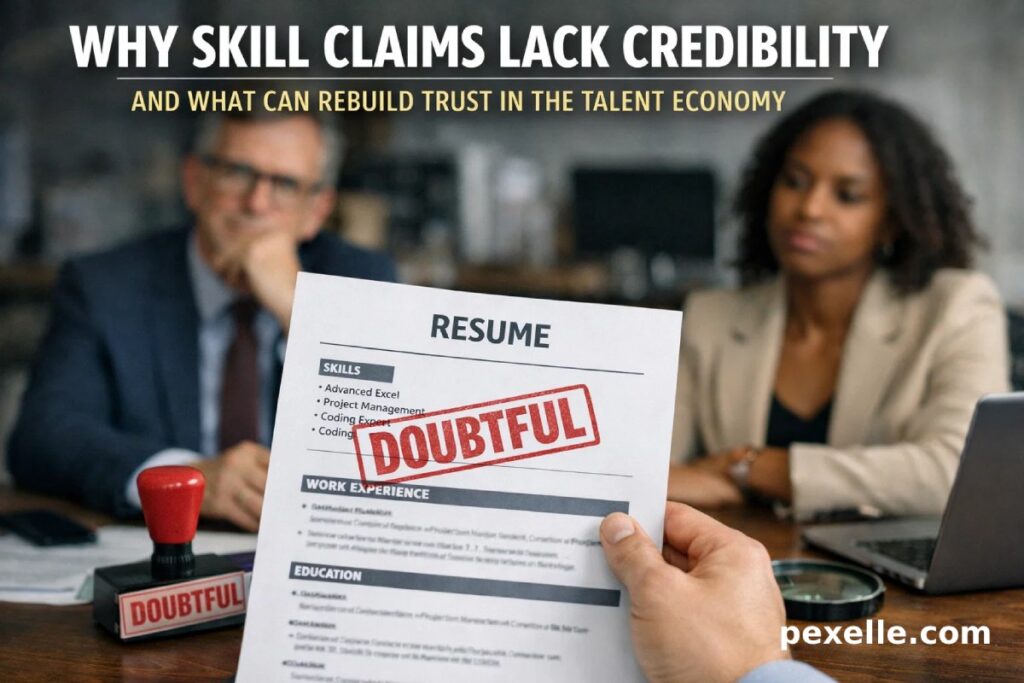
The Growing Problem of Unverified Skill Claims
In today’s digital economy, claiming a skill has become easier than ever. Anyone can list competencies on a résumé, LinkedIn profile, or portfolio without providing concrete evidence. While this accessibility has democratized opportunity, it has also created a serious credibility gap. Employers are increasingly confronted with candidates whose stated abilities do not align with their actual performance. Over time, this has led to skepticism toward self-reported skills, making hiring slower, riskier, and more expensive.
The Inflation of Skills in Competitive Environments
As competition in the job market intensifies, candidates feel pressure to present themselves as highly qualified. This often leads to “skill inflation,” where individuals exaggerate proficiency levels or list skills they have only briefly encountered. When everyone appears highly skilled on paper, differentiation becomes difficult. As a result, hiring decisions rely less on stated skills and more on proxies such as previous employers, degrees, or referrals, which may not accurately reflect true capability.
The Absence of Standardized Validation
One of the core reasons skill claims lack credibility is the absence of a universal validation framework. Unlike formal education, which follows relatively standardized systems, skills are fragmented across platforms, industries, and formats. Certifications vary widely in quality, and many are outdated or too theoretical. Without a consistent method to measure and verify skills, trust becomes subjective and inconsistent across organizations.
The Gap Between Knowledge and Execution
Knowing something is not the same as being able to apply it. Many individuals acquire theoretical knowledge through courses or tutorials but lack real-world execution experience. Employers, however, care about outcomes rather than familiarity. This disconnect between knowledge and application further weakens the reliability of skill claims, as traditional profiles rarely capture how well someone can perform under real conditions.
Static Profiles in a Dynamic World
Skills are not static, yet most professional profiles are. A developer who learned a framework three years ago may no longer be proficient if they have not actively used it. However, their profile may still list that skill without context. This lack of temporal information makes it difficult to assess the current relevance and depth of a person’s abilities. Trust erodes when there is no visibility into how skills evolve over time.
The Cost of Mistrust in Hiring and Collaboration
When skill claims cannot be trusted, organizations compensate by adding more layers to the hiring process. This includes multiple interview rounds, technical assessments, trial projects, and extended probation periods. These measures increase costs, slow down hiring, and create friction for both employers and candidates. In distributed and remote teams, the impact is even greater, as trust must be established without physical interaction.
What Can Rebuild Trust?
Evidence-Based Skill Verification
Trust begins with evidence. Instead of relying on self-declared skills, systems should prioritize verifiable proof of work. This can include completed projects, code repositories, case studies, or measurable outcomes. Evidence transforms a claim into something observable and testable, reducing ambiguity in evaluation.
Continuous Skill Tracking
To reflect the dynamic nature of skills, there must be mechanisms for continuous tracking and updating. Rather than a static list, skills should have a timeline showing when they were acquired, how frequently they are used, and how they have improved over time. This historical context allows employers to assess not just whether a skill exists, but how reliable and current it is.
Contextualized Performance Data
Not all experience is equal. Writing code in a tutorial environment is different from delivering production-ready systems under constraints. Trust can be rebuilt by attaching context to skill evidence. Information such as project complexity, team size, role responsibility, and real-world impact helps translate raw experience into meaningful insight.
Decentralized and Tamper-Resistant Records
Centralized systems are vulnerable to manipulation and inconsistency. A more reliable approach involves decentralized records where skill evidence is securely stored and cannot be altered retroactively. Technologies such as blockchain can provide immutable proof of achievements, ensuring that once a skill is verified, its record remains trustworthy.
Peer and Expert Validation Layers
While self-reported data lacks credibility, validation from peers and domain experts adds a layer of trust. However, this must go beyond simple endorsements. Structured evaluation, where experts assess actual work against defined criteria, can significantly improve reliability. When combined with evidence, this creates a multi-dimensional trust model.
Skill-to-Outcome Mapping
Ultimately, skills matter because of the outcomes they produce. Systems that link skills directly to measurable results can bridge the gap between capability and impact. For example, instead of stating “proficient in machine learning,” a profile could show “built a model that reduced prediction error by 25% in a production environment.” This shift from description to outcome strengthens credibility.
AI-Assisted Verification and Analysis
Artificial intelligence can play a critical role in analyzing skill evidence at scale. By evaluating code quality, project complexity, and consistency of contributions, AI systems can generate objective insights into a person’s capabilities. This reduces reliance on subjective judgment and enables more efficient and accurate assessments.
Toward a Trust-Centric Talent Ecosystem
Rebuilding trust in skill claims requires a fundamental shift from declarations to demonstrations. The future of hiring and collaboration will not depend on what individuals say they can do, but on what they have proven they can do over time. Platforms and organizations that adopt evidence-based, dynamic, and verifiable skill systems will gain a significant advantage in identifying true talent.
In this emerging model, credibility becomes an asset that is earned, tracked, and continuously validated. As trust is restored, the hiring process becomes faster, more efficient, and more equitable. More importantly, individuals are evaluated based on real capability rather than perceived credentials, creating a more transparent and merit-driven global workforce.
Source : Medium.com