
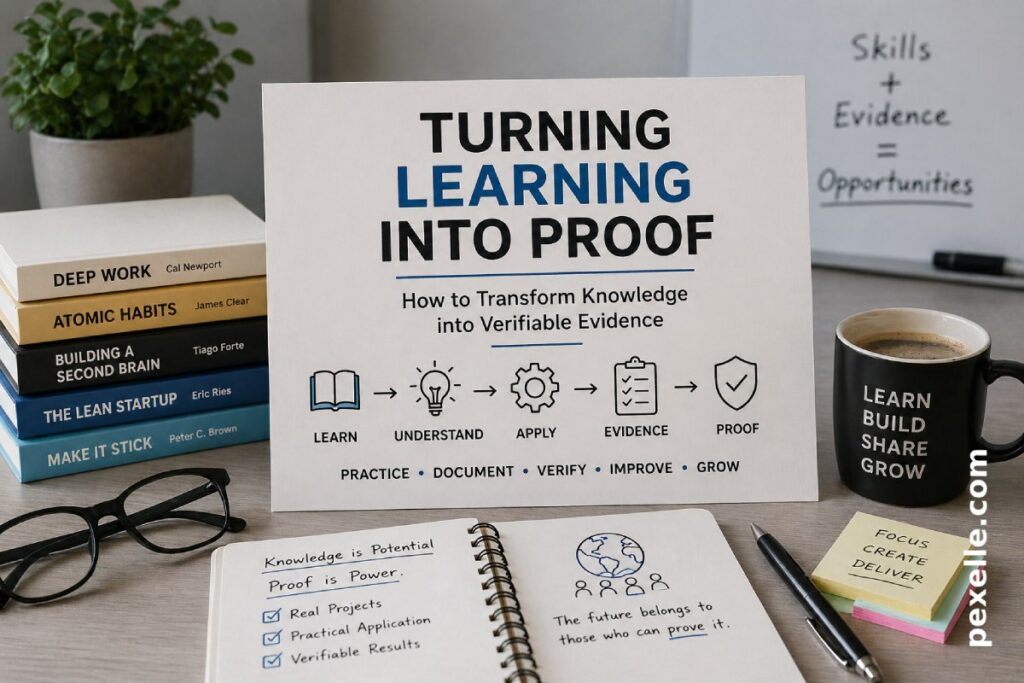
How to Transform Knowledge into Verifiable Evidence
1. The Shift from Learning to Demonstration
In today’s rapidly evolving digital economy, simply acquiring knowledge is no longer enough. Employers, collaborators, and platforms increasingly demand proof of capability rather than claims of competence. Traditional learning systems focused on certificates and degrees, but these often fail to reflect real-world ability. The modern shift is clear: learning must be transformed into demonstrable, verifiable outcomes that others can trust and evaluate.
2. Why Proof Matters More Than Ever
The global workforce is becoming more decentralized, remote, and skill-driven. In such an environment, trust cannot rely on reputation alone. Proof of learning provides a transparent way to validate skills across borders and industries. It reduces hiring risk, improves matching accuracy, and enables individuals to stand out in competitive markets. Without proof, learning remains invisible and undervalued.
3. Defining “Proof of Learning”
Proof of learning refers to tangible, verifiable evidence that demonstrates a person’s ability to apply knowledge in real scenarios. This can include completed projects, code repositories, case studies, simulations, assessments, or peer-reviewed contributions. Unlike traditional credentials, proof is dynamic, contextual, and directly tied to performance rather than participation.
4. The Problem with Traditional Credentials
Degrees and certificates often measure completion rather than competence. They rarely show how a learner solved problems, handled complexity, or applied critical thinking. Additionally, they are static and quickly become outdated in fast-moving fields like AI, blockchain, and software development. This gap creates a disconnect between what individuals claim to know and what they can actually do.
5. Building Evidence Through Real Work
The most powerful form of proof is real-world output. Projects, prototypes, and practical implementations provide clear evidence of capability. For example, instead of stating “I learned machine learning,” a learner can present a trained model, dataset analysis, and documented results. This transforms abstract knowledge into concrete, inspectable artifacts that others can evaluate.
6. Structuring Learning as a Portfolio
A structured portfolio is essential for organizing proof. It should not be a random collection of work, but a curated narrative of growth and capability. Each piece of evidence should include context, objectives, process, and outcomes. This allows reviewers to understand not just what was done, but how and why it was done.
7. The Role of Verification and Trust
Proof alone is not enough if it cannot be trusted. Verification mechanisms such as peer reviews, expert validation, timestamps, and blockchain-based records can enhance credibility. These systems ensure that the evidence is authentic, tamper-proof, and attributable to the individual who created it. Trust transforms evidence into recognized value.
8. Micro-Evidence and Continuous Validation
Instead of relying on a single large credential, modern systems benefit from continuous, small-scale validations. Micro-evidence includes individual tasks, skill demonstrations, and incremental achievements. Over time, these build a rich and detailed picture of a person’s capabilities. This approach aligns better with how skills actually develop in real life.
9. Bridging the Gap Between Learning and Hiring
One of the biggest challenges in recruitment is the mismatch between resumes and actual ability. Proof-based learning systems bridge this gap by providing direct insight into a candidate’s work. Employers can review real outputs instead of relying on interviews or assumptions. This leads to more accurate hiring decisions and reduces costly mistakes.
10. The Role of Technology in Proof Systems
Emerging technologies are enabling new ways to capture and verify learning. Platforms can track learning activities, link them to outcomes, and generate structured evidence automatically. Decentralized systems can store proofs securely, while AI can help evaluate and categorize skills. These technologies make proof scalable, accessible, and standardized.
11. Challenges in Turning Learning into Proof
Despite its advantages, this transformation is not without challenges. Creating meaningful proof requires effort, guidance, and proper frameworks. Not all learners know how to document their work effectively. Additionally, standardization across industries is still evolving, making it difficult to compare different types of evidence.
12. Designing Learning for Proof from the Start
To effectively turn learning into proof, the process must be designed with evidence in mind from the beginning. This means structuring courses around outputs, requiring practical assignments, and embedding validation mechanisms. Learning should not end with understanding; it should culminate in demonstrable results.
13. The Future of Skill-Based Identity
As proof-based systems mature, they will form the foundation of a new type of professional identity. Instead of resumes, individuals will present dynamic profiles built on verified evidence. These profiles will evolve continuously, reflecting real-time capabilities rather than static achievements. This represents a fundamental shift in how we define expertise.
14. Implications for Platforms and Ecosystems
Platforms that enable proof-based learning will have a significant competitive advantage. They can create ecosystems where learning, validation, and opportunity are seamlessly connected. Such systems not only benefit individuals but also improve efficiency for organizations and entire industries by reducing uncertainty and increasing trust.
15. Conclusion: From Knowledge to Trust
Turning learning into proof is not just a trend; it is a necessary evolution in a world driven by skills and outcomes. Knowledge gains value only when it can be demonstrated, verified, and trusted. By focusing on real work, structured evidence, and credible validation, individuals can transform their learning into powerful assets that open doors to new opportunities.
Source : Medium.com