
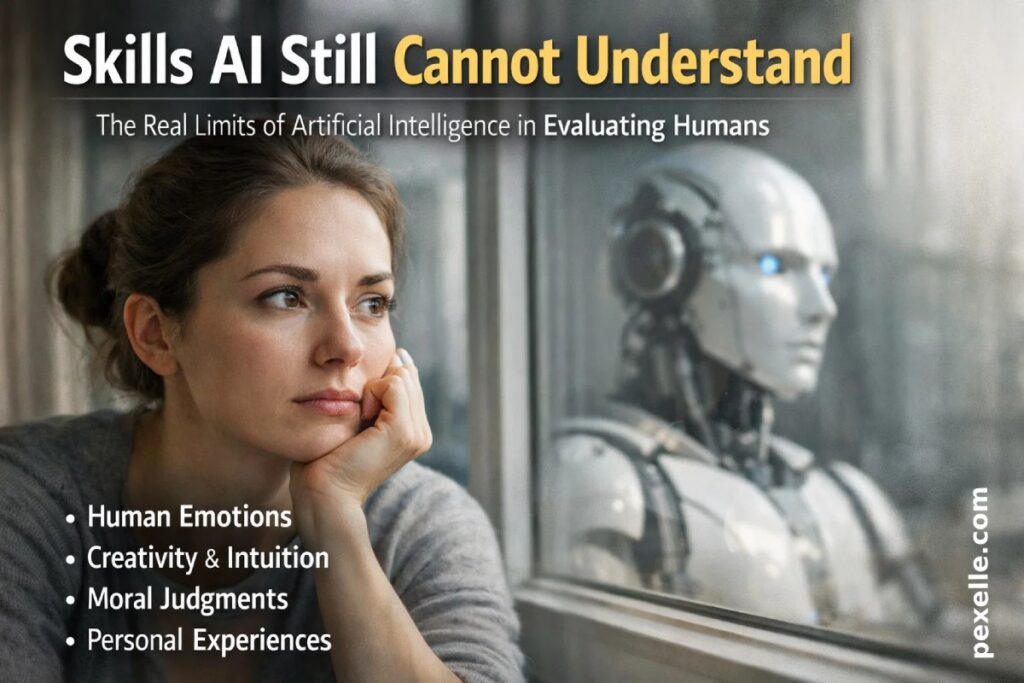
The Real Limits of Artificial Intelligence in Evaluating Humans
Artificial intelligence has rapidly evolved into a powerful tool for analyzing data, automating workflows, and even assisting in decision-making processes that were once considered uniquely human. From hiring systems to performance evaluation platforms, AI is increasingly used to assess human capability. However, despite its impressive progress, there are fundamental limitations in how AI understands and evaluates human skills. These limitations are not just technical gaps but stem from deeper differences between computational systems and human cognition.
1. The Illusion of Complete Evaluation
Modern AI systems are exceptionally good at measuring what is observable, structured, and quantifiable. They can analyze resumes, track productivity metrics, evaluate coding performance, and even interpret speech patterns. But this creates an illusion: that everything meaningful about a person can be captured in data.
In reality, AI evaluates proxies, not the actual human qualities themselves. For example, it might measure response time as a proxy for efficiency or keyword usage as a proxy for expertise. These approximations often miss the underlying context, intention, and nuance that define true human capability.
2. Skills That Resist Modeling
There are several categories of human abilities that remain extremely difficult or currently impossible for AI to model accurately:
a. Contextual Judgment
Humans constantly interpret situations based on subtle context signals: cultural norms, emotional tone, historical relationships, and implicit expectations. AI lacks true situational awareness and often misinterprets context when it deviates from training data patterns.
b. Moral and Ethical Reasoning
AI can follow predefined rules or optimize for certain outcomes, but it does not possess genuine ethical understanding. Human decisions often involve conflicting values, long-term consequences, and moral trade-offs that cannot be reduced to simple optimization problems.
c. Creativity with Intent
While AI can generate content that appears creative, it does not intend or mean anything by its output. Human creativity is deeply tied to experience, purpose, and emotional expression. This intentionality is not something AI truly possesses.
d. Social Intelligence and Trust
Trust is built through consistency, vulnerability, and shared experience over time. AI can simulate conversation, but it does not build real relationships. Evaluating someone’s leadership, influence, or trustworthiness requires understanding human dynamics that go beyond data.
e. Adaptation in Novel Situations
Humans can generalize from limited experience and operate effectively in completely new environments. AI, on the other hand, depends heavily on prior training data and often struggles in unfamiliar or ambiguous situations.
3. The Problem of Hidden Signals
One of the most critical gaps in AI evaluation is its inability to capture hidden or latent human signals:
- Internal motivation
- Resilience under pressure
- Learning agility
- Integrity and accountability
- Unspoken collaboration dynamics
These are often the factors that determine long-term success in individuals and teams. However, they are rarely directly observable and cannot be reliably inferred from surface-level data alone.
AI systems tend to over-rely on what is visible and measurable, ignoring what is invisible but essential.
4. Why Human Evaluation Still Matters
Given these limitations, human judgment remains indispensable. Not because humans are perfect evaluators, but because they operate with a richer understanding of reality.
Humans can:
- Interpret ambiguity rather than avoid it
- Balance logic with intuition
- Recognize patterns that are not explicitly defined
- Understand meaning beyond data
In complex environments such as leadership, innovation, and team dynamics, human evaluation provides depth that AI currently cannot replicate.
5. The Risk of Over-Reliance on AI
There is a growing risk in organizations that over-trust AI-based evaluation systems. When decisions are made purely based on algorithmic outputs, several issues can arise:
- Misclassification of talent: High-potential individuals may be overlooked because they do not fit predefined patterns
- Reinforcement of bias: AI models trained on historical data may perpetuate existing inequalities
- Loss of human nuance: Important qualitative insights are ignored in favor of simplified metrics
This leads to a dangerous scenario where organizations optimize for what is measurable rather than what is meaningful.
6. Toward a Hybrid Model of Evaluation
The future is not about replacing human judgment with AI, but about combining both effectively. A hybrid approach can leverage the strengths of each:
- AI for scale, speed, and pattern detection
- Humans for interpretation, judgment, and meaning-making
In this model, AI acts as an assistant rather than a decision-maker. It surfaces insights, highlights anomalies, and processes large volumes of data, while humans provide the final evaluation grounded in context and understanding.
7. Conclusion: The Irreplaceable Human Core
Despite the rapid advancement of artificial intelligence, there remains a core set of human abilities that resist full automation. These are not edge cases but central aspects of what makes individuals effective in real-world environments.
AI can process information, but it does not understand in the human sense. It can simulate behavior, but it does not experience. And it can evaluate data, but it cannot fully evaluate a person.
As we move forward, the most effective systems will not be those that attempt to eliminate the human role, but those that recognize its irreplaceable value.
Source : Medium.com