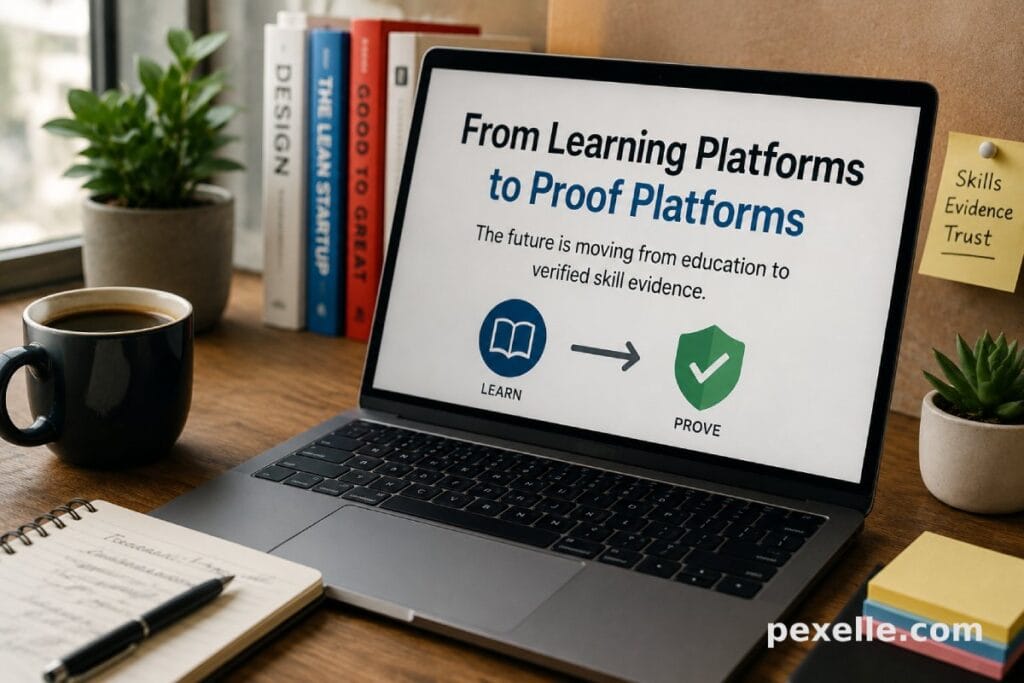
The Future Is Moving from Education to Verified Skill Evidence
Introduction: Learning Alone Is No Longer Enough
For more than two decades, digital education has been shaped by learning platforms. These platforms helped millions of people access courses, watch lessons, complete modules, and receive certificates. They made education more flexible, affordable, and global.
But the next phase of the digital economy is no longer only about learning. It is about proving.
In a world where anyone can claim a skill on a resume, LinkedIn profile, or online portfolio, employers, clients, and communities need stronger evidence. They do not only want to know what someone studied. They want to know what that person can actually do.
This is why the future is moving from learning platforms to proof platforms.
A learning platform answers the question: “What did you learn?”
A proof platform answers a deeper question: “Can you prove that you can do it?”
The Problem with Traditional Learning Platforms
Learning platforms solved an important problem: access. They gave people around the world the ability to learn programming, design, marketing, business, languages, data science, and many other subjects.
However, access to learning does not automatically create trusted capability.
A person may complete a course but still be unable to apply the knowledge in a real project. Another person may have strong practical skills but no formal certificate. Someone else may collect dozens of certificates without meaningful evidence of performance.
This creates a gap between education and trust.
Employers are not only looking for people who consumed content. They are looking for people who can solve problems, complete tasks, collaborate, think critically, and produce real outcomes. This is one reason skills-based hiring has grown strongly. The World Economic Forum has argued that skills-based hiring and workforce planning help employers prepare for jobs that may not even exist yet.
The issue is clear: learning platforms can show participation, but they often struggle to show proof.
The Rise of Skills-Based Hiring
The job market is changing. Companies are gradually moving away from relying only on degrees, job titles, and traditional resumes. Instead, they are looking more closely at skills, evidence, and practical ability.
Skills-based hiring focuses on what a person can do rather than where they studied or what title they previously held. This approach can help employers discover capable people who may not have traditional academic backgrounds.
Hays describes skills-based hiring as a shift away from formal education requirements toward a candidate’s actual skillset. Harvard Business School research also found a major rise in job postings where employers removed degree requirements, although it warned that changing job descriptions does not always mean companies truly change who they hire.
This is an important point. Removing degree requirements is only the first step. The next step is building systems that can verify skills in a trusted, structured, and portable way.
That is where proof platforms become essential.
What Is a Proof Platform?
A proof platform is a digital system that helps people collect, verify, organize, and share evidence of their skills.
It does not simply say, “This person completed a course.”
It says, “This person demonstrated this skill through this evidence, under these conditions, and this proof can be reviewed or verified.”
A proof platform may include:
- Skill cards
- Digital badges
- Verified credentials
- Project evidence
- Peer or expert attestations
- Work samples
- Assessment results
- Portfolio items
- Real-world task completion
- Employer or mentor validation
The key difference is that a proof platform connects learning to evidence.
For example, instead of saying:
“Sarah completed a UX design course.”
A proof platform can show:
“Sarah designed a mobile onboarding flow, submitted a case study, received expert review, demonstrated wireframing and user research skills, and earned a verified UX skill badge.”
This is much more valuable for hiring, collaboration, and career growth.
Why Certificates Are Not Enough
Certificates are useful, but they are limited.
A certificate usually proves that someone participated in a course or passed a test. But it may not prove whether the person can apply that knowledge in a real environment.
This is especially true in fast-changing fields such as AI, software development, cybersecurity, product management, data analytics, and digital marketing. In these fields, practical evidence matters more than static documents.
Digital credentials are becoming more important because they can be verified, shared, and connected to specific skills. Some credentialing experts argue that skills-based hiring needs more than resume claims and requires verifiable proof that employers can trust.
The future credential will not just be a digital version of a paper certificate. It will be a structured evidence object.
It may include:
- Skill name
- Skill level
- Evidence type
- Issuer
- Reviewer
- Assessment method
- Date earned
- Expiration or renewal status
- Related projects
- Verification link
- Metadata connected to a skills taxonomy
This creates a stronger bridge between learning, work, and trust.
The Shift from Content Consumption to Skill Verification
The first generation of online learning was built around content. The main goal was to deliver lessons, videos, quizzes, and certificates at scale.
The next generation will be built around verification.
This shift changes the role of platforms.
Old model:
- User watches course
- User completes quiz
- User receives certificate
- User adds certificate to profile
New model:
- User learns skill
- User applies skill
- User uploads evidence
- Evidence is reviewed
- Skill is verified
- Badge or credential is issued
- Credential becomes portable across jobs, platforms, and communities
This is a much stronger model because it values output, not just input.
- Watching ten hours of lessons is input.
- Building a working project is output.
- Passing a real assessment is output.
- Receiving expert validation is output.
- Solving a business problem is output.
The future of education will reward demonstrated ability.
Proof Platforms and the Future of Work
The modern workforce is becoming more dynamic. People change careers more often. New roles appear faster. AI changes job requirements. Companies need to understand skills at a more detailed level.
Traditional resumes are too weak for this environment.
A resume is mostly self-reported. It depends on claims. It often lacks proof, context, and verification.
A proof platform can create a richer professional identity. Instead of a person being represented by job titles, they can be represented by verified abilities.
This helps several groups:
- For job seekers, it creates a stronger way to show real capability.
- For employers, it reduces hiring risk.
- For educators, it connects learning outcomes to real-world value.
- For governments and workforce systems, it creates better skills data.
- For communities, it helps identify trusted contributors.
- For companies, it supports internal talent mobility and workforce planning.
This is why digital credential wallets and learning records are becoming more relevant. Jobs for the Future describes digital credential wallets as a way for people to manage and showcase skills in a more equitable talent marketplace.
The Role of AI in Proof Platforms
AI will accelerate the move from learning platforms to proof platforms.
AI can help analyze projects, match evidence to skills, recommend learning paths, detect gaps, and generate skill maps. It can also help employers compare candidates based on demonstrated capabilities instead of keywords.
However, AI also creates a new problem: content is easier to fake.
People can use AI to write resumes, generate portfolios, create answers, and produce polished documents. This means the future will require stronger evidence systems, not weaker ones.
Proof platforms will need to answer questions such as:
- Was this work actually done by the person?
- What was the person’s contribution?
- Was the evidence reviewed by a human expert?
- Can the credential be verified?
- Is the skill still current?
- Was the task completed in a realistic context?
In an AI-powered world, trust becomes more important. The more content AI can generate, the more valuable verified proof becomes.
From Degrees to Dynamic Skill Identity
Degrees will not disappear. They will still matter in many fields, especially regulated professions such as medicine, law, engineering, and academia.
But degrees will no longer be the only signal of ability.
The future professional identity will be more dynamic. It will combine education, verified skills, work evidence, projects, assessments, peer reviews, and real-world achievements.
Instead of one large credential earned years ago, people will build a living record of capability.
This record may show:
- What they can do now
- How strong they are in each skill
- What evidence supports that skill
- Who verified it
- How recently it was demonstrated
- What career paths it connects to
This is more useful than a static resume.
The future is not anti-education. It is anti-unverified claims.
Why Proof Platforms Matter for Emerging Markets
Proof platforms can be especially powerful in emerging markets.
Many talented people around the world do not have access to expensive universities, international networks, or prestigious employers. But they may have real skills.
A proof platform can help these people show their capabilities through evidence.
For example, a young developer in Uganda, Kenya, India, Iran, Brazil, or the Philippines may not have a famous degree. But if they can prove their skills through projects, badges, expert reviews, and verified work samples, they become more visible to global employers and clients.
This can make opportunity more fair.
Learning platforms gave people access to knowledge.
Proof platforms can give people access to trust.
That trust can become a new form of professional currency.
The Importance of Skill Taxonomies
A proof platform needs structure. It cannot simply collect random badges and files.
To be useful, skills must be organized through a clear taxonomy. A skill taxonomy defines skill names, categories, levels, relationships, and standards.
For example, “software development” is too broad. A better taxonomy may break it into:
- Frontend development
- Backend development
- API integration
- Database design
- Authentication
- Testing
- Deployment
- Security fundamentals
- Code review
- System design
Each skill can then be connected to evidence.
This makes the platform more useful for employers, learners, and institutions. It also makes skills easier to compare across industries and regions.
Without a taxonomy, proof becomes messy.
With a taxonomy, proof becomes searchable, comparable, and meaningful.
The New Learning Journey
In the old model, the learning journey ended with a certificate.
In the new model, the learning journey ends with verified capability.
A future learning path may look like this:
- First, the learner selects a career goal.
- Second, the platform identifies the required skills.
- Third, the learner studies the necessary concepts.
- Fourth, the learner completes real tasks.
- Fifth, the learner submits evidence.
- Sixth, the evidence is assessed.
- Seventh, verified skill badges are issued.
- Eighth, the learner uses those badges for jobs, freelance work, community recognition, or internal promotion.
This creates a more complete system.
Learning becomes the beginning.
Proof becomes the outcome.
Proof Platforms for Employers
For employers, proof platforms can improve hiring quality.
Instead of scanning hundreds of resumes full of similar claims, employers can review verified skill profiles. They can see actual evidence, project history, assessment results, and endorsements.
This can reduce hiring bias because candidates are evaluated more directly on capability. It can also reduce wasted time in recruitment.
A hiring manager does not only need to ask, “Does this person say they know React?”
They can ask, “Show me the evidence that this person can build a React interface, manage state, integrate APIs, and ship production-ready work.”
This is a stronger hiring process.
Skills tests are already widely used in skills-based hiring. TestGorilla’s 2025 report says many employers using skills-based hiring rely on skills tests to measure and validate candidate abilities.
But tests alone are not enough. The best proof systems combine tests, projects, reviews, credentials, and real-world evidence.
Proof Platforms for Learners
For learners, proof platforms create motivation and direction.
Many learners feel lost because they do not know which skills matter, how to prove them, or how to connect learning to job opportunities.
A proof platform can solve this by giving learners a clear path:
- Learn this skill
- Complete this task
- Submit this evidence
- Earn this badge
- Show this proof to employers
This makes learning more practical.
It also gives learners a sense of progress. Instead of collecting random courses, they build a verified professional profile.
This is especially important for beginners. A beginner may not have work experience, but they can still build proof through projects, challenges, simulations, and expert-reviewed tasks.
The Future of Digital Badges
Digital badges will become more valuable when they are connected to strong evidence.
A weak badge says:
“This person attended.”
A strong badge says:
“This person demonstrated a specific skill, at a specific level, through verified evidence.”
The value of a badge depends on trust.
- Who issued it?
- What skill does it represent?
- What evidence supports it?
- Was it assessed?
- Can it be verified?
- Is it connected to a recognized framework?
Badges without evidence may become noise. Badges with proof may become powerful hiring signals.
Challenges Proof Platforms Must Solve
The shift to proof platforms is promising, but it also comes with challenges.
- First, verification must be trustworthy. If badges are easy to fake or too easy to earn, they lose value.
- Second, privacy must be protected. People should control what evidence they share and with whom.
- Third, evidence must be portable. A user should not lose their skill identity when they leave one platform.
- Fourth, assessments must be fair. Proof systems should not create new forms of bias.
- Fifth, platforms must avoid over-credentialing. Not every small action needs a badge.
- Sixth, employers must actually use the proof. A verified skill profile is only valuable if companies trust and adopt it.
These challenges are real. But they are solvable with good design, transparent standards, strong verification, and meaningful industry partnerships.
The Bigger Vision: Evidence as the New Currency of Trust
The internet made information abundant.
AI made content abundant.
The next scarce resource is trust.
In this environment, evidence becomes the new currency.
- People will need evidence to prove their skills.
- Companies will need evidence to hire better.
- Communities will need evidence to identify reliable contributors.
- Educational institutions will need evidence to show real outcomes.
- Governments will need evidence to understand workforce capability.
Proof platforms are not just another category of education technology. They are part of a larger transformation in how society measures ability.
The future will belong to people who can not only learn, but also prove.
Conclusion: The Future Is Not Just Learning, It Is Verified Capability
Learning platforms changed the world by making education accessible. But the next chapter is about making skills trustworthy.
The future is moving from platforms that deliver content to platforms that verify capability.
This does not mean learning platforms will disappear. Instead, the best learning platforms will evolve into proof platforms. They will combine education, assessment, evidence, credentials, and career pathways.
The winners in this new era will not be the platforms with the most courses. They will be the platforms that can answer the most important question in the modern economy:
Can this person prove what they can do?
That is the future of education, hiring, and professional identity.
The future is not only about learning more.
The future is about proving better.
Source : Medium.com