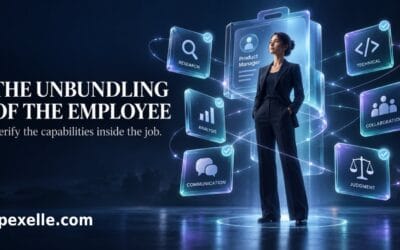

Why Experience Alone No Longer Has the Same Power
Introduction: The Old Meaning of Work History Is Changing
For many years, work history was one of the strongest signals in hiring. A person with ten years of experience was usually seen as more reliable, more skilled, and more valuable than someone with only two years of experience. Employers used job titles, company names, and years of service as shortcuts to judge ability.
But the modern job market is changing quickly. Technology, artificial intelligence, automation, remote work, and project-based careers are transforming how people learn, work, and prove their abilities. Today, work history still matters, but it is no longer enough on its own.
The main question is no longer: “Where have you worked?”
The better question is: “What can you actually do, and can you prove it?”
1. Years of Experience Do Not Always Equal Real Skill
One of the biggest problems with relying only on work history is that time does not always represent ability. Someone may have worked in a role for ten years but repeated the same tasks without real growth. Another person may have only two years of experience but completed advanced projects, solved real problems, and learned faster.
Work history tells us how long someone was present in a job. It does not always show how deeply they understood the work, how much responsibility they carried, or how effectively they performed.
For example, two people may both have the title “Software Developer.” One may have built scalable systems, managed production issues, and contributed to architecture decisions. The other may have only maintained small internal tools. On paper, their work history may look similar, but their actual skill levels can be very different.
This is why employers are becoming more careful. They are starting to look beyond job titles and years of experience and focus more on evidence of capability.
2. Job Titles Are Becoming Less Reliable
In the past, job titles were more standardized. A “Manager,” “Engineer,” or “Designer” often meant a clear set of responsibilities. Today, job titles vary widely between companies.
A “Product Manager” in one company may lead strategy, research, roadmap planning, and stakeholder communication. In another company, the same title may mostly involve writing tickets and managing deadlines.
The same problem exists with titles like “AI Specialist,” “Growth Manager,” “Full Stack Developer,” or “Business Analyst.” These titles can sound impressive, but without evidence, they do not prove much.
This makes work history less valuable as a standalone signal. Employers need more context. They want to know what the person actually built, improved, measured, or delivered.
A title is a label. Skill is proven through action.
3. Technology Is Changing Faster Than Traditional Careers
Another reason work history is losing value is the speed of technological change. In many industries, the tools, platforms, and methods used five years ago may already be outdated.
A person with long experience may not be valuable if their knowledge is no longer current. At the same time, someone newer to the field may be more useful if they have learned modern tools and adapted quickly.
This is especially true in areas such as:
- AI and machine learning
- Software development
- Cybersecurity
- Digital marketing
- Data analytics
- Blockchain
- Cloud infrastructure
- Product design
In these fields, continuous learning is more important than old experience. Employers need people who can adapt, learn, and apply new skills quickly.
The future belongs less to people who simply “have experience” and more to people who can keep learning and prove they can solve current problems.
4. AI Is Reducing the Value of Routine Experience
Artificial intelligence is changing the value of many types of work experience. Tasks that once required years of practice can now be supported, accelerated, or partially automated by AI tools.
For example, writing basic reports, creating simple designs, summarizing documents, generating code, analyzing data, and preparing marketing content can now be done faster with AI assistance.
This does not mean human experience is useless. But it does mean that routine experience is becoming less valuable. If someone’s work history is based mainly on repetitive tasks, that experience may not be as powerful as before.
What becomes more valuable is the ability to think critically, ask the right questions, use tools effectively, evaluate outputs, make decisions, and solve complex problems.
AI is not removing the need for humans. It is changing what kind of human ability matters most.
5. Employers Want Proof, Not Just Claims
A resume is mostly a list of claims. It says where someone worked, what title they had, and what responsibilities they say they handled. But employers increasingly want proof.
They want to see portfolios, case studies, GitHub repositories, certifications, skill assessments, project outcomes, references, client results, or measurable achievements.
For example, instead of saying:
“I have five years of marketing experience.”
A stronger proof-based statement would be:
“I increased organic website traffic by 180% in nine months through SEO strategy, content planning, and technical optimization.”
The second statement is more valuable because it shows evidence, impact, and skill.
This is why the future of hiring is moving from self-reported experience to verified capability. Work history may open the door, but proof of skill will increasingly decide who gets trusted.
6. Career Paths Are No Longer Linear
Traditional work history assumes that people move through a clear career path: junior role, mid-level role, senior role, manager, director, and so on. But modern careers are much more flexible.
People now learn online, freelance, build startups, contribute to open-source projects, work remotely, switch industries, and create digital products. Some of the most skilled people may not have a traditional career path at all.
A person may not have worked for a famous company, but they may have built a successful app, managed a community, created a useful AI tool, or completed complex freelance projects.
This makes traditional work history less complete. It cannot fully represent modern ability.
The future of work needs better ways to capture skills gained outside traditional employment.
7. Company Names Can Create False Confidence
Many employers still give extra attention to candidates who worked at famous companies. A well-known company name can make someone look more credible. But this can also create bias.
Working at a big company does not automatically mean someone was excellent. It may only mean they were part of a strong system. At the same time, someone from a smaller company may have had more responsibility, more pressure, and more practical experience.
In a startup, one person may handle strategy, execution, customer support, product decisions, and technical problem-solving all at once. In a large company, another person may have a narrow role with limited ownership.
Company name is useful context, but it is not enough. Real value comes from contribution, responsibility, learning speed, and measurable outcomes.
8. Skills Are Becoming More Important Than Roles
The modern job market is becoming skill-based. Employers are increasingly interested in what a person can actually do, not only what position they held.
For example, instead of hiring only based on “Project Manager experience,” a company may look for specific skills such as:
- Stakeholder communication
- Risk management
- Agile planning
- Budget control
- Team coordination
- Problem-solving
- Data-based reporting
This shift is important because roles can be vague, but skills are more specific. A skill-based approach helps employers understand whether a person can perform the tasks required for the job.
It also helps workers show their value more clearly. Instead of depending only on past job titles, they can demonstrate specific abilities with evidence.
9. Learning Ability Is Becoming a Core Career Asset
In the past, experience was often seen as the main career asset. Today, learning ability may be even more important.
A person who can learn quickly, adapt to new tools, understand new markets, and solve unfamiliar problems can become valuable faster than someone who only depends on old experience.
This is especially important because industries are changing continuously. Companies do not only need people who know the current system. They need people who can adjust when the system changes.
The most valuable professionals are not just experienced. They are adaptable, curious, analytical, and willing to improve.
In the future, the ability to learn may become one of the strongest signals of professional value.
10. The Rise of Evidence-Based Hiring
Evidence-based hiring means evaluating people based on real proof of skills, not only resumes and interviews. This can include practical tasks, portfolios, verified achievements, project history, simulations, technical tests, public work, and trusted recommendations.
This approach reduces the risk of hiring based on appearance, confidence, or impressive but unclear claims.
For companies, evidence-based hiring can lead to better decisions. For workers, it creates a fairer opportunity to prove themselves.
Someone without a traditional background can still show real ability. Someone with a strong resume must still prove they can perform.
This is a healthier direction for the future of work because it rewards capability, not just credentials.
11. Work History Still Matters, But Its Role Is Changing
It is important to say that work history is not useless. It still provides useful information. It can show consistency, exposure to real environments, professional maturity, and experience with teams, deadlines, and responsibility.
However, work history should not be treated as the final proof of ability. It should be one part of a larger picture.
A strong professional profile should include:
- Work history
- Verified skills
- Real projects
- Measurable results
- Learning evidence
- Recommendations
- Problem-solving examples
- Portfolio or case studies
The future is not “experience versus skills.” The future is experience plus proof.
12. What This Means for Professionals
For professionals, the message is clear: do not rely only on your past job titles. Build evidence around your skills.
Instead of only saying what you have done, show what you have achieved. Document your projects. Build a portfolio. Collect testimonials. Track measurable results. Earn relevant certifications. Share case studies. Contribute to real projects.
A modern career profile should answer three questions:
What can you do?
Where is the proof?
What impact have you created?
The people who can answer these questions clearly will have a stronger position in the future job market.
13. What This Means for Employers
For employers, the lesson is also important. Hiring based only on work history can lead to bad decisions. It can cause companies to overlook talented people and overvalue candidates with impressive but shallow resumes.
Employers should design hiring systems that test real skills. They should ask for evidence, create practical evaluations, and look at measurable outcomes.
This does not mean every job needs a long test or complicated assessment. But it does mean hiring should be based on more than job titles and years of experience.
Better hiring requires better signals.
Conclusion: The Future Belongs to Proven Ability
Work history is becoming less valuable because it no longer gives a complete picture of professional ability. Years of experience, job titles, and company names can still provide context, but they are not enough to prove real skill.
The modern world is moving toward proof-based work. Skills, adaptability, measurable impact, and verified evidence are becoming more important than traditional career history.
In the past, the resume was the main professional currency.
In the future, proof of ability will be the stronger currency.
The professionals who succeed will be those who can demonstrate what they know, show what they have built, and prove the value they can create.
Source : Medium.com