
Predicting the Collapse of Traditional Resumes
1. Introduction: A System Under Pressure
For decades, the traditional CV has been the primary gateway to employment. It served as a standardized summary of education, experience, and skills, acting as the first filter between candidates and opportunities. However, by the mid-2020s, cracks in this system have become increasingly visible. The rise of artificial intelligence, skills-based hiring, and digital identity systems is rapidly reshaping how talent is evaluated.
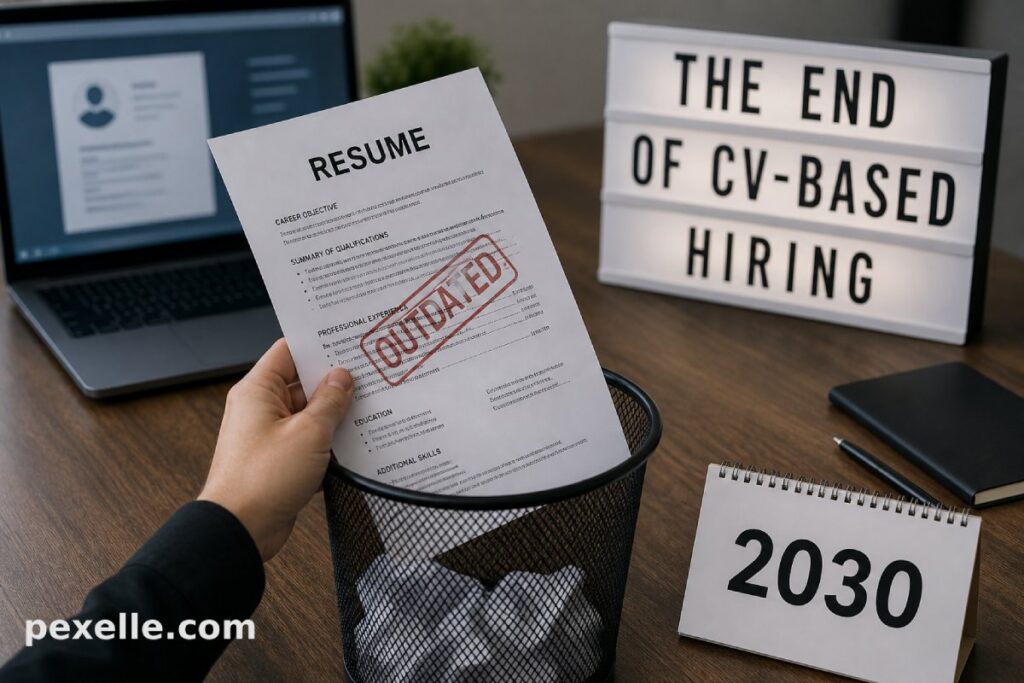
The central question is no longer whether CV-based hiring will decline, but how quickly it will be replaced. By 2030, the traditional resume is likely to become obsolete in many industries, replaced by dynamic, verifiable, and data-driven representations of human capability.
2. The Core Problem with Traditional CVs
The CV was designed for a slower, more predictable labor market. Today’s environment is neither. Jobs evolve faster than formal education systems, and skills become outdated within years, sometimes months.
One of the biggest flaws of CVs is their reliance on self-reported information. Candidates describe their own abilities, often with exaggeration or optimization. In fact, the growing use of AI tools has made it easier to generate highly polished but potentially misleading resumes, leading many hiring managers to distrust them.
Additionally, CVs are static. They fail to capture real-time skill development, project contributions, or actual performance. They represent what someone claims to have done, not what they can do now.
3. The Rise of Skills-Based Hiring
A major shift already underway is the move toward skills-based hiring. Instead of evaluating candidates based on degrees or job titles, employers are increasingly focusing on demonstrable competencies.
Research shows that demand for skills, particularly in areas like AI, is rising faster than demand for formal education credentials. At the same time, the importance of degrees is declining, with measurable wage premiums shifting toward skills rather than academic qualifications.
Companies adopting this approach benefit from faster hiring, better job matching, and lower turnover. In some cases, organizations report up to 70–80% reductions in hiring costs and significant improvements in productivity when hiring based on skills rather than resumes.
This fundamentally weakens the role of the CV. If hiring decisions are based on verified skills, the resume becomes secondary or even irrelevant.
4. AI as the Catalyst for Change
Artificial intelligence is accelerating the decline of CV-based hiring in two key ways.
First, AI enables automated evaluation of candidates through assessments, simulations, and behavioral data. Instead of reading resumes, systems can analyze how a person solves problems, writes code, or communicates in real scenarios.
Second, AI is exposing the inefficiencies of traditional hiring. Many organizations now rely on automated filtering due to the overwhelming volume of applications, a problem partly driven by CV-based systems. This has created a feedback loop where candidates send more applications, and employers rely more on automation.
However, current AI hiring practices are not without issues. Studies show that candidates often distrust AI-driven recruitment, especially when it lacks transparency or human interaction.
Despite these concerns, AI is not replacing hiring. It is transforming how candidates are evaluated, shifting focus away from documents and toward data.
5. The Emergence of Verifiable Digital Profiles
The next stage in hiring evolution is the rise of verifiable digital identities. Instead of static CVs, candidates will have continuously updated profiles that include:
- Verified skill assessments
- Project-based evidence
- Peer endorsements and attestations
- Real-world performance data
- Learning history and progression
These profiles are dynamic and machine-readable, allowing AI systems and employers to evaluate candidates in real time.
Platforms and ecosystems are already moving in this direction, where “proof of skill” replaces “claims of experience.” This aligns with broader trends in digital trust, where verification becomes more valuable than self-description.
6. Structural Shifts in the Labor Market
Several macro-level trends are reinforcing the decline of CVs:
6.1 Rapid Skill Evolution
Industries like AI, cybersecurity, and green technology evolve too quickly for traditional credentials to remain relevant. Employers need up-to-date capabilities, not historical summaries.
6.2 Decline of Entry-Level Pathways
Automation is reducing entry-level roles, forcing companies to prioritize candidates who can deliver value immediately.
This further reduces reliance on CVs and increases demand for proven skills.
6.3 Trust Crisis in Hiring
The rise of “ghost jobs” and mass applications has eroded trust in the hiring process. More than 20% of job postings may not lead to actual hires, contributing to inefficiency and frustration.
As trust declines, systems that provide verifiable and transparent data will replace traditional methods.
7. What Replaces the CV?
By 2030, the hiring process is likely to center around three core components:
7.1 Skill Graphs
Structured representations of an individual’s capabilities, mapped across domains and continuously updated.
7.2 Evidence-Based Portfolios
Instead of listing experiences, candidates will present proof, such as code repositories, completed projects, or measurable outcomes.
7.3 AI-Assisted Matching
AI systems will match candidates to roles based on multidimensional data, including skills, behavior, and learning potential.
In this model, the CV is no longer the primary artifact. It becomes optional or disappears entirely.
8. Challenges and Risks
Despite its advantages, the transition away from CVs introduces new challenges:
- Bias in AI systems can still influence hiring decisions, even when resumes are removed.
- Privacy concerns arise as more personal and behavioral data is used
- Standardization issues may create fragmentation across platforms
- Access inequality could disadvantage candidates without access to digital tools
These challenges must be addressed for the new system to be fair and effective.
9. Timeline: Why 2030 Is Realistic
The prediction that CV-based hiring will decline significantly by 2030 is grounded in observable trends:
- Rapid adoption of AI in recruitment
- Increasing shift toward skills-based hiring
- Declining reliance on degrees
- Growing demand for verifiable data
- Rising dissatisfaction with current hiring systems
Importantly, the transition will not be uniform. Some industries, particularly traditional sectors, may retain CVs longer. However, in technology, startups, and high-skill domains, the shift is already underway.
10. Conclusion: From Claims to Proof
The traditional CV is a product of a different era, one where information was scarce and slow-moving. In today’s data-rich, AI-driven world, it is increasingly inadequate.
By 2030, hiring will be less about what candidates say and more about what they can prove. The future belongs to systems that measure real capability, not those that summarize past claims.
The end of CV-based hiring is not just a technological shift. It is a fundamental transformation in how trust, talent, and opportunity are defined in the modern economy.
Source : Medium.com