
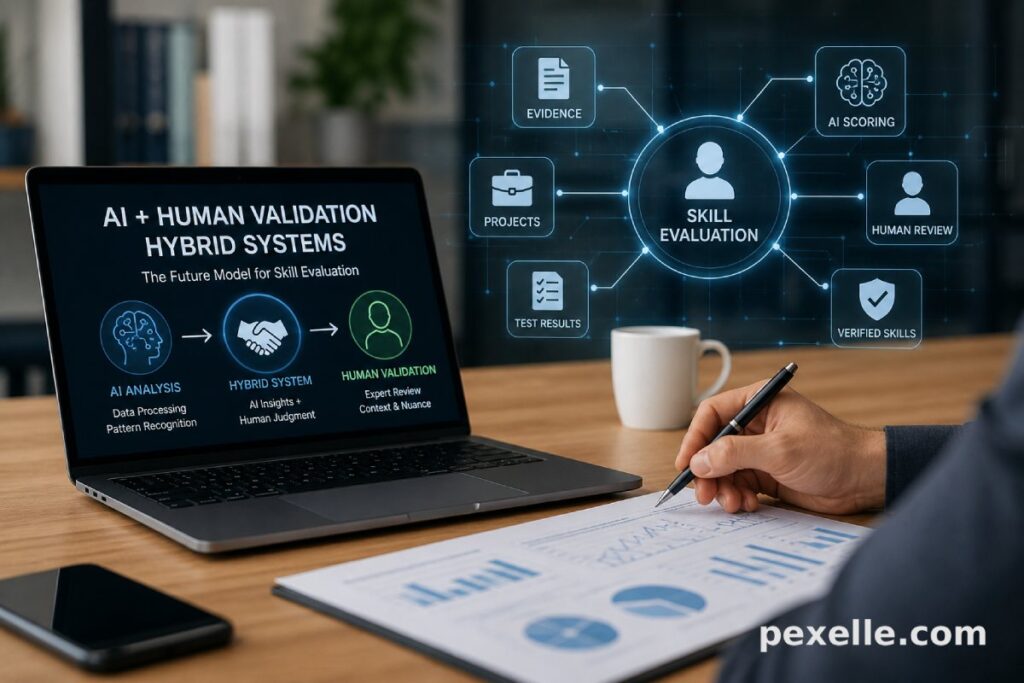
The Future Model for Skill Evaluation
Introduction: Why Skill Evaluation Is Broken
Traditional skill evaluation systems are increasingly misaligned with how people actually learn and work. Resumes, degrees, and self-reported experience often fail to reflect real capability. At the same time, fully automated AI-based assessments, while scalable, can lack context, nuance, and trust. This tension has led to the emergence of a new paradigm: AI + Human Validation Hybrid Systems.
These systems combine the scalability and pattern-recognition power of artificial intelligence with the judgment, contextual awareness, and credibility of human experts. The result is a more accurate, dynamic, and trustworthy model for evaluating skills in the modern economy.
The Core Problem: Trust vs Scale
Skill evaluation fundamentally struggles with two competing forces:
- Scale: Organizations need to evaluate thousands or millions of individuals quickly
- Trust: Decisions must be accurate, fair, and defensible
AI systems excel at scale but can misinterpret nuance. Human evaluators provide trust but cannot scale efficiently. Hybrid systems resolve this by distributing responsibility intelligently between both.
What Is an AI + Human Hybrid Validation System?
A hybrid validation system is a layered architecture where:
- AI performs initial analysis and scoring
- Humans validate, refine, or override decisions
- Feedback loops improve both AI and human judgment over time
Rather than replacing humans, AI acts as a co-pilot in evaluation, filtering, ranking, and highlighting signals that require human attention.
System Architecture: How It Works
1. Data Collection Layer
The system gathers evidence from multiple sources:
- Project submissions
- Code repositories
- Work history
- Behavioral signals
- Peer endorsements
This shifts evaluation away from static claims toward evidence-based assessment.
2. AI Analysis Layer
AI models process the data to:
- Extract skills and competencies
- Detect patterns and inconsistencies
- Score proficiency levels
- Identify anomalies or fraud
For example, an AI might analyze a developer’s GitHub activity to estimate real coding ability beyond stated experience.
3. Human Validation Layer
Human experts step in to:
- Review AI-generated scores
- Validate edge cases
- Assess qualitative aspects (creativity, communication, judgment)
- Provide final certification or rejection
This layer ensures that context and nuance are not lost.
4. Feedback Loop & Learning
The system continuously improves through:
- Human corrections fed back into AI models
- Performance tracking of validated individuals
- Reputation systems for validators
Over time, the system becomes both more accurate and more efficient.
Key Advantages of Hybrid Systems
1. Higher Accuracy
Combining AI detection with human judgment reduces both false positives and false negatives.
2. Scalability with Trust
AI handles volume, while humans ensure credibility. This enables large-scale evaluation without sacrificing reliability.
3. Fraud Resistance
AI can detect suspicious patterns, while humans investigate deeper. This dual-layer defense significantly reduces manipulation.
4. Dynamic Skill Representation
Skills are no longer static labels. They evolve based on new evidence, validations, and real-world performance.
Real-World Applications
Hiring and Recruitment
Companies can move beyond resumes by evaluating candidates based on verified skill evidence, reducing hiring risk.
Freelance Marketplaces
Platforms can rank professionals based on validated competencies rather than ratings alone.
Education and Certification
Institutions can issue evidence-backed credentials instead of relying solely on exams.
Internal Talent Management
Organizations can map real employee capabilities, enabling better project allocation and leadership decisions.
Challenges and Risks
Bias in AI Models
AI systems can inherit bias from training data. Human oversight is critical to detect and correct this.
Validator Quality Control
Not all human evaluators are equally skilled. Systems must include reputation and accountability mechanisms.
Cost vs Efficiency
Human validation introduces cost. The system must optimize when human intervention is necessary.
Privacy and Data Ownership
Handling sensitive skill data requires strong governance, especially in decentralized or global systems.
Design Principles for Effective Hybrid Systems
To build a robust hybrid validation system, several principles are essential:
- Human-in-the-loop by design, not as fallback
- Transparent scoring and validation processes
- Reputation systems for both users and validators
- Continuous learning pipelines
- Evidence-first, not claim-first evaluation
These principles ensure the system remains fair, explainable, and adaptive.
The Strategic Shift: From Credentials to Evidence
Hybrid systems represent a deeper transformation:
- From degrees → demonstrable skills
- From self-claims → verified evidence
- From static profiles → evolving skill graphs
This shift aligns evaluation with how value is actually created in the modern economy.
The Future Outlook
As AI models improve and human validation becomes more structured, hybrid systems will likely become the dominant infrastructure for:
- Global hiring
- Skill-based economies
- Decentralized work ecosystems
In this future, trust is not assumed it is constructed through continuous validation.
Conclusion
AI + Human Validation Hybrid Systems are not just a technical improvement they represent a fundamental redesign of how we measure human capability. By balancing scale with trust, automation with judgment, and data with context, these systems provide a realistic path toward fair, accurate, and scalable skill evaluation.
The organizations and platforms that adopt this model early will gain a significant advantage: the ability to truly understand and trust the people they work with.
Source : Medium.com