
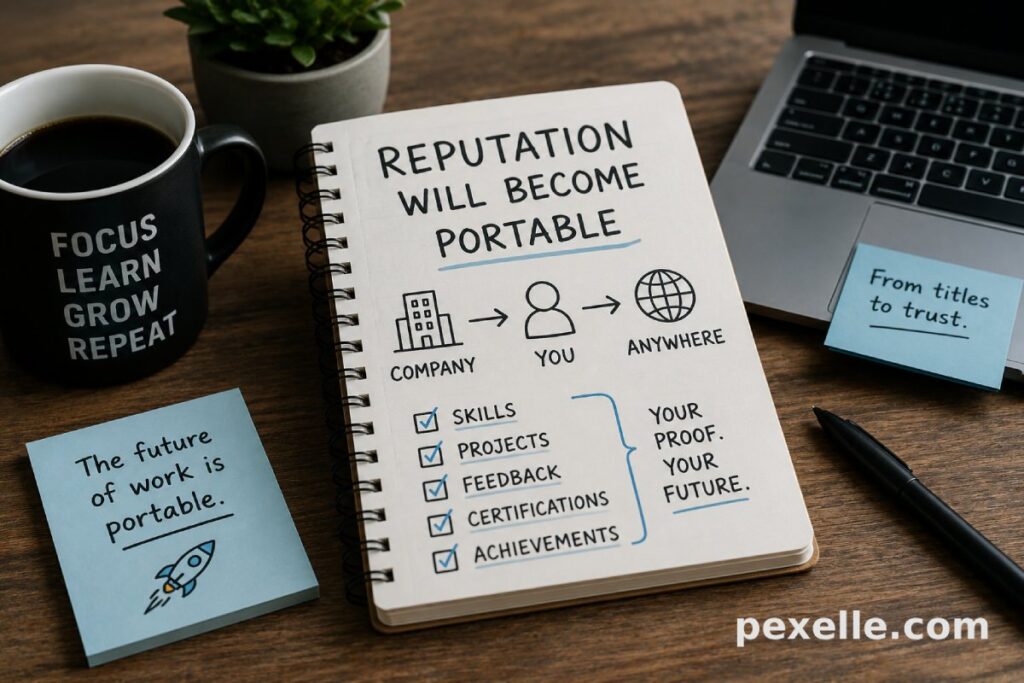
Professional Reputation Will No Longer Depend on Companies
Introduction: The Old Reputation System Is Breaking
For decades, professional reputation has been tied to institutions. A person’s credibility was often judged by the company they worked for, the university they attended, the title they held, or the brand names printed on their CV. If someone worked at a famous company, people assumed they were talented. If someone had a senior job title, people assumed they were experienced. If someone had a prestigious degree, people assumed they were capable.
But this system is becoming weaker. The modern economy is moving faster than traditional signals can handle. People change jobs more often. Remote work has expanded global competition. Freelancers, creators, contractors, founders, and independent professionals are no longer exceptions. At the same time, AI can generate polished CVs, portfolios, cover letters, and even fake-looking professional profiles.
In this environment, reputation can no longer remain locked inside companies, job titles, or private networks. The future of work needs a new kind of reputation: portable, evidence-based, verifiable, and owned by the individual.
What Portable Reputation Means
Portable reputation means that a person’s professional credibility can move with them across jobs, platforms, industries, and countries. It is not limited to one employer, one platform, or one internal HR system. It becomes a living professional identity that follows the person wherever they work.
Instead of saying, “I worked at this company, therefore trust me,” professionals will be able to show direct evidence of what they have done, what skills they have demonstrated, who has verified their work, and what outcomes they have produced.
This reputation may include completed projects, verified skills, peer reviews, client feedback, certifications, public contributions, open-source work, case studies, learning records, badges, professional assessments, and real-world evidence. The key difference is that reputation becomes attached to the person, not trapped inside the company.
Why Company-Based Reputation Is Limited
Company-based reputation has always had a major weakness: it gives too much power to the institution and too little visibility to the individual. Two people can work at the same company and have completely different levels of skill, responsibility, and impact. Yet from the outside, their reputation may look similar.
A famous company name can create trust, but it does not explain what the person actually did. A job title can suggest seniority, but it does not prove competence. A CV can describe achievements, but it is often self-reported and difficult to verify.
This creates problems for both sides of the labor market. Employers struggle to identify real talent. Skilled professionals from smaller companies, developing markets, freelance backgrounds, or non-traditional education paths may be underestimated. Meanwhile, people with strong institutional brands may receive more trust than their actual evidence deserves.
Portable reputation can reduce this imbalance by shifting attention from institutional prestige to demonstrated capability.
The Rise of Evidence-Based Professional Identity
The future of reputation will be built around evidence. Instead of relying mainly on claims, professionals will need to show proof. This proof does not have to be complicated. It can be a verified project, a work sample, a certificate, a skill assessment, a contribution history, a recommendation, or a badge connected to specific criteria.
Evidence-based identity changes the question from “Where did you work?” to “What can you prove you can do?”
This is a major shift. It benefits people who have real skills but lack traditional prestige. A developer in a small city, a designer working independently, a data analyst without a famous degree, or a young professional building public projects can all create a trustworthy reputation through evidence.
In this model, professional credibility becomes more transparent, more inclusive, and more dynamic.
Why AI Makes Portable Reputation More Important
AI is accelerating the need for portable and verifiable reputation. Today, anyone can use AI to generate a professional-looking CV, portfolio, LinkedIn profile, proposal, or case study. This does not mean all AI-generated content is dishonest, but it does mean polished presentation is no longer enough.
When everyone can sound professional, trust must come from verification.
Employers, clients, and platforms will increasingly ask: Is this work real? Was this skill actually demonstrated? Who verified it? What was the outcome? Can this claim be connected to evidence?
As AI lowers the cost of producing professional content, it raises the value of trusted proof. In the future, the strongest candidates will not simply be those with the best-written profiles. They will be those with the clearest verified reputation.
Portable Reputation and the Future of Hiring
Hiring is one of the areas most likely to be transformed by portable reputation. Traditional hiring depends heavily on CVs, degrees, job titles, interviews, and references. These signals are useful, but they are incomplete.
A portable reputation system could allow employers to see a richer picture of a candidate. They could understand which skills have been verified, what projects the candidate completed, how others rated their collaboration, what evidence supports their claims, and how their abilities developed over time.
This would make hiring more practical and less dependent on guesswork. Instead of filtering candidates only by company names or university degrees, employers could evaluate people based on verified capability.
For candidates, this creates a fairer system. They would not need to restart their credibility from zero every time they apply for a new job, move to a new country, or change industries. Their reputation would travel with them.
Benefits for Freelancers and Independent Professionals
Portable reputation is especially important for freelancers, consultants, contractors, and creators. These professionals often work across many clients and platforms. Their reputation may be scattered across marketplaces, emails, testimonials, payment platforms, social media, and private conversations.
This fragmentation makes it difficult to build long-term trust. A freelancer may have excellent experience, but much of that credibility is locked inside separate platforms or client relationships.
A portable reputation layer would allow independent workers to collect and present verified proof of their work in one professional identity. Client feedback, project outcomes, skill badges, and work samples could become part of a trusted record.
This would help independent professionals compete not only on price, but on verified quality.
Benefits for Employers and Organizations
Employers also benefit from portable reputation. Hiring mistakes are expensive. Companies often struggle to understand whether a candidate’s claims are accurate. Interviews can be biased. CVs can be exaggerated. References can be incomplete.
A portable reputation system gives organizations better signals before they make decisions. It can reduce uncertainty, improve talent matching, and help teams identify people with the right skills for specific roles.
It can also support internal mobility. Employees could build verified skill profiles inside an organization and carry that reputation across teams, projects, or future roles. This would help companies understand their workforce more accurately and reduce dependence on outdated job descriptions.
Reputation Should Be Dynamic, Not Static
Traditional reputation is often static. A degree earned years ago, a job title held in the past, or a company name on a CV may continue to influence perception long after the person’s actual skills have changed.
Portable reputation should be dynamic. It should reflect continuous learning, recent projects, new evidence, and updated verification. In a fast-changing economy, skills expire, improve, or transform. Reputation must be able to evolve with the person.
This is especially important in fields like AI, software development, cybersecurity, design, marketing, data analytics, and product management. In these areas, what someone learned five years ago may not be enough today. A living reputation system can show current capability, not only historical status.
The Role of Skill Badges and Verified Credentials
Skill badges and verified credentials can become important building blocks of portable reputation. However, not all badges are equal. A badge is only valuable if people trust the criteria behind it.
A strong badge should answer several questions. What skill does it represent? What evidence was required? Who verified it? Was the assessment practical or theoretical? Can the evidence be reviewed? Is the badge connected to real-world ability?
If badges become too easy to issue, they will lose value. But if they are connected to meaningful evidence and transparent standards, they can become powerful signals in the professional world.
The future will not be about collecting decorative badges. It will be about building a verified map of real capability.
Reputation Ownership and Digital Identity
A major question is ownership. Who should control professional reputation data? The employer? The platform? The university? The worker?
In the future, individuals should have more control over their professional identity. A person’s verified skills, achievements, and work history should not disappear when they leave a company or lose access to a platform. Their reputation should remain accessible, portable, and usable across different environments.
This does not mean anyone should be able to edit or fake their reputation freely. Verification still matters. But the individual should have the ability to carry their trusted record across opportunities.
This is where digital identity, verifiable credentials, decentralized identity, and secure professional profiles may become more important. The goal is not just convenience. The goal is fairness, trust, and continuity.
Risks and Challenges
Portable reputation also creates challenges. Privacy is one of the biggest concerns. Not every professional achievement, client project, or workplace review should be public. People need control over what they share, with whom, and under what conditions.
Another risk is reputation inequality. If portable reputation systems are poorly designed, they could create new forms of exclusion. People with more access to verified projects or prestigious reviewers could gain even more advantage. Systems must be designed to support early-career professionals, career changers, and people from less visible markets.
There is also the risk of over-measurement. Human talent cannot be reduced entirely to scores, badges, or dashboards. Reputation systems should support human judgment, not replace it completely.
The goal should be better trust, not robotic evaluation.
From CVs to Trust Graphs
The CV will not disappear immediately, but its role will shrink. A CV is a summary. A portable reputation system is a trust graph.
A trust graph connects skills, evidence, projects, feedback, credentials, and relationships. It shows not only what someone claims, but also how those claims are supported. It can reveal patterns of growth, collaboration, reliability, and impact.
This is much more powerful than a static document. It gives employers, clients, and collaborators a deeper understanding of professional credibility.
In the future, saying “I am skilled” will not be enough. The stronger statement will be: “Here is the evidence, here is who verified it, and here is how it connects to real outcomes.”
Portable Reputation and Global Talent
Portable reputation can also make the global talent market fairer. Many talented people live outside major economic centers. They may not have access to famous universities, global companies, or strong professional networks. But they may have real skills and strong work ethic.
A portable, evidence-based reputation system can help these people become visible. It allows talent to be judged more by proof and less by geography.
For employers, this expands access to talent. For workers, it opens doors beyond local limitations. For the global economy, it creates a more efficient and inclusive talent marketplace.
The Future: Reputation as Professional Infrastructure
In the coming years, reputation will become part of professional infrastructure. Just as payment systems, identity systems, and communication platforms support the digital economy, reputation systems will support the talent economy.
Professionals will need a trusted layer that records what they can do. Companies will need better ways to evaluate talent. Platforms will need more reliable trust signals. Education providers will need to connect learning to real-world proof.
This will create a new professional standard: reputation that is portable, verified, evidence-based, and controlled by the individual.
Conclusion: Trust Will Follow the Person
The future of work will not be built only around companies, titles, or degrees. These signals will still matter, but they will no longer be enough. As work becomes more flexible, global, AI-assisted, and skills-driven, reputation must become more portable.
Professional credibility will follow the person, not the institution.
The winners in this future will be people who can prove their skills, not just describe them. They will build trust through evidence, verified achievements, and real contributions. Companies that understand this shift will hire better. Platforms that support it will become more valuable. Professionals who prepare for it will gain a major advantage.
Reputation will become portable because work itself has become portable. And in a world full of claims, proof will become the new currency of trust.
Source : Medium.com