
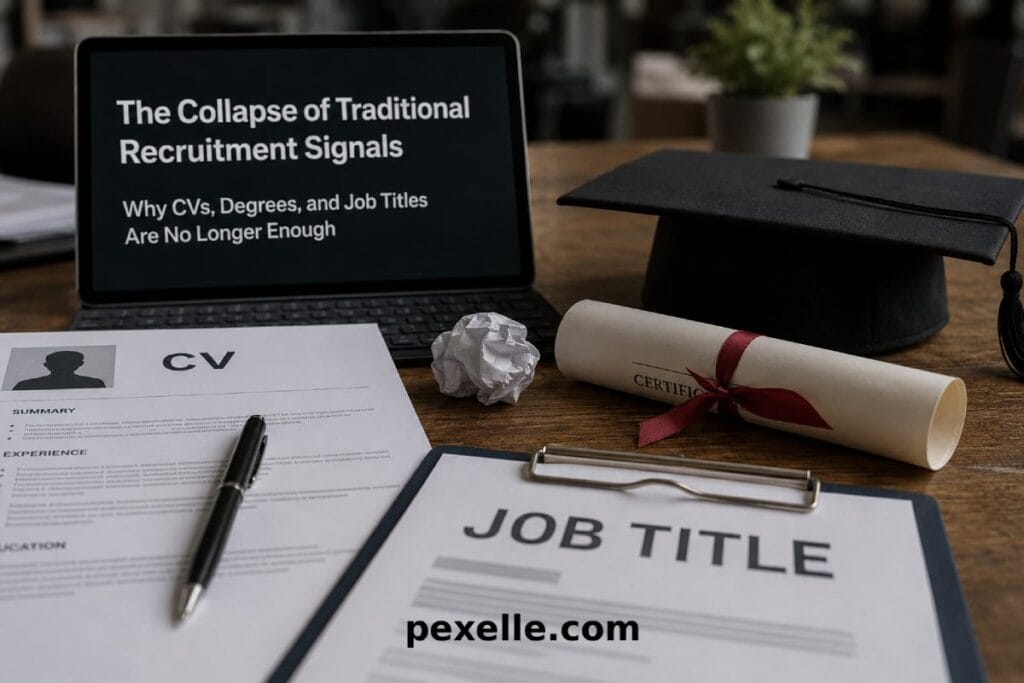
Why CVs, Degrees, and Job Titles Are No Longer Enough
Introduction: Recruitment Is Facing a Trust Crisis
For decades, hiring decisions have been built around a familiar set of signals: the CV, the university degree, the job title, and the number of years of experience. These signals helped employers quickly filter candidates, compare applicants, and reduce uncertainty. But today, the world of work is changing faster than these traditional signals can keep up.
A CV can describe what someone claims to have done, but it rarely proves how well they did it. A degree can show that someone completed a formal education path, but it may not reflect their current skills. A job title can sound impressive, but titles vary dramatically between companies, industries, and countries. As a result, recruitment systems are increasingly relying on signals that are incomplete, outdated, or easy to exaggerate.
This does not mean CVs, degrees, and job titles have no value. They still provide useful context. But they are no longer strong enough to act as the main foundation of hiring decisions. In a world shaped by AI, remote work, freelancing, portfolio careers, and rapid skill change, employers need better evidence.
The CV Was Designed for a Slower World
The traditional CV was created for a labor market where careers were more linear. A person studied, entered a profession, moved through a few companies, and built experience over many years. In that environment, listing education, employers, and responsibilities was often enough to create a reasonable picture of a candidate.
Today, work is no longer that simple. People learn from online courses, open-source projects, freelance work, startup experiments, bootcamps, communities, and AI-assisted tools. Many valuable skills are developed outside formal job roles. A person may build real product, design, data, or engineering ability without ever holding a traditional title in that field.
The CV struggles to capture this reality. It compresses complex human capability into a few bullet points. It rewards people who know how to write about themselves, not necessarily those who can perform well. This creates a gap between presentation and proof.
Degrees Are Losing Their Monopoly on Skill Validation
For a long time, degrees acted as one of the strongest signals in recruitment. They suggested discipline, knowledge, persistence, and access to formal education. In many professions, degrees are still essential, especially in regulated fields such as medicine, law, engineering, and accounting.
However, outside regulated professions, the relationship between degrees and job readiness is becoming weaker. Technology, digital marketing, product management, design, cybersecurity, data analysis, and AI-related roles often change faster than university curricula. Someone may graduate with a degree but still lack the practical tools required in the workplace. At the same time, another candidate may have no traditional degree but may have built real projects, solved real problems, and demonstrated stronger practical ability.
This shift does not make education irrelevant. It changes its role. A degree should be seen as one signal among many, not as the final proof of competence. Employers increasingly need to ask: What can this person actually do now?
Job Titles Have Become Unreliable Signals
Job titles used to provide a shortcut for understanding a person’s experience. A “manager,” “engineer,” “analyst,” or “director” title suggested a certain level of responsibility. But today, job titles are inconsistent and often misleading.
A “product manager” in one company may manage strategy, research, roadmap, and stakeholder alignment. In another company, the same title may mostly involve writing tickets and coordinating delivery. A “senior developer” in a startup may own architecture, infrastructure, mentoring, and deployment. In a large company, a similar title may describe a much narrower role.
Titles also suffer from inflation. Companies sometimes use impressive titles to attract talent, compensate for lower salaries, or create internal status. This makes it harder for employers to understand what a candidate actually contributed. The title tells us what the person was called, not what they achieved.
Years of Experience Can Be Misleading
Many job descriptions still require a fixed number of years of experience. Three years. Five years. Ten years. This seems objective, but it can be a weak measurement.
Two people may both have five years of experience, but their actual growth may be completely different. One person may have repeated the same tasks for five years. Another may have handled increasingly complex problems, learned deeply, led initiatives, and adapted to new technologies. Time alone does not equal competence.
A better question is not “How many years have you worked?” but “What level of problems have you solved, and what evidence proves it?” Recruitment needs to move from measuring time served to measuring capability demonstrated.
AI Has Made Traditional Signals Even Weaker
The rise of generative AI has accelerated the collapse of traditional recruitment signals. Candidates can now use AI tools to write polished CVs, cover letters, portfolios, and interview answers. This is not automatically dishonest. Many people use AI to communicate more clearly. But it does make written self-presentation less reliable as a signal of real ability.
Employers now face a difficult question: If a CV, cover letter, or written test can be heavily assisted by AI, how do we know what the candidate truly understands? The answer is not to reject AI. AI is becoming part of modern work. Instead, hiring systems need to measure how people think, verify what they have done, and observe how they apply tools to solve problems.
In this new environment, proof matters more than polish.
The Rise of Evidence-Based Hiring
The future of recruitment will rely more on evidence-based hiring. This means evaluating candidates through verifiable examples of skill, contribution, and performance.
Evidence can take many forms: project portfolios, code repositories, case studies, work samples, verified skill assessments, peer endorsements, customer outcomes, contribution history, certifications with practical testing, and real-world problem-solving tasks. The goal is not to create more paperwork. The goal is to reduce uncertainty.
A strong evidence-based profile answers questions that a CV often cannot:
What did this person actually build?
What problems did they solve?
What tools did they use?
What was the quality of their work?
Who can verify their contribution?
How recently did they demonstrate this skill?
This creates a more accurate and fair picture of ability.
Skills Are Becoming the New Currency of Employment
As job roles change, skills are becoming more important than titles. Employers increasingly need people who can perform specific tasks, adapt quickly, and learn continuously. This is especially true in technology, AI, sustainability, cybersecurity, design, analytics, and digital operations.
A skills-based approach allows companies to look beyond traditional filters. Instead of asking only where someone studied or what title they held, employers can ask what skills they have proven. This can open doors for non-traditional candidates, career changers, self-taught professionals, freelancers, and people from underrepresented backgrounds.
However, skills-based hiring only works if skills are verifiable. A list of skills on a CV is not enough. Anyone can write “leadership,” “Python,” “data analysis,” or “project management.” The real value comes when those skills are connected to evidence.
The Problem with Self-Reported Skills
Most recruitment platforms still depend heavily on self-reported information. Candidates describe their experience. They list their tools. They rate their abilities. But self-reporting is naturally limited.
Some candidates exaggerate. Others underestimate themselves. Some are excellent at explaining their work. Others are highly capable but poor at personal branding. This means hiring systems often reward confidence, language ability, and presentation skills more than actual competence.
A better system would allow candidates to attach proof to each skill. For example, instead of simply claiming “data visualization,” a candidate could show a dashboard they built, explain the business problem, include feedback from a manager, and link the skill to a verified assessment. This turns a claim into a signal.
Portfolios Are Becoming More Important
Portfolios are not only for designers anymore. In the modern economy, many professionals can benefit from a portfolio-based identity. Developers can show repositories and technical decisions. Marketers can show campaign results. Analysts can show dashboards and reports. Product managers can show case studies. Sustainability professionals can show impact projects. Educators can show learning materials and student outcomes.
A portfolio gives employers something more concrete than a CV. It shows how a person thinks, communicates, solves problems, and delivers work. It also helps candidates tell a more complete story about their abilities.
The challenge is that portfolios must be structured and trustworthy. A random collection of links can be hard to evaluate. The next generation of recruitment platforms will need to organize portfolios around verified skills, evidence, outcomes, and context.
Trust Will Become the Core Recruitment Problem
Recruitment is ultimately a trust problem. Employers ask: Can we trust this person to do the work? Candidates ask: Can I trust this company to judge me fairly? Traditional signals were once used to create trust quickly. But as those signals weaken, new trust infrastructure is needed.
This trust infrastructure may include verified skill cards, digital badges, work evidence, references, assessments, blockchain-based credentials, reputation systems, and AI-assisted evaluation. The purpose is not to remove human judgment. The purpose is to give human decision-makers better information.
Hiring should not become a cold algorithmic process. It should become more evidence-informed, transparent, and fair.
Why Companies Must Change Their Hiring Process
Companies that continue to rely only on CVs, degrees, and titles may miss strong candidates. They may also hire people who look good on paper but cannot perform at the required level. This creates cost, delay, team frustration, and poor business outcomes.
Modern hiring teams should redesign job descriptions around skills and outcomes. Instead of listing generic requirements, they should define what the person must actually be able to do. They should use work samples carefully, evaluate real evidence, and reduce unnecessary degree requirements when they are not essential.
This approach helps companies hire for capability, not just background.
Why Candidates Must Change Their Career Strategy
Candidates also need to adapt. In the past, building a strong CV was enough. Today, professionals need to build proof. They need to document projects, collect evidence, show outcomes, and connect their skills to real examples.
This is especially important for people entering new fields. A career changer may not have the right title yet, but they can still prove ability through projects, case studies, open-source work, volunteer work, freelance work, or structured assessments.
The future belongs to candidates who can answer not only “What have you done?” but also “Can you prove it?”
The Future: From Static CVs to Living Skill Profiles
The traditional CV is static. It is usually updated only when someone applies for a job. But skills are dynamic. People learn, improve, forget, specialize, and shift direction over time.
The future of recruitment may involve living skill profiles. These profiles would continuously collect evidence of learning, work, contribution, and verification. Instead of a one-page document, a candidate would have a trusted professional identity built around skills, achievements, and proof.
This could make hiring faster, fairer, and more accurate. Employers would spend less time guessing. Candidates would spend less time trying to fit their entire professional value into a few bullet points.
Conclusion: Recruitment Is Moving from Claims to Proof
The collapse of traditional recruitment signals does not mean the end of CVs, degrees, or job titles. It means their role is changing. They are no longer enough by themselves.
The modern labor market needs stronger signals: verified skills, real evidence, practical assessments, trusted reputation, and demonstrated outcomes. Hiring is moving from claims to proof, from titles to capabilities, and from static documents to dynamic professional identities.
In the future, the most important question in recruitment will not be: “What does your CV say?”
It will be:
“What can you prove?”
Source : Medium.com