The Future Economy Will Be Built on Skills People Can Prove
Introduction: The Economy Is Moving Beyond Job Titles
For decades, the professional world has relied on job titles, degrees, resumes, and company names to understand what people can do. A person was judged by where they studied, where they worked, and what title appeared next to their name. These signals were useful, but they were never complete. A title like “manager,” “developer,” “analyst,” or “designer” does not fully explain a person’s real abilities, practical experience, or problem-solving capacity.
The future economy will need something more accurate. As industries change faster, companies need to understand what people can actually do, not just what they claim. This is why verifiable skills are becoming one of the most important foundations of the future workforce. A verifiable skill is not only written on a profile. It is supported by evidence, proof, assessments, projects, endorsements, work history, or real-world outcomes.
In this new economy, trust will not come only from words. It will come from proof.
The Problem With Traditional Resumes
Traditional resumes are easy to write, but difficult to verify. A candidate can list many skills, but employers often have limited ways to confirm whether those skills are real, current, or practical. Someone may write “leadership,” “data analysis,” “AI,” or “project management,” but each of these terms can mean very different things depending on the person, industry, and context.
This creates a trust problem. Employers spend time interviewing, testing, and checking references because the resume alone is not enough. Candidates also suffer from this system because talented people without famous degrees or well-known company names may be ignored, even when they have strong abilities.
The traditional hiring system often rewards presentation more than proof. The future economy cannot depend on unclear signals. It needs a better way to connect people, opportunities, and organizations based on verified capability.
What Are Verifiable Skills?
Verifiable skills are abilities that can be supported by evidence. Instead of simply saying “I know Python,” a person can show completed projects, code contributions, certifications, peer reviews, assessment results, or work examples. Instead of saying “I am good at communication,” they can show presentations, client feedback, team collaboration records, or documented outcomes.
The key idea is simple: a skill becomes more valuable when others can trust that it is real.
Verifiable skills can include technical skills, soft skills, industry-specific abilities, leadership capabilities, creative skills, and problem-solving experience. They can be validated through different forms of evidence, such as completed tasks, portfolios, badges, expert reviews, workplace achievements, learning records, and community endorsements.
This does not mean every skill must be measured by a test. Some skills are best proven through real work, collaboration, and results. The important point is that the claim must be connected to credible evidence.
Why Skills Matter More Than Job Titles
Job titles are becoming less reliable because work itself is changing. Many people now perform tasks outside their official roles. A marketing specialist may use data analytics. A software developer may handle product strategy. A founder may do sales, hiring, operations, finance, and technology at the same time.
In modern work, people are not limited to one fixed identity. They are collections of skills, experiences, and capabilities. This is especially true in startups, remote teams, freelance work, and AI-driven workplaces where responsibilities change quickly.
A skill-based economy allows people to be understood more accurately. Instead of asking, “What is your title?” the future economy asks, “What can you do, how well can you do it, and what proof supports it?”
This shift helps companies find better talent and helps individuals show their real value beyond formal labels.
AI Makes Verifiable Skills Even More Important
Artificial intelligence is changing how work is created, reviewed, and distributed. Today, AI can generate text, code, images, designs, summaries, business plans, and research drafts. This creates new opportunities, but it also creates a new trust challenge.
When anyone can generate impressive-looking content with AI, it becomes harder to know who truly understands the work. A polished portfolio, document, or proposal may not always reflect a person’s actual capability. The future economy will need systems that can separate appearance from competence.
Verifiable skills solve this problem by connecting claims to evidence. In an AI-powered world, the question is not only “Can you produce an output?” The deeper question is, “Do you understand the process, can you apply the skill in real situations, and can your ability be trusted?”
As AI increases content production, proof of human skill becomes more valuable, not less.
The Rise of Skills-Based Hiring
Companies are increasingly realizing that degrees and titles alone are not enough. Many roles require practical ability, adaptability, and continuous learning. A person may not have a traditional background but may still be highly capable if their skills are proven.
Skills-based hiring focuses on what a person can do rather than only where they studied or previously worked. This can make hiring more fair, efficient, and accurate. It allows companies to discover talent from non-traditional backgrounds and gives individuals more ways to enter the professional market.
For example, a self-taught developer with verified projects may be more suitable for a role than someone with a degree but no practical experience. A community manager with proven engagement results may be more valuable than someone with a broad marketing title. A data analyst with verified dashboards and business insights may stand out more than someone with only generic resume claims.
The future hiring process will likely combine human judgment, AI tools, and verified skill evidence.
Verifiable Skills Create a New Form of Professional Identity
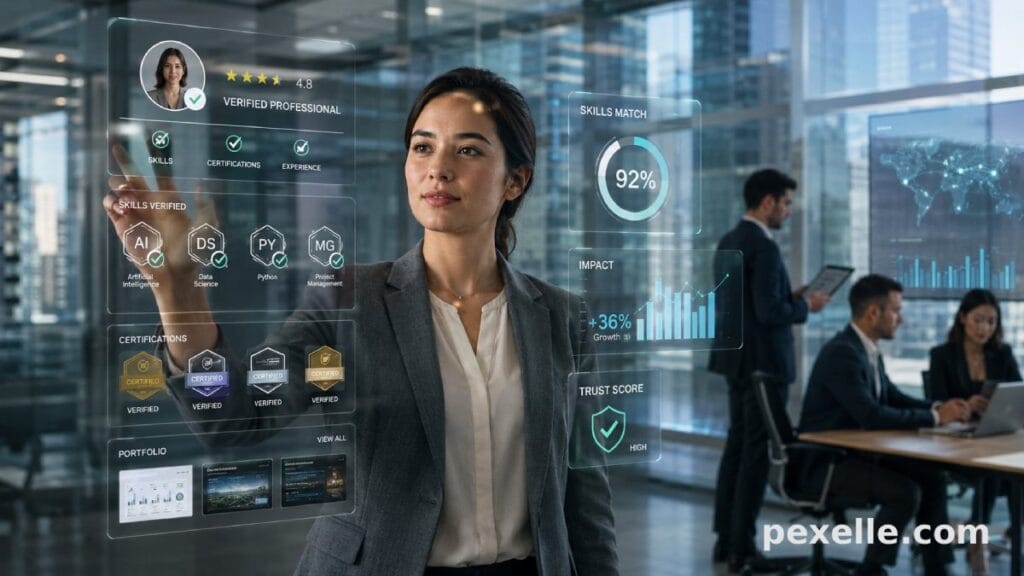
In the future, a professional identity may look less like a static resume and more like a living record of verified abilities. Instead of updating a PDF every few months, people may maintain dynamic skill profiles that show their growth, evidence, achievements, and trusted endorsements.
This identity could include skill cards, digital badges, verified project records, learning achievements, expert reviews, peer confirmations, and work-based evidence. Each part would help build a clearer picture of what the person can actually do.
This is powerful because it allows people to carry their reputation across platforms, companies, communities, and countries. A person’s professional value would not be locked inside one employer or one institution. It could become portable, transparent, and continuously updated.
In this model, skills become part of a person’s digital professional identity.
The Future Economy Needs Trust Infrastructure
Every economy depends on trust. People need to trust money, contracts, institutions, marketplaces, and professional relationships. In the digital economy, trust becomes even more important because many interactions happen remotely, across borders, and between people who have never met.
Verifiable skills can become part of the trust infrastructure of the future economy. They help employers trust candidates, clients trust freelancers, communities trust contributors, and platforms trust participants.
This is especially important in remote work, global hiring, online education, freelance marketplaces, and decentralized professional networks. When people collaborate across countries and cultures, verified skill evidence can reduce uncertainty.
The more digital and global the economy becomes, the more it needs reliable ways to prove capability.
Benefits for Workers
Verifiable skills give individuals more control over their professional future. Instead of depending only on a degree, title, or employer reputation, people can build evidence of their own abilities. This is especially useful for young professionals, career changers, freelancers, migrants, self-taught learners, and people from underrepresented backgrounds.
A person can gradually build a trusted skill profile through projects, assessments, learning, community work, and real outcomes. Over time, this profile becomes a professional asset.
This helps workers communicate their value more clearly. It also encourages continuous learning because every new verified skill can open new opportunities. In a fast-changing economy, the ability to prove new skills may become just as important as the skills themselves.
Benefits for Companies
Companies also benefit from verifiable skills. Hiring becomes more accurate when decision-makers can see evidence instead of relying only on claims. Teams can be built based on real capability rather than assumptions. Internal workforce planning also becomes easier because organizations can understand which skills already exist inside the company and which skills are missing.
This can improve recruitment, promotion, training, project allocation, and succession planning. A company that understands its verified skill map can respond faster to market changes. It can identify hidden talent, reduce hiring mistakes, and create better learning pathways for employees.
In the future, companies may compete not only through capital and technology, but also through how well they understand and develop their internal skill intelligence.
Benefits for Education
Education systems will also be affected by the rise of verifiable skills. Traditional degrees may still matter, but they will need to be supported by more specific evidence of learning outcomes. Students will need to show not only that they completed a course, but also what they can actually do because of it.
This could lead to more practical learning models, project-based education, micro-credentials, digital portfolios, and industry-aligned assessments. Instead of treating education as a one-time phase before work, the future economy may treat learning as a continuous process connected directly to employability.
Educational institutions that can issue credible, skill-level proof will become more valuable. Learners will want evidence that helps them enter the job market, change careers, or grow professionally.
The Role of Digital Badges and Skill Cards
Digital badges and skill cards can make skills easier to understand, display, and verify. A skill card can show the name of the skill, the level of proficiency, the evidence behind it, the issuing authority, the date of validation, and related achievements.
This makes professional ability more structured. Instead of reading a long resume, an employer or client can quickly review verified skill evidence. The value is not in the badge itself, but in the credibility of the proof behind it.
A weak badge without evidence is just decoration. A strong badge connected to real work, assessment, or trusted review can become a powerful professional signal.
The future will likely reward platforms that focus on evidence, not just visual certificates.
Verifiable Skills and the Freelance Economy
The freelance economy depends heavily on trust. Clients want to know whether a freelancer can deliver quality work before paying them. Freelancers want to prove their ability without starting from zero on every platform.
Verifiable skills can make freelance marketplaces more efficient. Instead of relying only on ratings from one platform, freelancers could carry verified proof of their capabilities across different ecosystems. This would reduce dependency on one marketplace and help clients make better decisions.
For example, a designer could show verified design systems, client outcomes, and expert-reviewed work. A developer could show code quality, project delivery history, and technical assessments. A consultant could show case studies, recommendations, and measurable business results.
In a global freelance economy, portable skill proof can become a major advantage.
Verifiable Skills and Internal Company Growth
Verifiable skills are not only useful for hiring. They are also useful inside organizations. Many companies do not fully know what their employees can do. Skills are often hidden because people are assigned to fixed roles and departments.
A verified internal skill system could help companies discover talent already inside the organization. An employee in customer support may have strong data analysis skills. A junior developer may have leadership potential. A marketing employee may have automation skills that could improve operations.
When companies can see verified skills internally, they can build better teams, assign people to better projects, and create smarter training plans. This reduces waste and increases employee growth.
The future organization will not only manage job titles. It will manage capabilities.
The Risk of Poor Verification
Not all verification systems are equal. A bad verification system can create false confidence. If badges are easy to issue, easy to fake, or not connected to real evidence, they may become as weak as traditional resume claims.
This is why credibility matters. Verification should be transparent, auditable, and connected to meaningful proof. The system should answer important questions: Who verified the skill? What evidence was used? When was it verified? Is the evidence still relevant? What level of ability does it represent?
Without strong standards, the market may become flooded with low-value credentials. The future economy needs verification systems that are trusted, not just attractive.
Privacy and Ownership Matter
As skills become part of digital identity, privacy becomes extremely important. People should have control over their own professional data. They should decide which evidence is public, which is private, and which organizations can access it.
A skill verification system should not become a surveillance system. It should empower individuals, not trap them. Workers need ownership over their records, especially if they move between jobs, platforms, or countries.
The best future systems will balance transparency with privacy. They will allow skills to be proven without exposing unnecessary personal information.
The Global Opportunity
Verifiable skills can create more opportunity across borders. Many talented people around the world are limited by geography, local reputation, or lack of access to famous institutions. A global skill verification system can help them show their abilities to international employers and clients.
This can make the economy more inclusive. It can help people from developing regions, immigrants, remote workers, and self-taught professionals participate in higher-value opportunities.
However, this only works if verification systems are accessible and fair. If they become too expensive, biased, or controlled by a few powerful organizations, they may create new barriers instead of removing old ones.
The future economy should make proof of skill easier to access, not harder.
From Claims to Evidence
The main shift is from claims to evidence. In the old model, people said what they could do and others had to investigate. In the new model, people can attach proof directly to their professional identity.
This does not remove the need for interviews, human judgment, or context. But it improves the quality of decision-making. Employers can ask better questions. Workers can present themselves more accurately. Platforms can match people to opportunities more intelligently.
A skill without evidence may still have value, but a skill with evidence creates trust.
Conclusion: Skills Are the New Economic Currency
The future economy will run on verifiable skills because trust, speed, and adaptability will matter more than ever. Companies need better ways to find talent. Workers need better ways to prove their value. Education needs better ways to connect learning with real outcomes. Digital platforms need better ways to build trust between people.
Job titles will not disappear, and degrees will not become useless. But they will no longer be enough on their own. The future will belong to people and organizations that can prove capability clearly, fairly, and credibly.
In a world where work changes quickly and AI can generate almost anything, human skill must become more transparent, portable, and trusted.
The economy of the future will not be built only on what people say they can do.
It will be built on what they can prove.
Source : Medium.com