
The Ability Internet: A New Digital World Where Human Potential Connects People, Skills, and Opportunities
2026-11-25
Pexelle
Introduction: What If the Internet Connected What People Can Do, Not Just Who They Know?
For decades, the internet has been built around connections. We connect through social networks, follow people we admire, join communities, exchange messages, and build digital identities. Our online presence is largely shaped by who we know, who follows us, where we studied, where we work, and what we choose to share.
But there is a fundamental question that the next generation of the internet should address:
What if the internet connected people based on what they can actually do?
Imagine a digital world where a software developer can discover a designer whose creative abilities perfectly complement their technical expertise. Where a small business owner can find someone with exceptional problem-solving skills, even if that person has never held a formal business position. Where individuals can connect not because they share the same interests, location, or professional background, but because their abilities create value together.
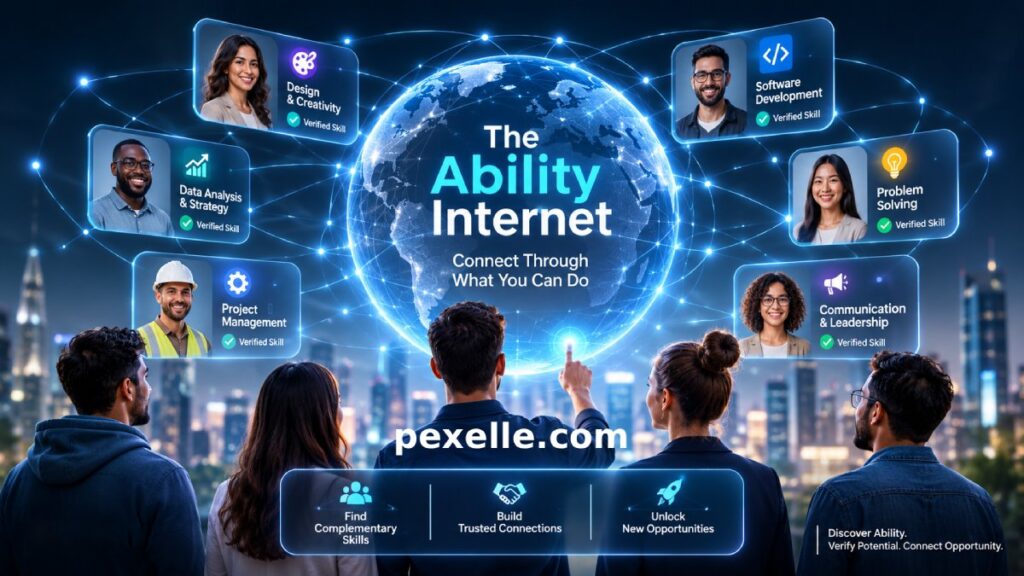
This is the idea behind the Ability Internet: a new vision of digital connectivity built around human capabilities, complementary skills, verified experience, and the potential for collaboration.
It represents a shift from a world organized around social relationships to one increasingly organized around human potential.
And it could fundamentally change how people discover one another, build teams, create opportunities, and contribute to society.
1. The Internet Connects People, But Does It Connect Their Abilities?
The traditional internet has made communication almost effortless. Social platforms help people find friends, professional networks help them discover colleagues, and online communities bring together individuals with similar interests.
Yet these systems have a limitation: they primarily organize people around relationships, interests, identities, and shared professional categories.
Consider LinkedIn, for example. Two people might have thousands of connections, impressive job titles, and extensive professional histories. However, none of this necessarily explains how effectively they could work together.
One person might be an excellent strategist who can identify opportunities but struggles to execute ideas. Another might be an outstanding operator who can turn complex strategies into practical results.
They may never discover each other because their professional profiles do not necessarily reveal how their abilities complement one another.
The same problem exists across many digital platforms.
- Social networks prioritize relationships and engagement.
- Professional networks prioritize career histories and professional visibility.
- Recruitment platforms prioritize job titles, qualifications, and predefined requirements.
- Learning platforms prioritize courses, certifications, and educational progress.
These systems serve important purposes, but they rarely provide a comprehensive picture of what people can contribute together.
The next evolution of connectivity should not simply help people find more people. It should help them find the right human capabilities.
2. From Social Graphs to Ability Graphs
The modern internet is largely powered by social graphs.
A social graph represents relationships between individuals, organizations, and communities. It helps platforms understand who knows whom, who follows whom, and which communities share common interests.
But what happens when we introduce another layer of connectivity?
An ability graph.
An ability graph represents the relationships between people’s skills, knowledge, experience, demonstrated achievements, and potential contributions.
Instead of asking only who someone knows, it explores:
- What can this person do?
- What problems can they solve?
- What experience supports their abilities?
- Which capabilities complement their own?
- What could they achieve when working with others?
Imagine a network where every individual contributes a unique combination of abilities.
A product developer connects with a market researcher. A construction specialist connects with a digital systems architect. An entrepreneur discovers someone with exceptional negotiation and operational skills.
These connections are not random.
They emerge from the value people could potentially create together.
Social graphs help us understand relationships.
Ability graphs could help us understand collaboration.
The two do not need to compete. In fact, the most powerful digital ecosystems may combine both, allowing relationships and capabilities to reinforce each other.
3. Why Complementary Skills Matter More Than Similar Profiles
One of the biggest limitations of traditional professional networking is its tendency to bring similar people together.
People often connect with others who share their industries, educational backgrounds, professional interests, and career paths.
While these relationships can be valuable, innovation frequently happens when different abilities come together.
Think about how a successful product is created.
It may require:
- A visionary who identifies an opportunity.
- An engineer who builds the technology.
- A designer who creates the user experience.
- A researcher who understands customer behaviour.
- A communicator who explains the product to the market.
- An operator who turns the idea into a sustainable business.
None of these individuals needs to possess all the necessary abilities.
Their collective strength comes from what they bring together.
This introduces an important principle:
The value of a person in a network is not determined only by the number of skills they possess, but also by how their abilities complement those of others.
A highly specialized individual might create enormous value when connected to someone with entirely different expertise.
The future of collaboration may therefore depend less on finding people who look professionally similar and more on discovering people whose capabilities complete the picture.
4. The Invisible Talent Problem
Millions of people possess abilities that are difficult to identify through conventional professional systems.
Some have developed valuable skills through independent projects. Others have gained practical expertise through years of solving real-world problems without receiving formal qualifications.
There are people who can negotiate exceptionally well but have never studied business. Individuals who understand complex technical systems but have no impressive academic background. People with extraordinary leadership, analytical, creative, or organizational abilities that are rarely reflected in their job titles.
Traditional professional profiles often struggle to capture this reality.
A person’s employment history tells us where they worked. Their education tells us what they studied. Their certifications tell us what qualifications they obtained.
But none of these necessarily provides a complete picture of what they can actually accomplish.
The Ability Internet could help make these capabilities more visible.
Instead of relying exclusively on self-declared skills, individuals could build digital profiles supported by practical evidence:
- Projects they have completed.
- Problems they have successfully solved.
- Contributions they have made.
- Professional recommendations and attestations.
- Demonstrated knowledge and practical assessments.
- Verifiable achievements and experience.
This would create a richer representation of human ability.
It would also help address a major problem in the global talent market: valuable people remain invisible simply because their capabilities do not fit traditional professional categories.
5. Artificial Intelligence Could Make the Ability Internet Possible
The growing capabilities of artificial intelligence introduce new possibilities for understanding human skills and discovering meaningful connections.
AI can help analyze complex information, identify relationships between different capabilities, and recognize patterns that might otherwise remain unnoticed.
For example, imagine a person whose profile includes:
- Financial analysis.
- Strategic thinking.
- Data interpretation.
- Risk assessment.
- Business communication.
An AI-powered ability network could recognize that this combination may be particularly valuable for financial technology startups, investment research teams, or business strategy projects.
More importantly, it could identify complementary capabilities.
A person with strong technical development skills might be an excellent match for someone with financial expertise and business insight.
The system would not simply recommend people with similar keywords. It could identify how different abilities work together to solve specific problems.
However, AI should not become the ultimate authority on human potential.
Algorithms can misunderstand context, reproduce existing biases, or confuse patterns in historical data with genuine ability.
A responsible Ability Internet should combine AI-assisted discovery with human judgment, transparent criteria, and verifiable evidence.
AI should help people discover possibilities, not decide the limits of what they can become.
6. From Discovering People to Discovering Opportunities
The real value of an ability-based network goes beyond professional networking.
It could change how opportunities are created and distributed.
Today, many opportunities are discovered through personal relationships, recruitment agencies, professional communities, or traditional job platforms.
This means access to opportunities can depend heavily on geography, social networks, educational background, and professional visibility.
An ability-based ecosystem could introduce a different approach.
Consider these scenarios:
For individuals
A talented individual in a small city could discover a global project that requires exactly their capabilities. They would not necessarily need an established professional network to become visible.
For businesses
A startup could identify the exact combination of skills needed to develop a new product, rather than searching for people based on conventional job descriptions.
For employers
Organizations could discover internal talent they did not know existed, helping employees move into roles where their abilities create greater value.
For entrepreneurs
People with complementary capabilities could find one another and build businesses without waiting for traditional recruitment or established professional introductions.
For communities
People could discover opportunities to contribute to local initiatives, solve shared problems, and exchange knowledge based on what they can offer.
The result could be a more dynamic opportunity ecosystem, where the distance between having an ability and finding a meaningful way to use it becomes significantly smaller.
7. The Importance of Verifiable Human Abilities
There is one critical challenge that an Ability Internet must solve: trust.
If a digital network is built around capabilities, how can participants know whether those capabilities are genuine?
A profile claiming expertise in cybersecurity, engineering, financial analysis, or leadership is not necessarily evidence of competence.
As digital identities become easier to create and artificial intelligence makes professional claims easier to generate, distinguishing genuine human capability from exaggerated or fabricated credentials becomes increasingly important.
An effective ability-based ecosystem needs a reliable foundation for establishing credibility.
This could involve several layers:
- Identity verification: Establishing that a digital profile belongs to a real individual.
- Skill verification: Providing evidence that a person possesses a particular capability.
- Experience validation: Connecting skills to actual projects, professional activities, and demonstrated outcomes.
- Third-party attestations: Allowing credible individuals or organizations to validate specific contributions.
- Continuous evidence: Enabling people to update their profiles as they develop new abilities and complete new work.
Importantly, verification should be specific.
Someone who has successfully managed a project should not automatically receive a universal leadership credential. Evidence should support the particular capability being claimed.
Trust should emerge from relevant proof, not simply from a collection of digital badges.
The Ability Internet will only become valuable when discovering an ability is accompanied by a meaningful way to evaluate its credibility.
8. A More Inclusive Global Talent Economy
An ability-based internet could also challenge some of the structural limitations of the global employment market.
Traditional systems often use education, employment history, geographical location, and professional networks as filters.
These filters can unintentionally exclude people who possess valuable capabilities but lack conventional credentials or access to established networks.
An ability-centered model could offer a broader way to discover talent.
A self-taught developer could demonstrate technical expertise through completed projects. A professional returning to work could showcase capabilities developed outside formal employment. Someone changing careers could demonstrate transferable skills rather than being defined by their previous job title.
This does not mean qualifications become irrelevant.
In many professions, formal education, licensing, and regulatory requirements remain essential.
Instead, it means that qualifications should be one part of a larger picture of human capability.
A person’s potential should not be reduced to the institutions they attended or the positions they previously held.
The opportunity is to build a system where people have more ways to demonstrate their value.
9. The Challenges of Building an Ability-Based Internet
The concept is powerful, but turning it into a functioning digital ecosystem will require solving several difficult problems.
Standardizing human abilities
Different industries use different terminology for similar capabilities. A skill taxonomy must make abilities understandable and comparable without oversimplifying them.
Measuring real competence
A certification, assessment, or completed project can provide useful evidence, but no single measurement can capture every dimension of human ability.
Protecting privacy
People should control which capabilities, achievements, and personal information they make visible. An ability network should not become a system of continuous employee surveillance.
Avoiding algorithmic bias
AI-powered matching systems must avoid reinforcing existing inequalities or repeatedly recommending people based on historical popularity.
Recognizing human potential
People are constantly learning. A person who cannot demonstrate a capability today may develop it tomorrow. The system must remain dynamic rather than treating profiles as permanent judgments.
Building trust across organizations
Employers, educational institutions, professional communities, and individuals need reliable ways to exchange and evaluate evidence.
These challenges demonstrate why the Ability Internet cannot simply be another social networking platform with a skills section.
It requires a fundamentally different approach to representing, validating, and connecting human capabilities.
10. Pexelle and the Foundation of an Ability-Based Digital World
At Pexelle, we believe the next evolution of professional connectivity should be built around something more meaningful than visibility.
It should be built around demonstrated human capability.
The idea is simple: people should have a better way to express what they can do, provide evidence of their abilities, discover complementary talent, and connect with opportunities where they can make a meaningful contribution.
This requires moving beyond conventional professional profiles.
A future-ready ability ecosystem should bring together several interconnected elements:
- Verifiable Skills: Capabilities supported by relevant evidence rather than unsupported claims.
- Skill Cards: Structured representations of individual abilities and achievements.
- Professional Attestations: Trusted validation of specific skills and contributions.
- Ability-Based Discovery: Finding people through complementary capabilities, not just shared job titles.
- Expert Communities: Connecting individuals around knowledge, practical expertise, and professional interests.
- Opportunity Matching: Bringing together people whose abilities align with real projects, roles, and challenges.
- Continuous Skill Development: Allowing individuals to build evidence of new capabilities throughout their professional lives.
These elements can help transform a professional profile from a static digital résumé into a living representation of human potential.
The objective is not to replace social networks, professional communities, or traditional recruitment systems.
It is to introduce a more meaningful layer of connectivity that helps people understand what they can contribute and discover what they could accomplish together.
Because the future of professional networking should not be limited to knowing more people.
It should be about discovering what becomes possible when the right abilities meet.
Conclusion: The Next Internet May Be Built Around What Humans Can Do
The first generation of the internet connected information.
The social internet connected people.
The emerging AI-powered internet is beginning to connect knowledge, systems, and intelligent services.
But there is another opportunity ahead: connecting human capabilities.
An Ability Internet could create a world where people are discovered through what they can demonstrate, where opportunities emerge from complementary skills, and where professional value is not determined exclusively by reputation, location, or social connections.
It could make hidden talent visible, enable more effective collaboration, and help organizations discover capabilities beyond traditional boundaries.
Perhaps the most important change is philosophical.
Instead of asking people to build their digital identities around where they have been, we could give them the tools to demonstrate what they can do and discover what they could achieve next.
The future of the internet may not be about having more connections. It may be about making better connections between human abilities.
And perhaps the most valuable network of the future will not be the one with the most users, followers, or interactions.
It will be the one that helps humanity make the most of its collective potential.
Pexelle | Discover Ability. Verify Potential. Connect Opportunity.
Source : Medium.com
Search site
Categories
Tags
AchievementUnlocked
AI
ArtificialIntelligence
blockchain
Business
CareerDevelopment
CareerGrowth
Communication
Competition
DecentralizedIdentity
DigitalBadges
DigitalCredentials
DigitalIdentity
DigitalTransformation
DigitalTrust
EmpowerYourSkills
FutureOfWork
HardSkills
Hiring
HRTech
ILO
Innovation
JobSkills
Leadership
Lyon2024
Museum of skills
Olympic
Onet
OpenAi
Pexelle
ProfessionalDevelopment
ProfessionalIdentity
Pursuit Of Excellence
PursuitOfExcellence
SelfManagedIdentity
Skill
SkillCertification
Skills
SkillsBasedHiring
SkillsForSuccess
SkillsLeaderboard
SkillVerification
Technology
trust
World skills
Subscribe to newsletter
Related blogs