
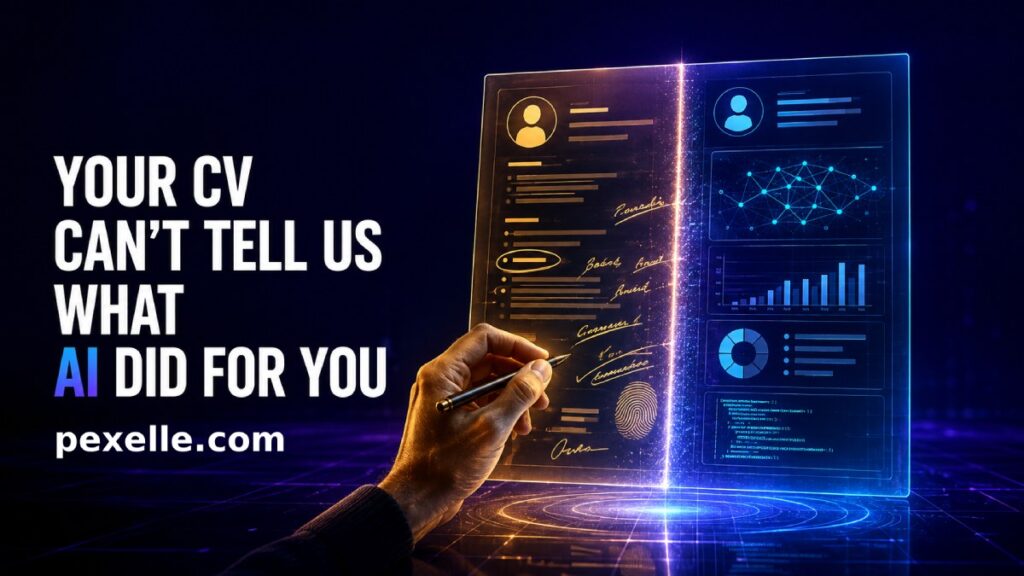
If AI wrote your code, drafted your article, designed your presentation, and analyzed your data, how should a resume reveal what you can actually do?
For generations, the resume has operated on a simple assumption: if your name appears beside a piece of work, you probably did the work.
You wrote the report. You built the product. You created the campaign. You analyzed the numbers. You designed the presentation. Your job title, project list, and portfolio were treated as reasonable evidence of your ability.
That assumption is collapsing.
Today, a person can produce polished code without understanding the architecture behind it. They can publish a convincing article without developing its argument. They can generate a professional presentation without making the strategic decisions inside it. They can summarize thousands of data points without knowing whether the conclusion is reliable.
The output may be excellent. But the output alone no longer tells us where the intelligence came from.
This does not make AI-assisted work illegitimate. AI is becoming part of modern work in the same way that search engines, spreadsheets, design software, and cloud platforms did before it. Refusing to use it will not become a meaningful signal of competence. In many roles, using AI effectively will itself be an important skill.
The real problem is attribution.
When human judgment and machine generation are mixed together, a traditional CV cannot show which decisions belonged to the person, which tasks were delegated to AI, what the person understood, or whether they could defend and reproduce the result.
In the AI era, claiming an outcome is no longer enough. We need a better way to prove contribution.
The Resume Was Built for a World of Clear Authorship
Most CVs describe work using compressed statements:
- Developed a scalable software platform
- Created a market research report
- Designed a new brand identity
- Improved operational efficiency by 30 percent
- Led the production of an investor presentation
These statements tell us what happened, but not how it happened.
Even before generative AI, resumes simplified collaboration. A successful product might involve dozens of people, yet each person described the result through the lens of their own contribution. Hiring depended on interviews, references, portfolios, and professional reputation to fill in the missing details.
AI makes that missing information much larger.
Two candidates can now present nearly identical outputs while possessing radically different levels of ability. One may have defined the problem, designed the method, challenged incorrect suggestions, tested the result, and taken responsibility for the final decision. The other may have entered a short prompt, accepted the first response, and remained unable to explain the work.
Their CVs may look the same.
Their competence is not.
AI Use Is Not the Problem
The wrong response is to treat every use of AI as a form of cheating.
A developer who uses an AI coding assistant can still demonstrate deep engineering judgment. A designer can use image generation while remaining responsible for the concept, visual system, accessibility, and final composition. An analyst can use AI to explore data while personally defining the assumptions, validating the calculations, and interpreting the consequences.
The important question is not:
Did you use AI?
It is:
What did the AI do, what did you do, and what can you personally stand behind?
Strong professionals do more than generate output. They frame problems, provide context, set constraints, recognize failure, verify claims, compare alternatives, make decisions, and accept responsibility. AI may accelerate these activities, but it does not automatically prove that the user possesses them.
The future of professional credibility therefore depends on separating three things that resumes currently blend together:
- The final outcome
- The process used to create it
- The individual’s verified contribution
From a List of Claims to a Record of Contribution
The next generation of CVs should not simply list what someone produced. It should show how the person contributed.
Imagine a project entry that includes more than a title and a result. It could identify:
- The problem the person was responsible for solving
- The decisions they made independently
- The tools and AI systems they used
- The tasks delegated to those systems
- The evidence they reviewed or created
- The errors they detected and corrected
- The outcome they influenced
- The people or organizations that verified the contribution
This creates a much more meaningful picture of ability.
For example, instead of writing:
Built an AI-powered customer support platform that reduced response time by 45 percent.
A contribution-based record might say:
Defined the support-routing architecture, selected the evaluation criteria, used AI assistance to generate initial integration code, manually reviewed security-sensitive components, designed the failure-handling process, and led production validation. The deployed system reduced median response time by 45 percent over three months.
The second version does not hide the use of AI. It makes the human contribution more credible.
The New Unit of Professional Trust Is Evidence
In an environment where text, images, software, analysis, and presentations can be generated instantly, polished output becomes weaker evidence of expertise.
What becomes more valuable is evidence surrounding the output.
That evidence may include:
- Version history showing how a project evolved
- Verified project roles and responsibilities
- Decision logs explaining why key choices were made
- Peer, manager, client, or institutional validation
- Assessments completed without unrestricted AI assistance
- Demonstrations in which the person explains or modifies the work
- Measurable outcomes connected to the individual’s actions
- Credentials issued by trusted organizations
- Work samples with transparent AI-use disclosures
This is not about monitoring every keystroke. Surveillance is not the same as trust. A system that captures everything a worker does may create risk without proving meaningful competence.
The goal should be selective evidence: enough to verify an important claim without unnecessarily exposing private data, confidential work, or the full internal process of an organization.
This is where verifiable credentials, cryptographic attestations, selective disclosure, and portable reputation can become useful. A person should be able to prove that a trusted party validated a skill, contribution, or outcome without publishing every underlying document.
What Human Ability Still Needs to Be Proven?
As AI becomes more capable, professional value will shift away from raw production and toward the qualities that determine whether production is useful, correct, and responsible.
1. Problem Framing
AI can answer a question, but choosing the right question remains a major source of value. Did the person understand the real problem? Could they identify hidden constraints, affected stakeholders, and the consequences of solving the wrong thing?
2. Judgment
AI can produce multiple plausible options. Someone still needs to decide which option fits the context. Judgment includes prioritization, tradeoffs, timing, and knowing when an apparently strong answer should not be trusted.
3. Verification
An AI-generated answer may be fluent and wrong. Professionals must be able to test claims, inspect sources, validate calculations, review code, and identify unsupported conclusions.
4. Domain Understanding
Prompting can produce an output. Domain expertise determines whether the output is safe, relevant, compliant, and realistic. This is especially important in engineering, healthcare, finance, law, security, and other high-consequence fields.
5. Original Direction
AI can generate variations, but a human may still define the purpose, taste, narrative, and strategic intent. In creative work, the important contribution may be less about manually producing every element and more about creating a coherent direction that deserves to exist.
6. Accountability
When a recommendation fails, a system causes harm, or a decision produces unexpected consequences, responsibility cannot disappear into a prompt history. Professional trust requires a person who understands the work well enough to own the outcome.
7. Adaptability
Can the individual respond when the context changes? Can they repair the work, explain it to different audiences, make a new decision with incomplete information, or continue when the AI tool is unavailable? These are stronger signals than a static final artifact.
What an AI-Transparent CV Could Look Like
The future CV may include an AI contribution layer for important projects. This does not need to become a long technical disclosure. A clear structure could be enough:
Project: Product launch strategy for a new financial platform
My responsibility: Market positioning, risk analysis, and final recommendation
AI assistance: Competitor clustering, first-draft summaries, and presentation formatting
Human decisions: Research scope, source selection, regulatory interpretation, prioritization, and final narrative
Verification: Approved by the strategy lead; launch results measured over six months
Evidence: Verified project credential, selected decision notes, and outcome metrics
This kind of record does not reduce the candidate’s value. It shows that the candidate can collaborate with AI without outsourcing responsibility.
Over time, such records could become portable. A verified project contribution from one company could be carried into another professional environment. A credential could confirm that a person led a particular decision, passed a practical assessment, or delivered a measurable result. The individual could disclose only the evidence relevant to a specific opportunity.
The result would be more useful than a document filled with unverified adjectives such as “innovative,” “strategic,” or “expert.”
Hiring Must Change Too
A better CV will not solve the problem if hiring processes continue rewarding polished claims over demonstrated ability.
Employers will need to redesign evaluation around evidence and reasoning. That may include:
- Asking candidates to explain the decisions behind a submitted project
- Giving candidates realistic scenarios rather than generic trivia
- Observing how they evaluate and correct AI output
- Testing whether they can adapt existing work to a new constraint
- Separating tool fluency from domain competence
- Verifying project contributions through trusted attestations
- Allowing responsible AI use while evaluating the quality of human oversight
Banning AI from every assessment may create an artificial test that does not reflect the real workplace. Allowing unrestricted AI use without examining the candidate’s reasoning creates the opposite problem.
The better approach is to evaluate the entire collaboration. Can the candidate direct the system effectively? Can they recognize weak output? Can they improve it? Can they explain why the final result should be trusted?
The Risk of Creating a New Performance Theatre
Transparency can also fail.
If AI disclosures become another box-ticking exercise, candidates may simply write vague phrases such as “AI was used for support.” That tells an employer almost nothing. If contribution systems demand excessive documentation, they may reward people who are good at recording work rather than those who are good at doing it. If verification depends entirely on large platforms, workers may lose control over their professional identity.
Any credible system must therefore follow several principles:
- Evidence should be connected to specific claims
- Verification should come from identifiable and trusted sources
- Individuals should control what they disclose
- Sensitive information should remain protected
- AI use should be described in practical terms
- Human contribution should be evaluated through decisions and responsibility, not just manual effort
- Credentials should be portable across platforms and employers
The purpose is not to calculate a fictional percentage such as “70 percent human, 30 percent AI.” Knowledge work is rarely divisible with that precision. The purpose is to reveal the parts that matter: ownership, understanding, judgment, verification, and accountability.
Proof Will Become More Valuable Than Presentation
AI is rapidly lowering the cost of creating professional-looking work. That is good for access, productivity, and experimentation. It also means appearance alone will carry less information.
A beautiful portfolio will not prove that its owner can make sound design decisions. Clean code will not prove that its owner understands security, scalability, or failure. A persuasive report will not prove that its author checked the facts. A confident presentation will not prove that the presenter developed the strategy.
As generated output becomes abundant, verified contribution becomes scarce.
That scarcity will make proof increasingly valuable.
The strongest professional identity will not belong to the person who claims to have done everything manually. It will belong to the person who can show that they used powerful tools intelligently, contributed meaningful judgment, verified the result, and took responsibility for what entered the world.
The CV Is Becoming a Trust Interface
The resume of the future may no longer be a static summary of titles, dates, and self-reported achievements. It may become a permission-based interface to a person’s verified professional history.
An employer could see the skills relevant to a role, the projects that support those skills, the trusted parties that validated them, and a transparent description of where AI assisted the work. The candidate would retain control over unrelated or sensitive information.
This would move hiring from a culture of assertion toward a culture of evidence.
It would also create a healthier relationship with AI. People would not need to pretend that they worked without modern tools. Nor could they rely on generated polish to substitute for competence. The system would recognize both AI fluency and human responsibility.
Conclusion: Do Not Ask Who Typed It
The central question of the AI era is not who typed every sentence, wrote every line of code, or moved every element on a slide.
The better questions are:
- Who understood the problem?
- Who made the consequential decisions?
- Who verified the result?
- Who can explain and defend it?
- Who is accountable for what happens next?
Your CV cannot answer those questions today. It was designed for a world in which authorship, effort, and ability were assumed to travel together.
They no longer do.
The future of work needs a new professional record, one that makes AI collaboration visible while proving the human contribution behind it. Because when anyone can generate an impressive result, trust will belong to those who can show what they truly brought to the work.
Source : Medium.com