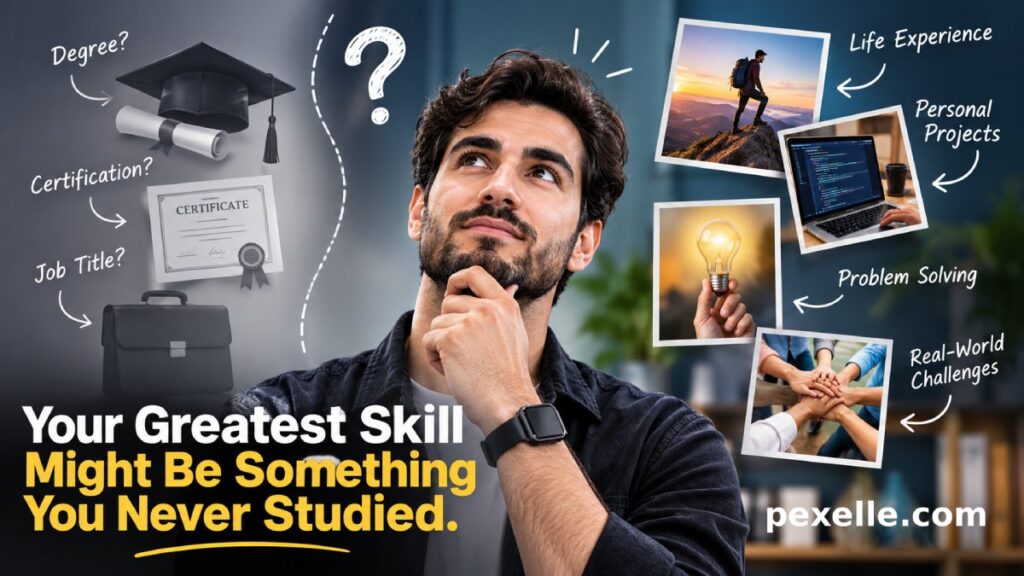
Why the abilities developed through life experiences, personal failures, independent projects, and real-world problem-solving deserve to be recognized as valuable professional skills.
Introduction: The Skills That Never Appear on a Diploma
Imagine two people applying for the same position.
The first has a university degree, several professional certifications, and a carefully structured career history.
The second has no formal qualification in the field. However, over the past five years, they have independently built digital products, managed difficult projects, solved unexpected technical problems, helped small businesses overcome operational challenges, and learned to adapt when things went wrong.
Which one is more capable?
The answer is not necessarily the person with the degree.
Formal education provides structure, theoretical knowledge, and an important foundation for professional development. But it does not represent the full range of human ability. Some of the most valuable skills people possess are developed far away from classrooms, training programmes, and professional environments.
They emerge through experience.
They develop when someone faces a problem nobody has taught them how to solve. They become stronger through failure, responsibility, curiosity, experimentation, and the determination to find a better way forward.
Yet many of these abilities remain invisible.
People often underestimate what they know because they have never studied it formally, received a certificate for it, or held a job title that demonstrates it.
This creates an important question for the modern workforce:
How can we recognize professional abilities that were never formally taught, but have been repeatedly demonstrated in real life?
1. Life Experience Is an Untapped Source of Professional Skills
Not every meaningful learning experience happens inside an educational institution.
Consider someone who has spent years helping their family manage financial difficulties. Without realizing it, they may have developed budgeting, negotiation, resource allocation, risk assessment, and decision-making skills.
Someone who has repeatedly organized community events may have developed project management, stakeholder communication, leadership, and conflict-resolution abilities.
A person who has moved between countries may have learned how to navigate unfamiliar systems, communicate across cultural differences, adapt quickly, and solve problems under uncertainty.
These experiences may not appear on a traditional CV, but they can represent genuine professional capabilities.
The problem is that people tend to describe their experiences rather than identify the skills behind them.
For example:
- “I helped my family run a small business” may represent operations management, customer relationship management, financial planning, and sales.
- “I organized a local community event” may demonstrate project coordination, leadership, negotiation, and logistics.
- “I taught myself how to repair computers” may demonstrate technical troubleshooting, independent learning, and analytical thinking.
- “I managed difficult situations during a personal crisis” may reveal adaptability, resilience, and decision-making under pressure.
The experience is only the starting point. The real value lies in understanding what someone learned, how they applied it, and whether they can demonstrate that ability in another context.
2. Failure Can Develop Abilities That Traditional Education Cannot Fully Simulate
Failure is often treated as something people should hide when presenting their professional background.
However, failure can be one of the most powerful sources of practical learning.
When a project fails, people are forced to examine assumptions, identify mistakes, reconsider strategies, and make decisions with incomplete information.
This process can develop several important capabilities:
- Critical Thinking: Understanding why an approach failed rather than simply repeating it.
- Problem-Solving: Finding alternative solutions when the original plan no longer works.
- Risk Management: Recognizing potential problems before they become serious.
- Resilience: Recovering from setbacks without abandoning long-term objectives.
- Adaptability: Changing direction when circumstances demand it.
Consider an entrepreneur whose first business did not succeed.
Although the business failed financially, the individual may have gained substantial experience in customer acquisition, product development, supplier negotiations, cash-flow management, and market research.
That experience does not automatically make someone an expert in every one of those areas.
But it creates evidence worth examining.
The important distinction is between someone who has simply experienced failure and someone who has learned from it, applied that learning, and demonstrated improvement.
A failed project is not automatically proof of competence. What someone does with the experience can become proof of competence.
3. Personal Projects Are Real-World Laboratories for Talent
Some people demonstrate their greatest abilities outside their professional responsibilities.
They build applications after work, develop websites for personal interests, create digital communities, repair equipment, experiment with new technologies, produce educational content, or develop solutions to problems they have personally encountered.
These activities are particularly interesting because they often involve self-directed learning.
Unlike structured employment, personal projects may have:
- No manager assigning responsibilities.
- No formal training programme.
- No predefined learning objectives.
- No guaranteed financial reward.
- No certification at the end.
Yet people still identify problems, research solutions, acquire new knowledge, experiment, and produce results.
A personal project can reveal more than an individual’s claimed interests. It can demonstrate how they approach unfamiliar challenges.
For example, someone who independently develops a mobile application may demonstrate:
- Software development fundamentals.
- Product thinking.
- User experience awareness.
- Independent research.
- Technical troubleshooting.
- Project ownership.
- Continuous learning.
Someone who creates and grows an online community may demonstrate communication, audience development, content strategy, moderation, and community leadership.
The significance of personal projects is that they show what people are capable of doing when they are motivated by curiosity rather than simply fulfilling a job description.
For employers, these projects can become valuable sources of professional evidence.
For individuals, they can reveal abilities they never previously considered part of their professional identity.
4. The Hidden Skills Behind Everyday Problem-Solving
One of the most overlooked sources of professional talent is ordinary problem-solving.
People solve problems every day without recognizing the professional skills involved.
A parent coordinating complicated family responsibilities may develop planning and prioritization skills.
A person managing household repairs may develop practical engineering thinking, research skills, and resource management.
Someone who regularly helps friends understand complicated technical issues may have strong communication, analytical, and knowledge-transfer abilities.
These capabilities are not necessarily equivalent to professional qualifications. However, they may represent transferable skills that can be developed further and demonstrated in professional environments.
The challenge is learning to distinguish between an isolated activity and a repeatable capability.
For example, fixing a computer once does not automatically establish technical expertise.
But repeatedly diagnosing different technical problems, understanding their causes, documenting solutions, and successfully applying that knowledge across different situations provides much stronger evidence.
This distinction matters.
The future of professional recognition should not reward people simply because they claim to have experience. It should help identify the abilities demonstrated through that experience.
5. Why Traditional Recruitment Often Misses These Abilities
For decades, recruitment systems have relied heavily on recognizable indicators of professional credibility:
- University degrees.
- Industry certifications.
- Previous job titles.
- Years of employment.
- Recognized employers.
- Professional references.
These indicators can be useful. They provide a relatively familiar way to assess candidates.
However, they also have limitations.
A degree demonstrates that someone completed a particular educational programme. It does not necessarily establish how effectively they can solve practical problems.
A job title describes a position, but it may not accurately represent everything an individual contributed.
Years of experience indicate time spent in an environment, but not necessarily the quality, depth, or relevance of that experience.
As a result, recruitment systems can overlook people who developed valuable capabilities outside conventional career paths.
This becomes particularly important as technology, entrepreneurship, remote work, and independent learning continue to change how people acquire professional knowledge.
A person may have developed practical skills through open-source contributions, freelance projects, online communities, independent research, or personal experimentation.
If recruitment systems only recognize conventional career signals, much of this talent remains undiscovered.
The question is no longer simply where someone studied or worked.
It is also what they have actually learned to do.
6. Turning Unrecognized Experience Into Verifiable Skills
Recognizing hidden talent requires more than asking people to list everything they believe they can do.
Self-assessment is useful, but claims alone are not enough.
A more meaningful approach is to connect experiences with identifiable capabilities and supporting evidence.
This can be achieved through a structured process.
Step 1: Identify the Experience
Start with activities that required effort, responsibility, learning, or problem-solving.
These could include personal projects, volunteer work, independent learning, business activities, difficult life situations, or practical responsibilities.
Step 2: Identify the Underlying Capability
Look beyond the activity itself.
Ask:
- What problem did I solve?
- What knowledge did I need?
- What decisions did I make?
- What tools or methods did I use?
- Which abilities did I repeatedly demonstrate?
Step 3: Collect Supporting Evidence
Evidence could include:
- Completed projects.
- Portfolio items.
- Documentation.
- Demonstrations.
- Published work.
- Source code or technical contributions.
- Project outcomes.
- Testimonials from people who directly observed the work.
Step 4: Evaluate the Level of Capability
Not every experience represents the same level of expertise.
Someone who has completed one small project may have introductory knowledge. Someone who has independently delivered multiple complex projects may demonstrate a considerably stronger level of practical capability.
Assessment should consider complexity, consistency, independence, quality, and the ability to reproduce results.
Step 5: Make the Skill Transferable
Finally, translate the experience into language that employers, collaborators, and professional communities can understand.
For example, instead of simply writing:
“I built a website for my personal business.”
A more meaningful description could be:
“Demonstrated practical capabilities in web development, project ownership, user-focused problem-solving, and independent technical learning through the delivery of a functioning digital product.”
The objective is not to exaggerate an experience.
It is to reveal the professional value that was already there.
7. Evidence Should Matter More Than the Place Where Learning Happened
One of the most important changes in professional recognition is the distinction between the source of knowledge and the demonstration of knowledge.
Two individuals may develop the same capability through completely different paths.
One may learn software development at university.
Another may learn through online resources, open-source projects, and independent experimentation.
A third may acquire practical experience through employment and mentorship.
Their learning journeys are different. Their ability to perform a particular task can still be assessed using comparable standards.
This does not mean formal education should lose its value.
Degrees, professional licences, and regulated qualifications remain essential in many fields, particularly where safety, legal responsibility, or specialized professional standards are involved.
Instead, the objective should be to expand the ways in which genuine capabilities can be recognized.
A credible skills assessment should consider:
- What the individual claims to know.
- How that knowledge was acquired.
- What they have actually demonstrated.
- How consistently they can apply it.
- Whether the evidence is authentic and relevant.
When these elements are connected, professional recognition becomes less dependent on someone’s educational background and more focused on their demonstrated abilities.
8. The Future of Talent Recognition Is Built Around Evidence
The professional world is gradually moving towards a more skills-oriented approach.
Organizations increasingly need people who can adapt, learn independently, solve unfamiliar problems, and contribute across different areas of work.
At the same time, individuals are developing capabilities through an expanding range of experiences.
This creates an opportunity for new professional identity systems.
Imagine a professional profile where skills are not simply self-declared keywords.
Instead, each capability can be connected to evidence:
- A project demonstrating practical application.
- A verified contribution showing collaboration.
- An assessment establishing technical knowledge.
- A professional attestation confirming observed performance.
- A portfolio documenting continuous development.
Such a system could help people communicate their abilities more accurately while giving employers better information for evaluating talent.
It could also help identify transferable skills that traditional CVs frequently overlook.
Importantly, verification should not mean that every personal experience must become a public record.
Individuals should remain in control of what they share, which evidence they provide, and who can access their professional information.
The goal is to make skills more understandable and credible, not to turn every aspect of life into a recruitment assessment.
9. Pexelle: Making Invisible Abilities Visible
At Pexelle, we believe professional potential should not be limited by the boundaries of traditional education or conventional career histories.
People develop valuable abilities through different journeys.
Some learn through universities. Others learn through professional environments, personal projects, entrepreneurship, community contributions, independent research, and real-world challenges.
What matters is understanding what they can actually do.
This is why a more evidence-based approach to skills recognition is important.
Pexelle focuses on connecting skills with meaningful evidence, allowing individuals to build a professional identity that goes beyond job titles and educational qualifications.
Rather than treating a skill as just another keyword on a profile, the objective is to give it context.
Where did the capability come from?
How has it been applied?
What evidence supports it?
Can others credibly recognize the individual’s contribution?
By connecting skills, evidence, and professional recognition, Pexelle aims to help people communicate their real capabilities and help organizations discover talent beyond traditional recruitment signals.
Because someone who has never studied project management may have successfully managed complex projects.
Someone without a formal programming degree may have built functional software.
And someone whose career does not follow a conventional path may possess exactly the capabilities an organization needs.
Their abilities should not remain invisible simply because they were developed outside a classroom.
Conclusion: Your Experience Might Be More Valuable Than You Think
Your greatest professional ability might not come from your university degree.
It might come from a business that failed, a project you built on your own, a problem you spent months trying to solve, a responsibility you never expected to have, or a challenge that forced you to learn something completely new.
These experiences shape how people think, work, communicate, adapt, and make decisions.
But experience alone is not enough.
To become professionally meaningful, it needs to be recognized, understood, demonstrated, and supported by credible evidence.
The future of work should not be about choosing between formal education and real-world experience.
It should be about recognizing valuable capabilities wherever they are developed and evaluating them based on what people can genuinely demonstrate.
Because your greatest skill might be something you never studied.
And the world should have a better way to recognize it.
About Pexelle
Pexelle is building an evidence-based professional ecosystem where skills, achievements, and demonstrated capabilities help define professional identity. We believe talent deserves to be recognized through what people can actually do, not just what their CV says.
Pexelle | Skill → Evidence → Contribution → Impact
Source : Medium.com