
The New Competitive Advantage in the Age of Artificial Intelligence
For centuries, knowledge was the foundation of professional value. The people who knew the most, remembered the most, and could access information the fastest held a significant advantage.
Artificial Intelligence has fundamentally changed that equation.
Today, AI can answer questions in seconds, write software, analyze contracts, summarize research papers, generate marketing campaigns, translate languages, and even produce creative content that rivals human work. Access to knowledge is no longer rare. It has become nearly universal.
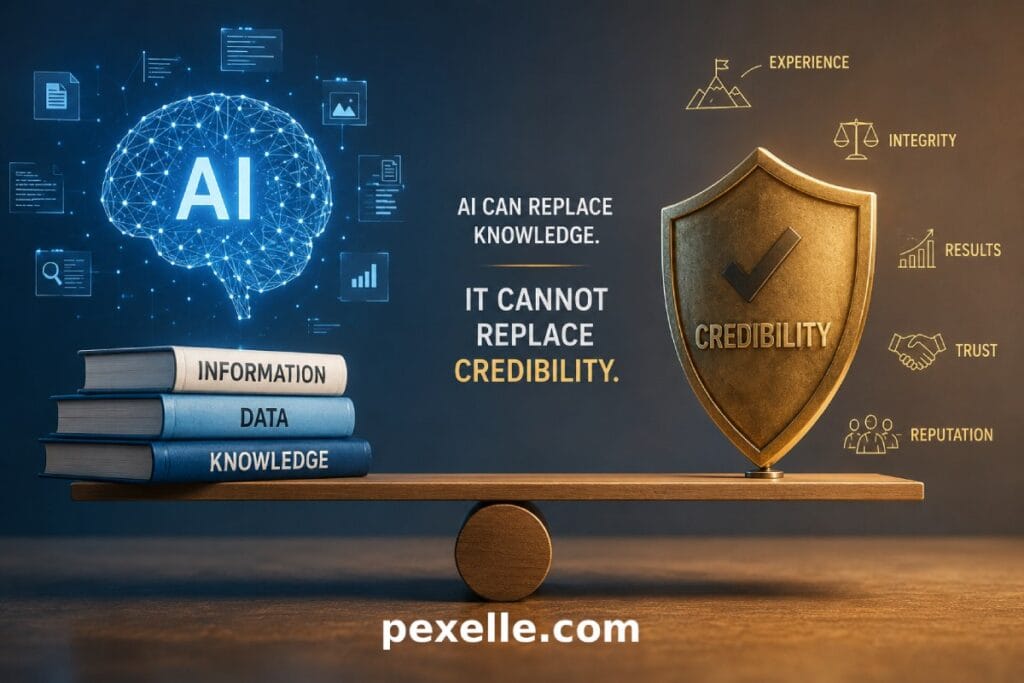
But while AI is rapidly commoditizing knowledge, it cannot commoditize one thing:
Credibility.
And that distinction may become the defining economic advantage of the next decade.
Knowledge Is Becoming a Commodity
Every major technological revolution reduces the cost of something valuable.
The Industrial Revolution reduced the cost of manufacturing.
The Internet reduced the cost of communication.
Cloud computing reduced the cost of infrastructure.
Artificial Intelligence is reducing the cost of knowledge production.
When anyone can generate a business plan, legal summary, software architecture, presentation, or research report within minutes, possessing information alone is no longer enough to stand out.
The question is no longer:
“Can you produce knowledge?”
The question becomes:
“Can people trust that what you produced reflects real expertise, experience, and integrity?”
That is a completely different challenge.
Information Is Easy to Generate
Proof Is Difficult to Earn
Generative AI can create convincing outputs without ever experiencing reality.
- It has never led a team.
- It has never negotiated a difficult contract.
- It has never spent years mastering surgery, engineering, cybersecurity, or architecture.
- It predicts language exceptionally well.
- It does not possess lived experience.
Humans, however, build credibility through years of consistent action.
Projects completed.
Problems solved.
People helped.
Failures overcome.
Responsibilities accepted.
Results delivered.
Those experiences cannot simply be generated with a prompt.
The Coming Credibility Economy
As AI-generated content floods the internet, distinguishing authentic expertise from synthetic expertise becomes increasingly difficult.
Soon, every resume may appear perfect.
Every portfolio may look polished.
Every proposal may sound professional.
Every interview answer may be AI-assisted.
Ironically, AI’s greatest achievement may also create its biggest problem:
It dramatically increases uncertainty about who actually knows what.
This shifts value away from content itself and toward evidence behind the content.
In the future, organizations will increasingly ask questions like:
- Who verified this person’s skills?
- Has this experience been independently confirmed?
- Can these achievements be trusted?
- Are these credentials authentic?
- Is this work original?
- Has this individual consistently demonstrated competence?
Knowledge opens doors.
Credibility determines who gets invited inside.
Trust Becomes the Scarce Resource
Economics teaches a simple principle:
Scarcity creates value.
Information is becoming abundant.
Trust is becoming scarce.
When abundance increases, scarcity becomes more valuable.
This means credibility is transforming into one of the world’s most important digital assets.
Companies will compete for trustworthy employees.
Customers will prefer trustworthy businesses.
Investors will seek trustworthy founders.
Platforms will prioritize trustworthy creators.
Communities will reward trustworthy contributors.
In every case, credibility becomes a competitive moat that AI alone cannot replicate.
Reputation Will Become Machine Readable
Today’s professional reputation is fragmented.
A LinkedIn profile shows employment.
GitHub shows code.
Academic papers show research.
Certificates show completed courses.
Recommendations live across different platforms.
Future digital ecosystems will likely move toward connected evidence.
Instead of claiming expertise, professionals will increasingly present verified proof.
Instead of listing skills, they will demonstrate validated capability.
Instead of asking people to trust them, they will show why they deserve trust.
This represents a shift from self-declared identity to evidence-backed identity.
AI Makes Human Signals More Valuable
Some fear AI will eliminate the value of human work.
The opposite may happen.
As synthetic content becomes effortless, authentic human signals become increasingly valuable.
Original thinking.
Consistent ethical behavior.
Long-term accountability.
Verified accomplishments.
Transparent decision-making.
Reliable collaboration.
These characteristics cannot be mass-produced by language models.
They emerge from relationships, responsibility, and experience accumulated over time.
AI amplifies productivity.
Credibility amplifies opportunity.
The two are complementary, not competing.
The Professionals Who Will Thrive
The highest-performing professionals will not be those who compete against AI.
They will be those who combine AI with strong credibility.
Imagine two consultants using identical AI tools.
Both generate equally impressive reports.
One has years of verified successful implementations, trusted references, measurable outcomes, and independently validated expertise.
The other has none.
The technology is identical.
The credibility is not.
Clients rarely buy information.
They buy confidence.
Organizations Will Need New Trust Infrastructure
Businesses already verify payments, identities, compliance, cybersecurity, and financial transactions.
Professional capability is becoming the next major verification challenge.
Freelancing.
Remote work.
Open-source collaboration.
Creator economies.
Professional marketplaces.
AI agents acting on behalf of humans.
Every one of these environments depends on confidence in the people behind the work.
As AI continues lowering the cost of producing knowledge, demand for systems that verify credibility will continue rising.
The future digital economy will not simply require smarter AI.
It will require stronger mechanisms for proving that humans deserve trust.
Conclusion
Artificial Intelligence is changing what it means to be knowledgeable.
It is not changing what it means to be credible.
Knowledge can increasingly be generated.
Credibility must still be earned.
AI can answer questions.
- It cannot build a reputation.
- It can draft impressive work.
- It cannot inherit years of integrity.
- It can simulate expertise.
- It cannot replace trust that has been earned through real actions.
The next generation of professionals will not be defined by how much information they possess.
They will be defined by how much confidence others place in them.
Because in the age of AI, knowledge may become abundant.
Credibility will remain priceless.
Source : Medium.com