
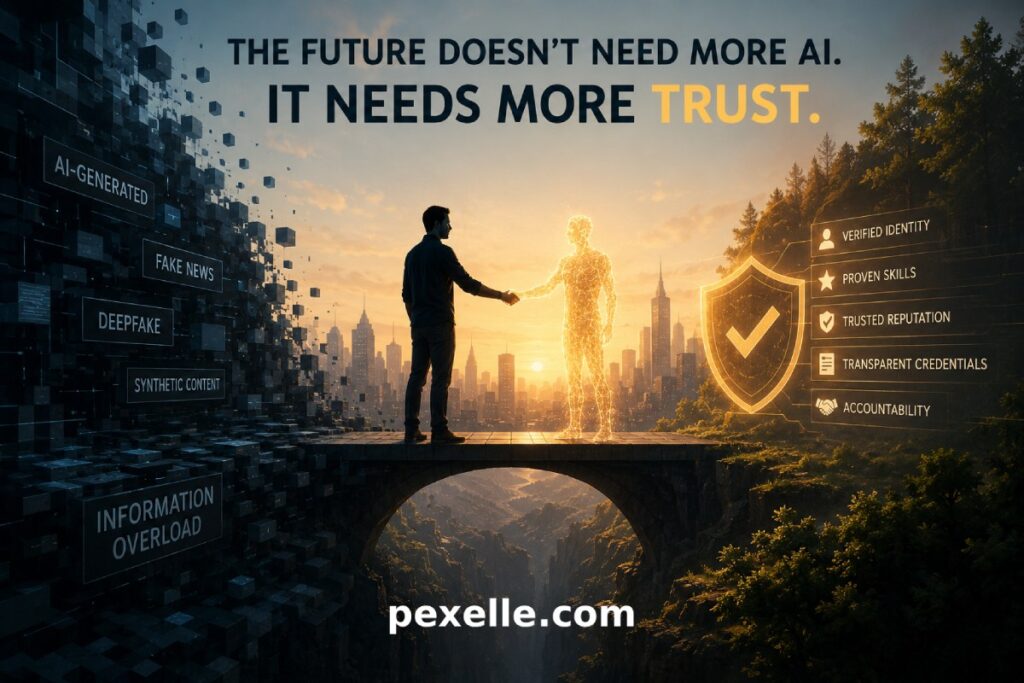
Intelligence Is No Longer the Scarce Resource
For decades, humanity chased intelligence.
We built universities to create it.
We built companies to monetize it.
We built software to automate it.
Then artificial intelligence changed the equation.
Today, anyone with an internet connection can generate code, write articles, design products, create videos, analyze contracts, translate languages, and build businesses in minutes. The cost of intelligence is rapidly approaching zero.
This is one of the greatest technological shifts in history.
Yet as AI becomes more capable every month, another problem grows even faster.
The future isn’t limited by intelligence anymore.
It is limited by credibility.
The New Bottleneck
Imagine a world where AI can instantly produce:
- A legal contract
- A medical recommendation
- A business strategy
- A software application
- A university thesis
- A realistic video
- A complete financial analysis
Now ask a much harder question:
Who created it?
Did a qualified expert write it?
Did AI generate it?
Was it edited?
Was it manipulated?
Was it stolen?
Was it verified?
Most importantly…
Can you trust it?
The real challenge of the AI era isn’t generating information.
It’s knowing what deserves confidence.
Intelligence Without Trust Creates Noise
The internet dramatically reduced the cost of publishing.
AI dramatically reduces the cost of producing knowledge.
But neither automatically increases truth.
Instead, we are entering an economy flooded with content that looks intelligent.
Every day the world receives:
- millions of AI-generated images
- millions of AI-written articles
- synthetic voices
- cloned identities
- fake reviews
- automated resumes
- fabricated portfolios
- convincing deepfakes
The output keeps increasing.
Confidence keeps decreasing.
The result is not an intelligence crisis.
It is a trust crisis.
Every Digital Decision Starts With Trust
Think about nearly every important decision you make online.
Hiring someone.
Investing.
Choosing a doctor.
Buying software.
Accepting legal advice.
Reading research.
Hiring a freelancer.
Selecting a supplier.
Joining a startup.
Voting.
Every one of these decisions begins with one invisible question:
Can I trust this person?
Not:
Can they use AI?
Not:
Can they write prompts?
Not:
Can they create content quickly?
The first filter is always credibility.
AI Makes Verification More Valuable
Ironically, AI is making human verification more valuable than ever.
When everyone can produce impressive work, impressive work stops being enough.
Proof becomes the differentiator.
The future belongs to people who can demonstrate:
- verified experience
- verified achievements
- verified identity
- verified education
- verified reputation
- verified skills
- verified contributions
Claims become cheap.
Evidence becomes expensive.
Reputation Becomes Infrastructure
For centuries, reputation lived inside communities.
People trusted neighbors because they knew them.
Businesses trusted suppliers because they had long histories together.
Today, global collaboration happens between strangers.
Remote teams.
Freelancers.
Creators.
Open source contributors.
Communities spread across continents.
Traditional trust mechanisms no longer scale.
The world needs portable reputation.
A trust layer that follows people everywhere.
One that isn’t controlled by a single employer, university, platform, or country.
One that allows credibility to travel with the individual.
AI Agents Need Trust Too
The next wave of technology isn’t just human users.
It is autonomous AI agents.
Agents will negotiate.
Buy products.
Book meetings.
Write software.
Manage finances.
Coordinate supply chains.
Execute business operations.
But before agents can cooperate with humans or with each other, they must answer familiar questions.
Who owns this agent?
Who authorized it?
What permissions does it have?
Can it be audited?
Has it behaved reliably before?
Trust is not only a human problem.
It is becoming an AI problem.
Without trusted identity and accountability, autonomous systems cannot safely operate at global scale.
The Economic Cost of Low Trust
Every missing layer of trust creates friction.
Companies spend billions every year on:
- compliance
- identity verification
- fraud detection
- audits
- legal reviews
- background checks
- document verification
- security teams
These costs exist because trust is missing.
Imagine if credibility were portable and verifiable by design.
Transactions would become faster.
Hiring would become simpler.
Cross-border collaboration would expand.
Fraud would become significantly more difficult.
Trust isn’t just a social value.
It is economic infrastructure.
The Next Generation of Platforms
The most valuable platforms of the next decade won’t simply generate more content.
They will generate more confidence.
Instead of asking:
“What can AI create?”
The better question becomes:
“What can society verify?”
Future platforms will compete on:
- authenticity
- transparency
- accountability
- verifiable identity
- reputation portability
- trusted credentials
- proof of contribution
- auditability
Because information without trust has limited value.
Verified information compounds in value over time.
Trust Is the New Competitive Advantage
History shows that every technological revolution creates a new scarce resource.
Industrial Revolution
Machines replaced manual labor.
Information Age
Computers replaced repetitive thinking.
AI Revolution
Artificial intelligence replaces routine cognitive work.
What remains scarce?
The ability to prove who you are.
The ability to prove what you’ve accomplished.
The ability to prove that others can confidently rely on you.
That scarcity will define the next generation of winners.
Building the Human Layer of AI
The future doesn’t need humans competing with AI.
It needs humans building the systems AI cannot replace.
Systems of:
- trust
- verification
- reputation
- accountability
- credibility
- ethical governance
These are not obstacles to AI.
They are the foundation that allows AI to scale responsibly.
Without them, intelligence becomes noise.
With them, intelligence becomes progress.
Conclusion
Artificial intelligence will continue becoming faster, cheaper, and more accessible.
That trend is almost inevitable.
But intelligence alone cannot build functioning economies, resilient organizations, or healthy digital societies.
Trust is what transforms intelligence into action.
Trust transforms information into decisions.
Trust transforms strangers into collaborators.
Trust transforms technology into progress.
The next decade will not be defined by who builds the smartest AI.
It will be defined by who builds the most trusted digital world.
Because the future doesn’t need more artificial intelligence.
It needs more human confidence.
It needs more credibility.
It needs more proof.
Above all, it needs more trust.
Source : Medium.com