
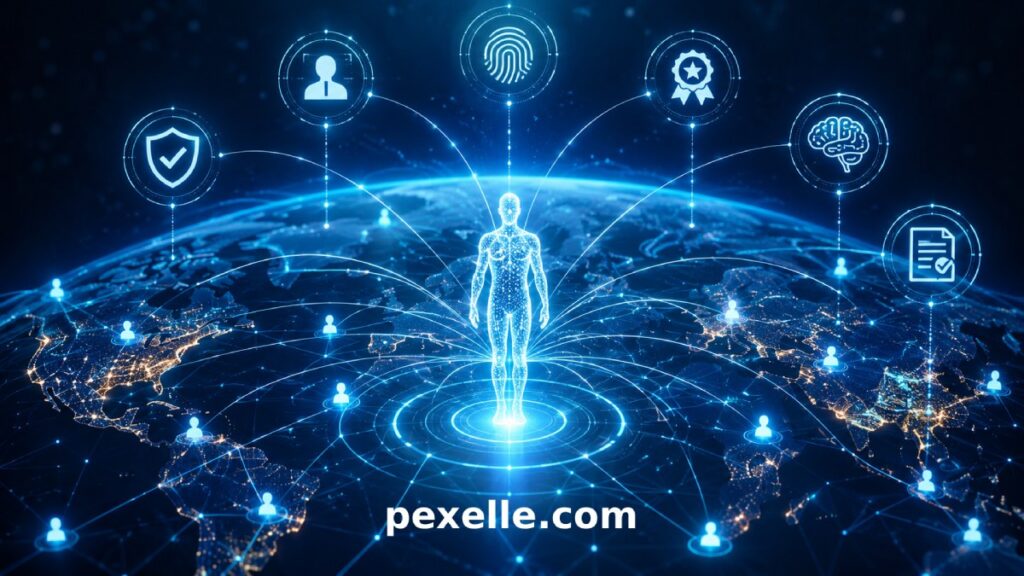
We Built a Network for Information. We Never Built One for People.
The internet has become humanity’s most important infrastructure.
It moves trillions of dollars every day.
It powers governments, healthcare, education, finance, and global commerce.
It allows ideas to travel across continents in milliseconds.
Yet despite decades of innovation, the internet still cannot answer one surprisingly simple question:
Who is actually on the other side?
Everything online can be encrypted.
Almost everything can be copied.
Almost anyone can pretend to be someone else.
The web solved communication.
It never solved human identity.
That missing piece is becoming one of the defining challenges of the AI era.
The Internet Was Designed Around Machines
The internet’s architecture is exceptional at connecting computers.
Protocols verify servers.
Certificates verify domains.
Cryptography verifies transactions.
Blockchains verify ownership.
Machines trust machines remarkably well.
Humans, however, remain largely unverifiable.
An email address says almost nothing about a person.
A LinkedIn profile can be fabricated.
A portfolio may contain someone else’s work.
Followers can be purchased.
Reviews can be generated.
Even government-issued IDs often verify only that a document exists, not that someone possesses the skills, experience, or reputation they claim.
The internet authenticates devices better than it authenticates people.
AI Has Exposed the Problem
Artificial intelligence did not create the trust crisis.
It simply accelerated it.
Today, AI can generate:
- Professional resumes
- Code repositories
- Research papers
- Marketing campaigns
- Artwork
- Videos
- Voice recordings
- Entire businesses
The cost of producing convincing digital content has collapsed.
Quality is no longer evidence of authenticity.
The traditional signals we relied on for evaluating people are disappearing.
Soon, every profile may appear impressive.
Every application may look polished.
Every proposal may sound intelligent.
The challenge shifts from creating information to verifying its origin.
Trust Is Becoming the Internet’s Biggest Bottleneck
For years, digital platforms optimized for speed.
Publish faster.
Ship faster.
Connect faster.
Now they face a new problem.
Can they trust what they receive?
Companies spend billions every year trying to answer questions that should already have reliable answers:
- Did this person actually build this software?
- Does this freelancer possess the skills they advertise?
- Is this creator authentic?
- Did this employee complete the work?
- Is this review genuine?
- Was this research generated responsibly?
- Is this AI agent acting on behalf of a verified organization?
Verification has become an expensive manual process.
The internet scales information.
Trust does not scale nearly as well.
The Missing Infrastructure Is Human Verification
Imagine if people could carry portable, verifiable evidence of who they are.
Not merely identity.
But credibility.
- Proof of skills.
- Proof of work.
- Proof of education.
- Proof of contributions.
- Proof of reputation.
- Proof that achievements actually happened.
Instead of asking people to repeatedly prove themselves, the internet could verify those claims automatically through trusted evidence.
This is not about replacing privacy.
It is about enabling selective, consent-based proof.
Just as HTTPS made secure communication standard, verifiable human credentials can make trustworthy interaction standard.
Reputation Should Become Portable
Today’s reputation is fragmented.
- A developer builds credibility on GitHub.
- A designer earns trust on Behance.
- A researcher publishes elsewhere.
- A freelancer collects reviews on another platform.
- A founder builds influence on LinkedIn.
None of these systems communicate effectively with one another.
Reputation remains trapped inside platforms.
People should own their credibility instead of renting it from websites.
When achievements become portable, individuals gain lasting digital assets that move with them throughout their careers.
AI Agents Will Need Human Anchors
The next decade will introduce billions of AI agents.
They will negotiate.
Purchase.
Write software.
Manage workflows.
Represent companies.
Coordinate logistics.
Eventually, agents will communicate with other agents more frequently than humans communicate with each other.
But every autonomous system will eventually require an answer to one question:
Which verified human is accountable?
Without that connection, responsibility disappears.
Trust collapses.
The future internet cannot consist solely of autonomous software.
It needs verified humans behind autonomous intelligence.
Beyond Identity: Verifiable Capability
Traditional identity answers one question:
“Who are you?”
The future internet must answer a far more valuable question:
“What can you reliably prove?”
This distinction changes everything.
Capability matters more than appearance.
Evidence matters more than claims.
Verified experience matters more than self-description.
In an AI-generated world, proof becomes more valuable than presentation.
The Human Layer
The internet evolved in layers.
Physical infrastructure connected continents.
Networking protocols connected devices.
The web connected information.
Cloud computing connected services.
Artificial intelligence is connecting knowledge.
The next layer will connect trust.
A true Human Layer would allow individuals to securely present verifiable evidence about themselves while maintaining control over privacy and consent.
Rather than asking people to constantly rebuild trust, digital systems could inherit trust from independently verified facts.
This transforms reputation from opinion into infrastructure.
A Better Digital Economy
The benefits extend far beyond hiring.
Healthcare can verify professional qualifications instantly.
Financial institutions can streamline onboarding.
Educational achievements become portable across borders.
Governments reduce identity fraud.
Marketplaces eliminate fake sellers.
Communities reward genuine contributions.
Businesses reduce verification costs.
Individuals gain ownership over their digital reputation.
Entire industries become more efficient because trust becomes easier to establish.
The Next Internet Upgrade
History shows that every major leap in the internet solved an infrastructure problem.
Broadband solved bandwidth.
Cloud solved scalability.
Mobile solved accessibility.
AI solves productivity.
The next challenge is trust.
Without trustworthy humans, increasingly intelligent systems become increasingly unreliable.
The future internet does not simply need more AI.
It needs stronger human foundations.
The internet connected the world.
Now it must connect confidence.
Not confidence in machines.
Confidence in people.
Because information alone is no longer enough.
The future belongs to networks that can verify the humans behind every idea, every transaction, every decision, and every intelligent system.
The next evolution of the internet is not another protocol.
It is the Human Layer.
Source : Medium.com