
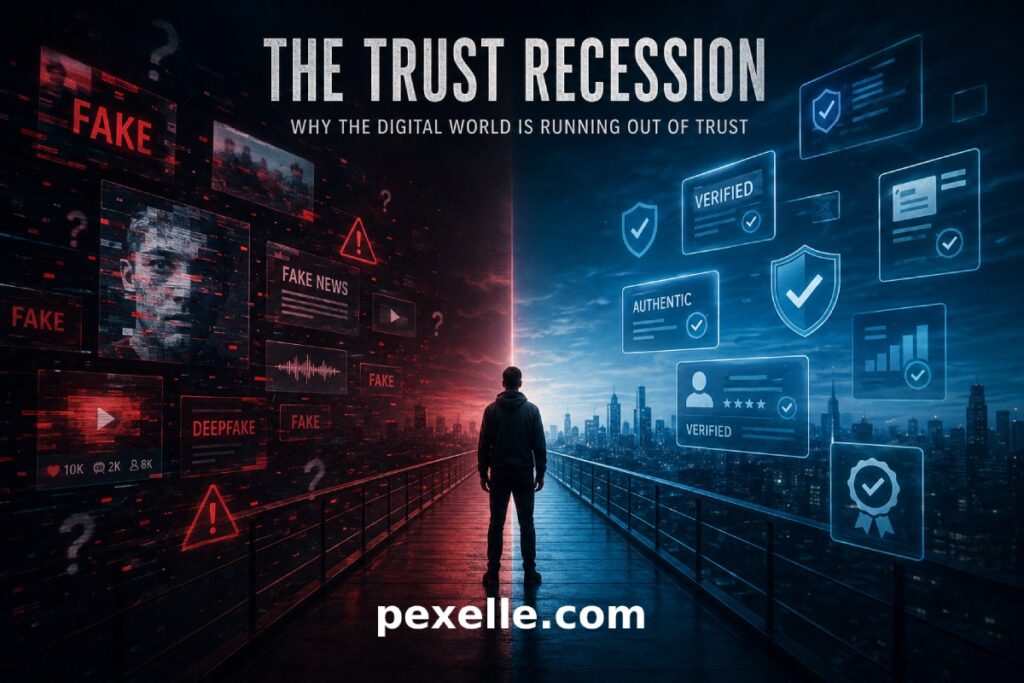
Why the Digital World Is Running Out of Trust
Introduction
For decades, the internet has been celebrated as humanity’s greatest engine of connection. It removed geographical barriers, accelerated the spread of knowledge, and enabled billions of people to communicate instantly. Yet beneath this extraordinary progress lies a growing crisis that receives far less attention than artificial intelligence, cybersecurity, or digital transformation.
The digital world is experiencing something that resembles an economic recession, but instead of losing money, it is losing trust.
Every day, people question whether an image is authentic, whether a video has been manipulated, whether an online profile represents a real person, whether reviews are genuine, and whether professional credentials can be believed. As AI becomes more powerful, the cost of producing convincing deception approaches zero while the cost of verifying truth continues to rise.
This is not simply a technology problem.
It is becoming the defining infrastructure challenge of the digital economy.
The Era of Unlimited Information
The internet solved one of history’s greatest bottlenecks: access to information.
Search engines made knowledge instantly searchable.
Cloud computing made software globally accessible.
Social media gave everyone a publishing platform.
AI now creates text, images, audio, and video in seconds.
Information has become abundant.
Trust has not.
In fact, trust has become the scarcest resource online.
When information was expensive, people naturally valued it. Today information is almost free, but certainty about its origin has become incredibly expensive.
The digital economy is no longer constrained by content creation.
It is constrained by content verification.
Why Trust Is Collapsing
Several powerful forces are converging at the same time.
AI Can Create Almost Anything
Generative AI can produce:
- realistic resumes
- professional portfolios
- coding samples
- research papers
- product reviews
- voice recordings
- video interviews
- certificates
- social media histories
Most of these can now be created within minutes.
The question has shifted from:
“Can someone create this?”
to
“Can anyone prove they actually did?”
Creation is becoming effortless.
Proof is becoming priceless.
Digital Identity Was Never Designed for AI
Today’s identity systems were built for a simpler internet.
Passwords verify devices.
Emails verify inbox ownership.
Phone numbers verify SIM cards.
Government IDs verify legal identity.
None of these verify capability.
None verify experience.
None verify contribution.
None verify reputation earned over time.
The internet knows who you claim to be.
It still struggles to know what you have genuinely accomplished.
Every Platform Has Its Own Trust Island
LinkedIn stores employment history.
GitHub stores code.
Behance stores design work.
Google Scholar stores publications.
Stack Overflow stores technical reputation.
Freelance marketplaces store reviews.
Learning platforms store certificates.
Each platform builds trust independently.
None creates a complete picture.
A person’s digital credibility becomes fragmented across dozens of isolated ecosystems that rarely communicate with one another.
Trust does not travel.
The Hidden Cost of Low Trust
When trust declines, every interaction becomes more expensive.
Companies spend more on recruitment.
Customers spend more time researching.
Banks require more verification.
Governments introduce additional compliance.
Businesses increase fraud prevention budgets.
Users become increasingly skeptical.
Every missing layer of trust adds friction.
Friction slows innovation.
Eventually it slows economic growth itself.
This is why trust should no longer be viewed as a social issue.
It is an economic resource.
AI Is Accelerating the Trust Recession
Artificial intelligence is not causing the trust crisis.
It is accelerating an existing one.
Every breakthrough in generative AI lowers the cost of producing convincing digital artifacts.
Meanwhile, verification still depends heavily on manual review, interviews, background checks, references, and institutional reputation.
Creation scales exponentially.
Verification scales linearly.
That imbalance cannot continue indefinitely.
Eventually society reaches a point where creating evidence becomes easier than validating it.
That is where we are heading.
The Rise of the Verification Economy
Throughout history, societies have repeatedly built infrastructure to solve trust problems.
Money required banks.
Commerce required contracts.
International trade required standards.
The internet required encryption.
AI will require verifiable proof.
The next generation of digital infrastructure will focus less on creating information and more on validating it.
The future economy will reward systems capable of answering questions like:
- Who actually created this?
- Was this work independently verified?
- Has this skill been demonstrated repeatedly?
- Can this credential be trusted?
- Has this contribution been authenticated?
These questions will become fundamental to every industry.
Trust Will Become a Competitive Advantage
Organizations often compete on:
- speed
- cost
- innovation
- customer experience
Soon another category will dominate.
Trustworthiness.
Companies capable of proving the authenticity of their employees, AI systems, products, and digital interactions will enjoy significant advantages.
Customers will choose verified businesses.
Employers will prioritize verified talent.
Investors will value transparent organizations.
Platforms that provide trusted ecosystems will outperform those built only for engagement.
Trust will become measurable infrastructure rather than a marketing slogan.
Beyond Identity: Verifiable Human Potential
The next evolution of the internet is unlikely to focus solely on identifying people.
It will focus on verifying what people have genuinely done.
Imagine a world where every meaningful achievement carries cryptographic proof.
Projects.
Skills.
Research.
Employment.
Volunteer work.
Professional growth.
Creative contributions.
Not controlled by a single platform.
Not dependent on a single employer.
Not vulnerable to AI-generated imitation.
Instead, every accomplishment becomes portable, verifiable, and trusted wherever it is presented.
This shifts digital reputation from claims to evidence.
Building the Trust Layer
Just as the internet required protocols such as HTTP, SSL, and DNS to become scalable, the AI era will require a universal trust layer.
This layer should enable:
- verifiable achievements
- tamper-resistant credentials
- trusted professional reputation
- transparent AI attribution
- cross-platform credibility
- privacy-preserving verification
- decentralized ownership of digital accomplishments
Without such infrastructure, AI will continue increasing uncertainty faster than society can reduce it.
Conclusion
History remembers technological revolutions not only for what they created but also for the new institutions they demanded.
Industrialization required financial systems.
Globalization required logistics networks.
The internet required digital communication standards.
Artificial intelligence will require trust infrastructure.
The greatest challenge of the next decade is not producing more information.
It is restoring confidence in the information we already have.
The digital world is not running out of intelligence.
It is running out of certainty.
And in an age where anyone can generate almost anything, the most valuable asset will no longer be content.
It will be credible proof.
The organizations that recognize this shift early will not simply build better products.
They will build the foundation of the next digital economy.
Source : Medium.com