
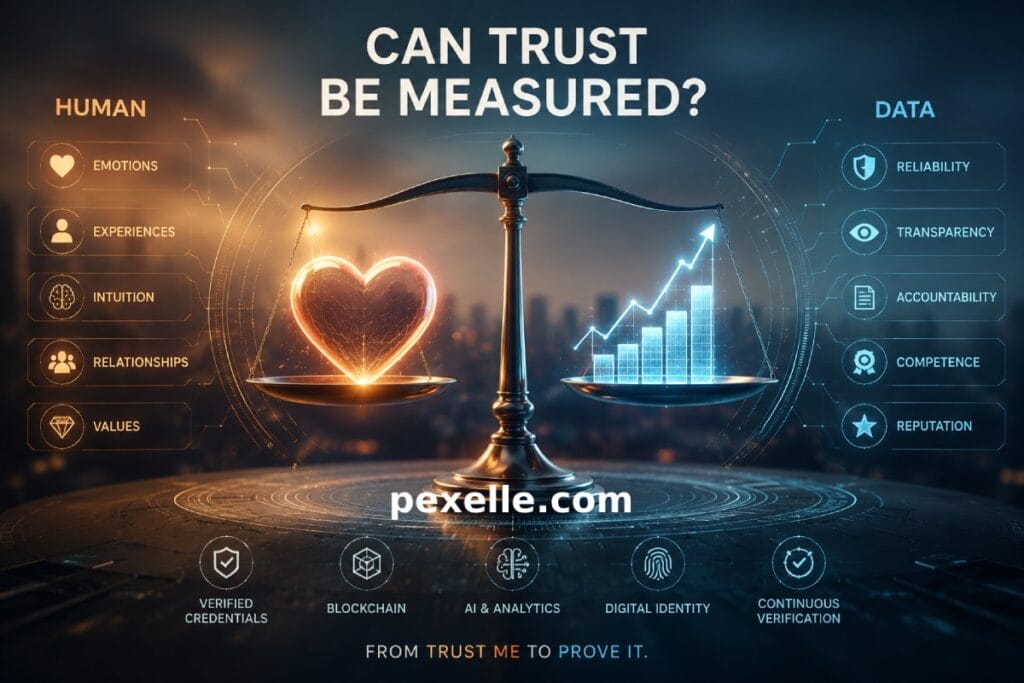
Is Trust Quantifiable in the Digital Age?
Introduction
Trust is one of humanity’s oldest and most valuable assets. Every relationship, transaction, organization, and society depends on it. We trust doctors with our health, banks with our savings, employers with our careers, and increasingly, artificial intelligence with our decisions.
Yet trust has traditionally been treated as something subjective. It is often described as a feeling, intuition, or personal judgment rather than something that can be objectively evaluated.
As digital systems become responsible for financial transactions, identity verification, hiring, education, healthcare, and autonomous decision making, relying solely on intuition is becoming increasingly risky.
This raises an important question:
Can trust actually be measured?
The answer is both fascinating and challenging. While trust itself is emotional and contextual, many of the signals that create trust can indeed be measured.
The future does not belong to systems that simply ask people to trust them. It belongs to systems that can continuously demonstrate why they deserve trust.
What Is Trust?
Trust is the confidence that another person, organization, or system will behave as expected, even when uncertainty exists.
It generally answers questions such as:
- Will this person keep their promise?
- Will this company protect my data?
- Will this AI produce reliable answers?
- Will this freelancer deliver quality work?
- Can this information be believed?
Trust always exists under uncertainty.
If outcomes were perfectly predictable, trust would not be necessary.
Why Measuring Trust Has Been Difficult
Trust is influenced by many human factors:
- Personal experiences
- Culture
- Reputation
- Communication
- Transparency
- Consistency
- Emotions
- Risk tolerance
Two people can observe identical behavior yet assign very different levels of trust.
For decades, this subjectivity made trust appear impossible to quantify.
However, modern technology changes this perspective.
Rather than measuring emotions directly, we can measure the behaviors that consistently produce trust.
Trust Is Built From Evidence
Every trustworthy relationship leaves behind evidence.
Examples include:
- Successful project deliveries
- Verified educational achievements
- Professional certifications
- Customer satisfaction
- Secure transactions
- Consistent communication
- Ethical behavior
- Independent audits
- Peer endorsements
- Long term reliability
Instead of asking:
“Do you trust me?”
Future systems increasingly ask:
“Can I prove why you should trust me?”
Evidence transforms trust from opinion into observable reality.
Components of Measurable Trust
A measurable trust model can evaluate multiple dimensions simultaneously.
1. Reliability
How consistently does someone fulfill commitments?
Possible indicators:
- Delivery rate
- Deadline adherence
- Service uptime
- Failure frequency
- Repeat success rate
Consistency is one of the strongest predictors of trust.
2. Competence
Can the individual actually perform the required task?
Indicators may include:
- Verified certifications
- Practical assessments
- Portfolio quality
- Years of experience
- Skill validation
- Independent testing
Competence reduces uncertainty.
3. Integrity
Does behavior remain ethical even when nobody is watching?
Possible evidence:
- Policy compliance
- Security history
- Audit records
- Legal violations
- Transparency reports
- Conflict of interest disclosures
Integrity creates long term confidence.
4. Transparency
Trust grows when information is visible.
Transparent organizations openly share:
- Decision processes
- Data sources
- Pricing
- Security policies
- AI model limitations
- Performance metrics
Hidden processes reduce confidence.
5. Accountability
Can actions be traced?
Accountability requires:
- Immutable logs
- Digital signatures
- Identity verification
- Version history
- Decision records
Without accountability, trust cannot be verified.
6. Reputation
Reputation represents collective historical experience.
Traditional examples include:
- Reviews
- Ratings
- Recommendations
- References
Modern reputation systems increasingly require verified evidence instead of anonymous opinions.
AI and Trust Measurement
Artificial intelligence introduces entirely new trust challenges.
Users now ask:
- Is this output factual?
- Is it biased?
- Was the training data appropriate?
- Can results be reproduced?
- Is the reasoning explainable?
- Can mistakes be corrected?
Future AI systems may receive trust scores based on:
- Accuracy
- Hallucination rate
- Explainability
- Data provenance
- Privacy protection
- Security compliance
- Human oversight
- Continuous evaluation
AI itself will increasingly be evaluated through measurable trust indicators.
Blockchain and Verifiable Trust
Blockchain technology contributes an important principle:
Trust through verification instead of central authority.
Immutable records provide evidence for:
- Ownership
- Transactions
- Credentials
- Supply chains
- Identity
- Certifications
However, blockchain only guarantees that records have not changed.
It does not guarantee that the original information was true.
Trust still depends on the quality of the evidence being recorded.
Reputation Is Not the Same as Trust
Many platforms confuse popularity with trustworthiness.
High follower counts do not necessarily indicate:
- Expertise
- Honesty
- Reliability
- Competence
Similarly:
- Viral content is not automatically accurate.
- Influencers are not automatically experts.
- High ratings may be manipulated.
True trust requires verified evidence, not just public attention.
Measuring Trust in Organizations
Companies increasingly evaluate trust through measurable indicators such as:
- Customer retention
- Employee satisfaction
- Security incidents
- Regulatory compliance
- Product quality
- Delivery reliability
- Privacy protection
- Response times
- Audit outcomes
These metrics provide objective signals that reflect organizational trustworthiness.
Measuring Trust in Individuals
Future professional identities may include continuously updated trust profiles based on verified accomplishments rather than static résumés.
Such profiles could include:
- Verified skills
- Project outcomes
- Educational credentials
- Client feedback
- Professional contributions
- Certifications
- Community participation
- Continuous learning
Instead of saying:
“I am experienced.”
Professionals will increasingly demonstrate:
“Here is verified evidence of my experience.”
The Role of Continuous Verification
Trust should not be treated as permanent.
People change.
Organizations evolve.
Skills improve.
Policies shift.
Therefore, trust measurement should also evolve continuously.
Modern trust systems are moving toward real time verification instead of one time validation.
This creates dynamic trust rather than static trust.
Challenges of Measuring Trust
Although measurable trust offers enormous benefits, significant challenges remain.
Privacy
Collecting evidence must respect individual privacy and data ownership.
More data does not automatically produce better trust.
Responsible governance is essential.
Bias
Poor measurement systems may reinforce existing inequalities.
Trust algorithms must avoid unfair discrimination.
Transparent methodologies are critical.
Context
A highly trusted surgeon may not be a trusted software engineer.
Trust is context dependent.
Measurement systems must evaluate trust within the relevant domain.
Manipulation
Whenever metrics exist, some individuals attempt to optimize the score instead of improving genuine behavior.
Future trust systems must prioritize authentic evidence over easily manipulated signals.
The Future of Trust
The next generation of digital infrastructure will likely combine:
- Artificial Intelligence
- Blockchain
- Digital Identity
- Verifiable Credentials
- Privacy-Preserving Technologies
- Reputation Networks
- Continuous Skill Verification
Together, these technologies can create trust ecosystems where confidence is earned through transparent, verifiable evidence rather than assumptions.
The goal is not to replace human judgment but to support it with reliable information.
Conclusion
Trust may never be reduced to a single number because it is influenced by human emotions, relationships, context, and values.
However, the behaviors that inspire trust can increasingly be measured, verified, and continuously updated.
The future will belong to organizations, professionals, AI systems, and digital platforms that do not merely claim to be trustworthy but consistently provide evidence that they are.
In an increasingly connected world, trust is evolving from a subjective feeling into an evidence based asset.
Those who can measure, verify, and maintain trust transparently will become the most valuable participants in tomorrow’s digital economy.
Source : Medium.com