
The Future of Work Depends on Finding the People We Have Not Yet Learned to See.
The Global Talent Paradox
The world is full of people capable of extraordinary things. Engineers who never received the right degree. Developers whose skills were built outside traditional institutions. Creative thinkers whose potential has never been recognized. Professionals who have spent years solving complex problems but remain invisible to the organizations that need them most.
At the same time, companies struggle to find qualified people. Industries face persistent skill shortages. Recruitment teams search through thousands of applications, while talented individuals remain unemployed, underemployed, or disconnected from opportunities that match their capabilities.
Something does not add up.
If the world has so much talent, why is finding it still so difficult?
Perhaps the problem is not a shortage of human capability. Perhaps the problem is the infrastructure we use to discover, evaluate, and connect that capability.
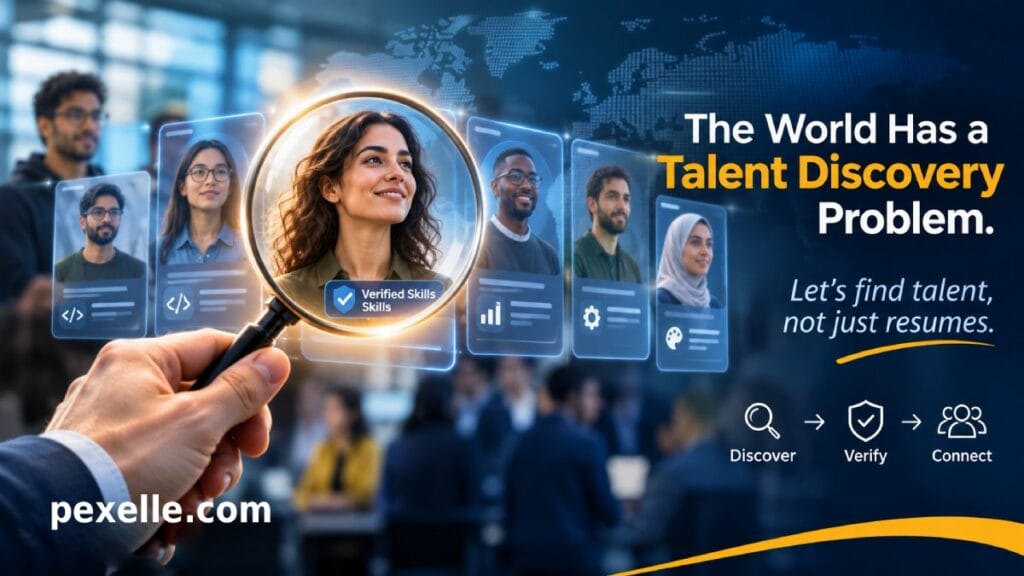
The world does not simply have a talent shortage. It has a talent discovery problem.
The Illusion of a Talent Shortage
When organizations cannot find the right people, the immediate conclusion is often that the required talent does not exist.
But what if the talent exists in places traditional systems are not designed to look?
A highly skilled software developer may have learned through independent projects rather than a university. A construction professional may possess exceptional practical knowledge that is not reflected in formal qualifications. A cybersecurity expert may have developed critical capabilities through years of personal research and real-world experience.
These individuals are not necessarily unqualified.
They may simply be difficult to identify using conventional recruitment methods.
The distinction is fundamental.
A talent shortage suggests that the world needs to produce more capable people. A talent discovery problem suggests that the world needs better systems for recognizing the capabilities that already exist.
Both challenges matter, but they require very different solutions.
If we focus exclusively on producing more talent while ignoring the mechanisms that discover and connect existing talent, we risk continuously overlooking the people who could solve today’s problems.
The Resume Was Never Designed to Reveal Human Potential
For decades, the resume has served as one of the primary tools for professional discovery.
It provides a structured summary of education, employment history, certifications, and professional achievements.
However, a resume is fundamentally a representation of a person, not a complete measurement of their capabilities.
It tells us where someone worked, but not necessarily what they can do.
It tells us what someone studied, but not how effectively they can apply that knowledge.
It tells us what someone claims to have accomplished, but often provides limited evidence of their actual contribution.
Two individuals may have nearly identical resumes while possessing dramatically different capabilities.
Conversely, two people with entirely different professional histories may be equally capable of performing the same task.
The traditional resume creates a dangerous assumption: that professional history is a reliable proxy for professional ability.
In an increasingly dynamic economy, that assumption becomes harder to defend.
The future of talent discovery requires a shift from interpreting professional backgrounds to understanding demonstrated capabilities.
The question must evolve from “Where have you worked?” to “What can you actually do?”
Talent Is Distributed. Opportunity Is Not.
Human capability is not concentrated in a handful of universities, technology hubs, or major corporations.
It exists everywhere.
In emerging economies. In remote communities. In people changing careers. In individuals who never had access to prestigious institutions. In professionals whose skills evolved faster than their job titles.
Yet access to opportunity remains heavily influenced by visibility, networks, geography, credentials, and institutional recognition.
A talented individual may never encounter the right employer.
An organization may never discover the right candidate.
A professional may possess the exact skills required for an opportunity but lack the connections necessary to be considered.
This creates a structural inefficiency in the global labor market.
The problem is not that capability is absent. It is that capability and opportunity frequently exist in separate systems.
The internet connected people to information.
Professional networks connected people to relationships.
But the next evolution of professional infrastructure must connect people to opportunities based on what they can demonstrably contribute.
The Cost of Invisible Talent
Undiscovered talent is not merely an individual problem. It is an economic and organizational problem.
When capable individuals remain invisible, several consequences emerge.
Organizations lose access to better candidates.
Recruitment processes that prioritize familiar credentials and conventional career paths may exclude people who could outperform traditional candidates.
Individuals lose opportunities to contribute.
People who cannot translate their capabilities into recognizable professional signals may struggle to access work that reflects their actual potential.
Innovation becomes unnecessarily restricted.
When organizations repeatedly recruit from the same talent pools, they limit the diversity of perspectives, experiences, and problem-solving approaches available to them.
Human potential remains underutilized.
The global economy invests enormous resources in education, training, and professional development. Yet the value of these investments is reduced when the resulting capabilities cannot be effectively identified and connected to demand.
The consequences extend beyond recruitment.
Talent discovery influences innovation, economic mobility, productivity, collaboration, and the ability of societies to respond to complex challenges.
A world that cannot effectively discover its talent is a world that cannot fully utilize its human potential.
The Missing Layer: A Capability Graph
Imagine a professional ecosystem where every individual can build a continuously evolving representation of their capabilities.
Not simply a profile.
Not merely a list of skills.
A structured capability graph.
Such a system would connect skills to evidence, evidence to projects, projects to contributions, and contributions to measurable impact.
Consider a professional who claims expertise in data engineering.
Instead of relying exclusively on a job title or certification, an organization could explore:
- The specific skills the individual has demonstrated.
- Projects where those skills were applied.
- Evidence supporting the claimed capabilities.
- Contributions made within collaborative environments.
- Relevant achievements and outcomes.
- The relationships between their capabilities and the requirements of a particular opportunity.
This changes the nature of professional discovery.
Talent is no longer represented as a static document. It becomes a dynamic network of capabilities and evidence.
A capability graph could help identify individuals whose demonstrated skills align with an opportunity, even when their career histories appear unconventional.
It could reveal connections that traditional recruitment systems would never recognize.
For example, a professional with experience in logistics, data analysis, and process automation might possess an unusually strong capability combination for a supply-chain optimization role.
A conventional recruitment system might classify that person according to their previous job title.
A capability-based system could recognize the relevance of their combined skills.
The difference is not simply better search.
It is a fundamentally different way of understanding human potential.
From Skill Claims to Verifiable Evidence
Discovering talent requires more than identifying people who list the right skills.
It requires a reliable way to distinguish demonstrated capability from unsupported claims.
In a world increasingly influenced by AI-generated resumes, automated applications, and digitally fabricated professional content, trust becomes a critical component of talent discovery.
A professional skill should ideally be connected to meaningful evidence.
That evidence might include:
- Completed projects.
- Technical assessments.
- Work samples.
- Verified contributions.
- Professional attestations.
- Demonstrated performance in relevant environments.
Different forms of evidence provide different levels of confidence.
A certification may demonstrate knowledge. A project may demonstrate practical application. A verified contribution may demonstrate the ability to deliver value within a real environment.
No single signal should automatically define an individual’s entire capability.
The objective is to construct a more complete and contextual understanding of professional ability.
This is where verifiable professional identity becomes increasingly important.
The future of talent discovery should not depend entirely on what people say about themselves. It should increasingly incorporate what they can demonstrate, what others can validate, and what they have actually contributed.
Trust should be built around evidence, not appearances.
AI Can Discover Connections. Humans Must Define Value.
Artificial intelligence introduces a powerful new dimension to talent discovery.
AI can analyze complex skill relationships, identify patterns across professional experiences, and uncover potential matches between individuals and opportunities.
It can recognize that a person with experience in one domain may possess capabilities relevant to another.
It can help organizations understand the skills required for emerging roles and identify professionals whose experience may be transferable.
However, AI-based talent discovery also introduces serious risks.
A system trained on historical recruitment decisions may reproduce existing biases. Automated ranking can create false confidence. Poorly designed algorithms may prioritize individuals who already have strong digital visibility rather than those with genuine capability.
The objective should not be to replace human judgment with automated ranking.
It should be to improve the quality of discovery.
AI should help reveal opportunities that humans might otherwise overlook. Evidence should help establish credibility. Context should help determine relevance. Human judgment should remain essential when evaluating complex professional decisions.
Technology should expand the talent pool, not create another invisible barrier.
The Future of Recruitment Is Not Better Filtering
Traditional recruitment has largely been built around a filtering process.
Organizations publish job descriptions. Candidates submit applications. Recruitment systems filter resumes. Hiring teams evaluate the remaining candidates.
The process begins with people searching for opportunities.
But what if the future begins with opportunities searching for capability?
Imagine an organization defining the capabilities required to solve a specific problem.
Instead of searching exclusively for candidates with matching job titles, the organization could discover professionals whose demonstrated skills, experiences, and contributions align with the actual requirements.
A person who has never held the exact title could still emerge as a highly relevant candidate.
A professional from another industry could become visible because their capabilities are transferable.
An individual with an unconventional background could be recognized because their evidence is stronger than their credentials.
This does not eliminate the importance of experience, education, or professional qualifications.
It changes their role.
They become valuable signals within a broader capability assessment rather than the exclusive gateways to opportunity.
The future of recruitment should be less about eliminating candidates and more about discovering the right people.
Building a More Connected Capability Economy
A capability-based economy requires a new kind of professional infrastructure.
An infrastructure capable of connecting:
Skill → Evidence → Contribution → Impact → Opportunity
Skills describe what an individual can do.
Evidence demonstrates the credibility of those capabilities.
Contributions reveal how those capabilities have been applied.
Impact illustrates the value created.
Opportunities connect those capabilities to meaningful demand.
When these elements become interconnected, professional discovery can become more intelligent, transparent, and effective.
Individuals gain a better way to communicate their capabilities.
Organizations gain access to broader and more relevant talent pools.
Communities gain the ability to recognize and mobilize expertise.
The labor market gains a more precise understanding of the relationship between human capability and economic opportunity.
This is not simply a new recruitment model.
It is a new way of organizing professional value.
Pexelle: Making Human Capability Discoverable
At Pexelle, we believe the next generation of professional infrastructure should be built around verifiable human capability.
The world needs more than digital resumes and professional profiles.
It needs systems that help people demonstrate what they can do, establish credible evidence of their skills, and connect those capabilities to relevant opportunities.
Pexelle is built around the principle that professional value should be understood through a richer combination of skills, evidence, contributions, and impact.
A person’s potential should not be limited by the visibility of their job title.
Their capabilities should not disappear because they followed an unconventional career path.
Their professional identity should be capable of evolving as they learn, demonstrate new skills, and contribute to meaningful work.
The objective is to create a more connected relationship between human capability and opportunity.
Because discovering talent should not be an advantage reserved for organizations with the largest recruitment budgets or individuals with the strongest professional networks.
It should become an essential capability of the global professional ecosystem.
The Question We Should Be Asking
The world is entering an era in which technology is transforming the nature of work, professional skills are evolving rapidly, and the boundaries between traditional occupations are becoming increasingly fluid.
In this environment, the ability to discover human capability becomes more important than ever.
We cannot afford to define talent exclusively through historical job titles.
We cannot afford to overlook capable individuals because their skills were developed outside traditional institutions.
And we cannot afford to treat professional visibility as a substitute for demonstrated ability.
The next great challenge of the global economy may not be creating more talent.
It may be learning how to recognize the talent we already have.
The question is no longer simply how to educate more people, train more professionals, or create more jobs.
The question is:
How do we build a world where the right capabilities can be discovered, trusted, and connected to the right opportunities?
Because the future of work will not be determined only by how many talented people exist.
It will be determined by how effectively we discover them.
And perhaps the most valuable professional of tomorrow is not someone the world has yet to create.
Perhaps it is someone the world has simply failed to discover.
Pexelle
Verifiable Humans. Discoverable Skills. Meaningful Opportunities.
The future of professional identity is not just about who you are.
It is about what you can prove, what you can contribute, and what you can become.
Source : Medium.com