Why Social Media Understands Our Interests Better Than Our Abilities
Introduction: The Paradox of Being Known Online
Every day, millions of people interact with digital platforms that seem to understand them remarkably well.
Social media algorithms know which videos capture our attention, which topics make us stop scrolling, which products we might purchase, and which creators we prefer to follow. They learn from our clicks, searches, likes, comments, and viewing habits. Over time, they construct increasingly sophisticated profiles of our interests and behaviors.
The result is a digital experience that often feels deeply personal.
But there is a fundamental question hiding beneath this technological achievement:
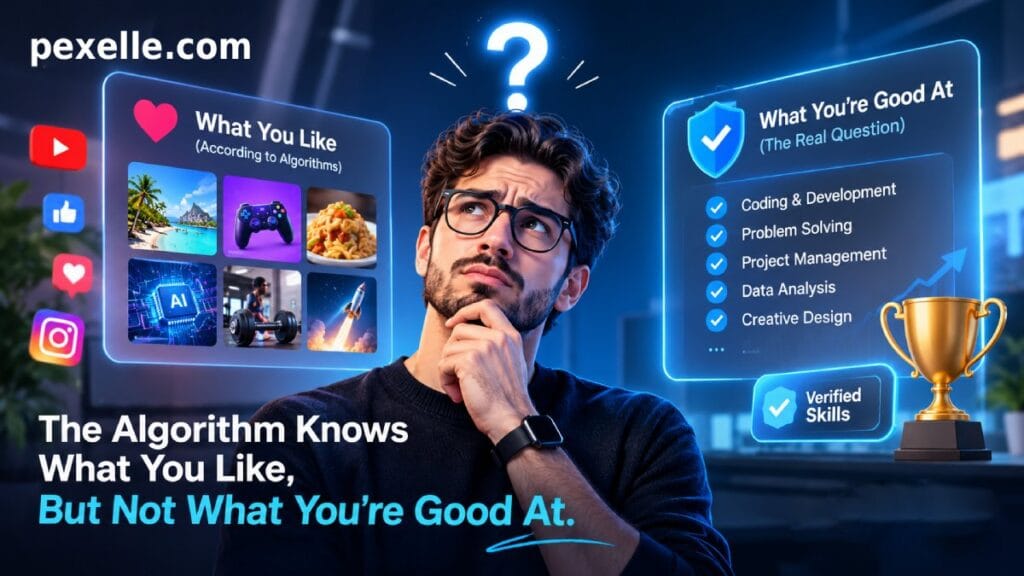
If algorithms can understand what we like with extraordinary precision, why do they still struggle to understand what we are actually good at?
A person may spend hours watching videos about software development without being able to write a single functional application. Another person may rarely engage with programming content online yet possess exceptional coding skills developed through years of practical experience.
One is visible to the algorithm. The other may remain invisible.
This distinction reveals one of the most important limitations of today’s digital identity systems: they are increasingly effective at understanding human attention, but far less effective at understanding human capability.
And as artificial intelligence transforms the way people learn, work, and compete for opportunities, this gap is becoming more significant than ever.
1. The Internet Was Built to Understand Attention, Not Ability
The modern internet operates on a powerful economic principle: attention has value.
Social media platforms are designed to identify the content that keeps users engaged. Their recommendation systems analyze behavioral signals to predict what a person is likely to watch, read, share, or interact with next.
These systems are extraordinarily effective at answering questions such as:
- What topics interest this person?
- Which content keeps them engaged?
- What are their likely preferences?
- Which communities might attract them?
- What products or services might they find appealing?
However, these questions describe preferences rather than capabilities.
Knowing that someone enjoys watching architectural videos does not establish that they can design a building.
Knowing that someone frequently reads financial analysis does not demonstrate their ability to manage investments.
Knowing that someone follows cybersecurity experts does not prove they can identify vulnerabilities or secure a network.
Interest is a signal of attention. Ability is a demonstration of performance.
The distinction is simple, but its consequences are enormous.
The digital systems that shape our online experiences have become increasingly sophisticated at predicting what we want. Yet the systems responsible for evaluating what we can contribute to society remain heavily dependent on traditional credentials, professional titles, resumes, and fragmented evidence.
The internet knows what captures our attention.
It does not necessarily know what deserves our trust.
2. The Difference Between Consuming Knowledge and Demonstrating Competence
One of the most significant challenges in the digital age is distinguishing between exposure to knowledge and the ability to apply it.
The accessibility of information has transformed education. Anyone with an internet connection can explore programming, engineering, medicine, business strategy, design, or countless other disciplines.
This creates unprecedented opportunities for learning.
However, information accessibility also introduces a problem.
The ability to access knowledge is increasingly disconnected from the ability to demonstrate competence.
Consider three individuals:
Person A: The Knowledge Consumer
They follow hundreds of educational accounts, watch tutorials regularly, and maintain an impressive collection of bookmarks and learning resources.
Their digital profile suggests a strong interest in technology.
But their actual practical capabilities remain unverified.
Person B: The Credential Holder
They possess a university degree, professional certifications, and a polished resume.
Their credentials indicate that they have completed certain educational or professional requirements.
However, their current practical abilities may not fully reflect the qualifications they earned years ago.
Person C: The Demonstrated Practitioner
They have built applications, solved technical problems, completed projects, contributed to collaborative work, and produced verifiable evidence of their capabilities.
Their profile may contain fewer traditional credentials.
Yet their demonstrated performance provides meaningful insight into what they can actually do.
These three individuals represent different forms of professional identity.
The challenge is that many recruitment systems, professional networks, and digital platforms still struggle to distinguish between them.
A more effective approach would recognize that interests, credentials, and demonstrated capabilities are different forms of information.
Each has value.
But they should not be treated as interchangeable.
3. Why Real Human Ability Is So Difficult to Measure
Understanding human capability is fundamentally more complicated than understanding human preferences.
Preferences can often be inferred from repeated behavior.
Capabilities require context.
A person’s ability to perform a task may depend on several interconnected factors:
Context
A developer may be highly skilled at building scalable applications but inexperienced in embedded systems.
A designer may excel at creating digital interfaces but struggle with physical product design.
Competence is rarely universal. It is usually connected to specific tasks, environments, and expectations.
Experience
A person may have developed substantial expertise through years of practical work without obtaining formal qualifications.
Their knowledge may exist in projects, decisions, problem-solving processes, and professional contributions that never appear on a traditional resume.
Evidence
A claim of competence is not equivalent to evidence of competence.
A professional profile may contain impressive statements, but meaningful verification requires supporting information.
This could include completed projects, practical assessments, authenticated credentials, trusted references, or independently reviewed work.
Time
Capabilities evolve.
A person who was an expert in a particular technology five years ago may need to update their knowledge.
Another individual may have developed a new specialization within the last six months.
A static professional profile cannot adequately represent this continuous evolution.
Collaboration
Many valuable abilities are difficult to evaluate in isolation.
Leadership, communication, teamwork, judgment, and problem-solving frequently emerge through interactions with other people.
A single test or certificate may capture only a limited part of these capabilities.
Human ability is multidimensional, contextual, and constantly changing.
This is why measuring it requires more than collecting digital activity.
It requires meaningful evidence.
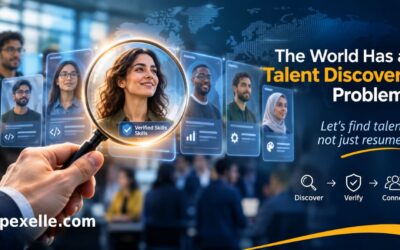
4. The Hidden Talent Problem
The consequences of this gap extend far beyond technology.
Every day, talented individuals remain overlooked because their abilities are not adequately represented by the systems used to evaluate them.
A skilled professional may lack a prestigious university degree.
An experienced worker may have developed expertise outside traditional educational institutions.
A self-taught developer may have built sophisticated software without obtaining formal certification.
A career changer may possess highly transferable skills that are difficult to communicate through conventional employment history.
A person returning to the workforce may have valuable capabilities that are no longer reflected in their most recent job title.
These individuals are not necessarily lacking ability.
They may simply lack visibility.
Traditional recruitment often relies on recognizable signals: degrees, job titles, employment history, professional networks, and institutional reputation.
These signals can be useful.
But they are incomplete.
When professional opportunities depend heavily on the visibility of credentials rather than the quality of demonstrated work, organizations risk overlooking individuals who could deliver exceptional value.
The problem is not that every credential is unreliable.
The problem is that credentials alone cannot represent the full spectrum of human potential.
The future of professional recognition must be capable of identifying talent beyond conventional boundaries.
5. Artificial Intelligence Is Making the Problem More Urgent
The rise of artificial intelligence is changing the relationship between knowledge, work, and professional competence.
AI tools can generate code, produce written content, analyze data, create designs, and assist with increasingly complex tasks.
As these capabilities become more accessible, the distinction between possessing information and applying judgment becomes even more important.
A professional may use AI to produce an impressive result.
But what does that result actually demonstrate?
- Can the person evaluate the output?
- Can they identify errors?
- Can they adapt the solution to a different environment?
- Can they explain the decisions behind the work?
- Can they take responsibility for the outcome?
These questions are becoming increasingly relevant.
In an AI-enabled world, the ability to access information may become less valuable as a standalone advantage.
The ability to apply knowledge, exercise judgment, solve problems, and produce reliable outcomes may become significantly more important.
This does not mean AI-assisted work should be considered less valuable.
Quite the opposite.
AI collaboration can itself be an important professional capability.
However, the evidence of competence should reflect the actual contribution, the context of the work, and the individual’s ability to understand and validate the result.
The future of professional credibility will depend not only on what people know, but on what they can demonstrably accomplish.
6. From Interest-Based Profiles to Evidence-Based Professional Identity
Imagine a digital professional identity that goes beyond the conventional resume.
Instead of simply listing skills, qualifications, and job titles, it could present a structured record of demonstrated capabilities.
A professional’s profile might include:
- Verified educational qualifications.
- Practical assessments linked to specific skills.
- Evidence from completed projects.
- Authenticated professional contributions.
- Trusted endorsements with clear context.
- Relevant work samples.
- Skill development over time.
- The source, date, and methodology of each verification.
Such a system would not need to reduce a human being to a single score.
In fact, doing so could introduce new problems.
Human capability is too complex to be represented accurately by one universal ranking.
Instead, professional identity could become a collection of contextual, evidence-supported signals.
For example, an employer looking for a cybersecurity specialist could evaluate verified evidence of vulnerability assessment, incident response, and security architecture.
A company hiring a product designer could examine demonstrated experience in user research, interface design, accessibility, and prototyping.
A person seeking a software engineering role could present evidence of coding ability, system design, collaborative development, and problem-solving.
The evaluation would become more closely aligned with the actual requirements of the opportunity.
This approach would not eliminate interviews, professional judgment, or traditional credentials.
It would provide additional information that makes those decisions more informed.
7. Pexelle: Making Human Capabilities More Visible
This is where a new approach to professional identity becomes necessary.
Pexelle is built around the idea that professional capabilities should be supported by meaningful evidence.
Instead of relying exclusively on claims, titles, or online activity, Pexelle aims to help individuals create a more verifiable representation of their skills and professional development.
The underlying concept is straightforward:
Your professional identity should reflect what you can demonstrate, not merely what you claim or what an algorithm assumes about you.
A more evidence-oriented professional ecosystem can create value for multiple groups.
For Individuals
People can build a clearer representation of their capabilities through verifiable skills and supporting evidence.
This can help them communicate their value beyond traditional resumes and educational backgrounds.
For Employers
Organizations can gain access to additional information about candidates’ demonstrated abilities.
This can support more informed recruitment decisions while reducing unnecessary dependence on superficial signals.
For Educators
Learning institutions and training providers can connect educational achievements with evidence of practical competence.
This can help make learning outcomes more transparent.
For Professional Communities
Communities can contribute to the recognition of expertise through contextual assessments, professional contributions, and trusted verification.
The objective is not to create another platform that measures how much attention a person receives.
It is to create a professional environment where demonstrated ability can become more visible, discoverable, and credible.
Of course, verification itself must be designed carefully.
Evidence should be relevant, proportionate, and transparent. Verification methods should account for their limitations, and individuals should retain meaningful control over their professional information.
A trustworthy system must recognize ability without turning professional identity into a mechanism for excessive surveillance.
8. The Next Evolution of Digital Identity
The internet has already transformed how people communicate, learn, and build relationships.
Social media introduced a new form of identity based on interests, communities, and personal expression.
Professional networks introduced a digital representation of employment history, qualifications, and career connections.
The next evolution may involve a more meaningful representation of human capability.
Consider the difference:
An interest-based profile tells the world what attracts your attention.
A credential-based profile tells the world what qualifications you have obtained.
An evidence-based professional identity provides insight into what you have demonstrated the ability to accomplish.
These identities are not mutually exclusive.
They can complement one another.
Interests help people discover opportunities.
Credentials communicate educational and professional achievements.
Evidence helps establish the relationship between a person’s claims and their demonstrated performance.
Together, they can provide a richer understanding of an individual.
The challenge for the next generation of professional platforms is to connect these dimensions without confusing them.
Conclusion: The Algorithm Can Predict Your Preferences. Can It Recognize Your Potential?
We are living in a world where algorithms can predict our interests with extraordinary accuracy.
They can recommend the next video we might watch, the next product we might purchase, and the next topic that might capture our attention.
Yet identifying genuine human capability remains a fundamentally different challenge.
A person’s potential cannot be reliably inferred from their browsing history.
Their competence cannot be established by the content they consume.
Their professional value should not be determined exclusively by the institutions they attended or the titles they have held.
As artificial intelligence continues to reshape the global workforce, the ability to distinguish between attention, knowledge, credentials, and demonstrated competence will become increasingly important.
The next generation of digital platforms must move beyond simply understanding what people like.
They must create better ways to understand what people can do.
Because the most valuable person in the room may not be the one with the most followers, the most impressive profile, or the most recognizable credentials.
It may be the person whose abilities have never been properly seen.
And perhaps the most important question for the future of the internet is not:
What does the algorithm know about you?
It is:
What can the world actually verify about your ability?
Pexelle believes that making human capabilities more visible through meaningful evidence is an important step toward a more credible, transparent, and opportunity-driven professional ecosystem.
The future should not reward attention alone.
It should recognize ability.
About Pexelle
Pexelle is building an evidence-oriented professional ecosystem designed to make skills, capabilities, and professional achievements more visible and verifiable.
By connecting professional identity with meaningful evidence, Pexelle aims to support a future in which opportunities are more closely aligned with demonstrated human ability.
Suggested SEO Metadata
SEO Title: The Algorithm Knows What You Like, But Not What You’re Good At | Pexelle
Meta Description: Social media algorithms understand our interests, but can they recognize real human ability? Explore the future of evidence-based professional identity, verified skills, and talent discovery with Pexelle.
Focus Keyword: Evidence-Based Professional Identity
Related Keywords:
- Verified Human Skills
- Digital Professional Identity
- Skill Verification
- Human Capability
- Talent Discovery
- AI and the Future of Work
- Verifiable Skills
- Professional Credibility
Source : Medium.com