
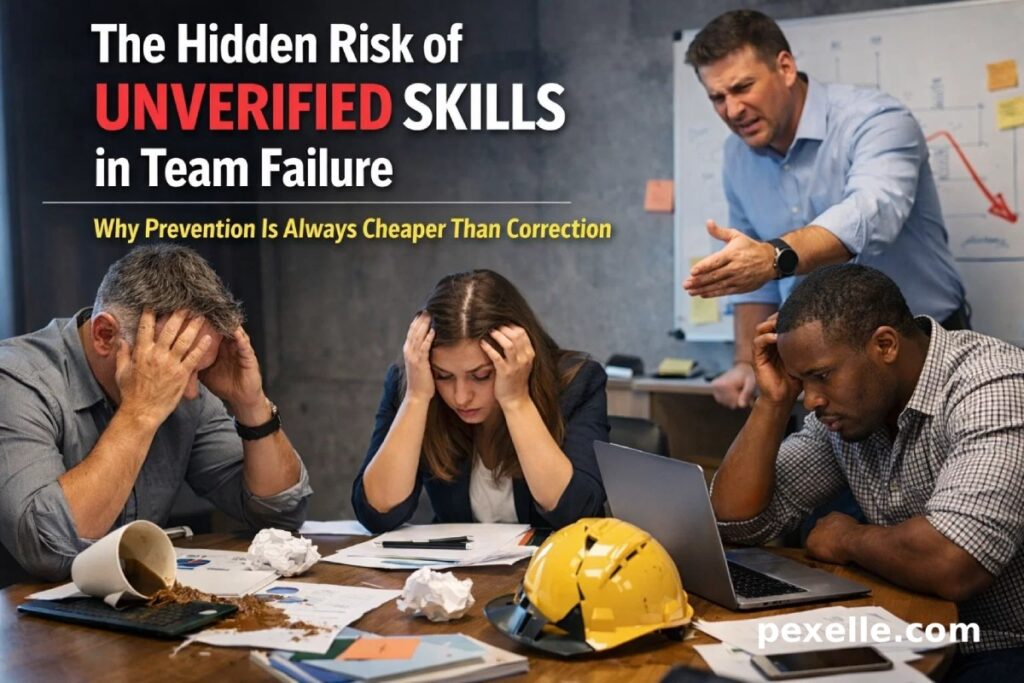
Why Prevention Is Always Cheaper Than Correction
Introduction: The Illusion of Capability
In modern organizations, especially fast-growing startups and high-pressure teams, speed often takes priority over validation. Hiring decisions are made quickly, responsibilities are assigned optimistically, and assumptions about individual capabilities go largely unchallenged. On the surface, everything appears efficient. But beneath that speed lies a silent risk: unverified skills.
Unverified skills refer to abilities that are assumed rather than proven. These may come from self-declarations, poorly evaluated resumes, or even internal promotions without proper assessment. While this may seem harmless at first, it creates a fragile foundation that can destabilize entire teams over time.
The Core Problem: Assumption-Based Execution
When teams operate based on assumed competencies, execution becomes unpredictable. Tasks are assigned under the belief that individuals are capable, but without validation, this belief can quickly break down.
This leads to:
- Misaligned expectations
- Rework and inefficiencies
- Increased dependency on a few competent individuals
- Hidden bottlenecks that emerge under pressure
In early stages, these issues are often masked by effort and improvisation. However, as complexity increases, the cracks become visible and costly.
The Compounding Effect: Small Gaps, Large Failures
One of the most dangerous aspects of unverified skills is how small gaps compound over time. A developer who lacks deep understanding of system architecture may still deliver features, but those features introduce technical debt. A manager with weak decision-making skills may keep operations running, but creates long-term strategic misalignment.
These gaps accumulate silently until they reach a tipping point, where:
- Systems become unstable
- Teams lose trust in each other
- Delivery timelines collapse
- Recovery becomes exponentially harder
At this stage, the problem is no longer individual, it becomes systemic.
The Cost of Correction: A Delayed Explosion
Correcting unverified skill issues is significantly more expensive than preventing them. By the time problems are identified, they have already spread across processes, codebases, and team dynamics.
Correction often requires:
- Replacing or retraining team members
- Refactoring systems or rebuilding components
- Reorganizing team structures
- Restoring lost trust and morale
These actions are not only financially expensive but also time-consuming and psychologically draining for the organization.
Prevention as a Strategy: Building Verified Foundations
Prevention is fundamentally about verification before dependency. Instead of assuming capability, organizations must create systems that validate skills before assigning critical responsibilities.
Effective prevention strategies include:
- Skill-based assessments instead of resume-based hiring
- Real-world task simulations during recruitment
- Continuous skill verification within teams
- Transparent evidence of capability (projects, outputs, peer validation)
This shifts the culture from assumption to evidence.
Cultural Impact: From Ego to Evidence
One of the deeper benefits of skill verification is cultural transformation. In environments where skills are verified, individuals are evaluated based on demonstrated ability rather than perception or hierarchy.
This leads to:
- Higher accountability
- Reduced internal politics
- Clearer ownership of responsibilities
- Faster identification of skill gaps
Teams become more resilient because their structure is based on reality, not assumption.
The Economic Argument: Prevention vs Correction
From an economic perspective, prevention has a dramatically higher return on investment. The cost of validating a skill early is minimal compared to the cost of fixing failures later.
Consider:
- A few hours of assessment vs months of rework
- A structured hiring process vs replacing a key team member
- Early feedback vs late-stage crisis management
Organizations that invest in prevention operate with lower long-term risk and higher efficiency.
The Role of Technology: Enabling Scalable Verification
Modern platforms and systems can play a key role in solving this problem at scale. By leveraging data, structured skill frameworks, and decentralized validation mechanisms, organizations can create transparent and verifiable skill ecosystems.
This allows:
- Skills to be continuously updated and validated
- Teams to be built based on real capabilities
- Organizations to reduce reliance on subjective evaluation
In such systems, skills become assets that are measurable, comparable, and trustworthy.
Conclusion: Building Teams That Don’t Collapse
Team failure is rarely caused by a single mistake. It is often the result of accumulated assumptions that were never challenged. Unverified skills represent one of the most underestimated risks in modern organizations.
By shifting focus from correction to prevention, companies can build teams that are not only efficient but also resilient. The principle is simple but powerful:
It is always cheaper to verify a skill before relying on it than to repair the damage after failure.
In a world where execution speed defines success, the real competitive advantage lies not just in moving fast, but in building on verified foundations.
Source : Medium.com