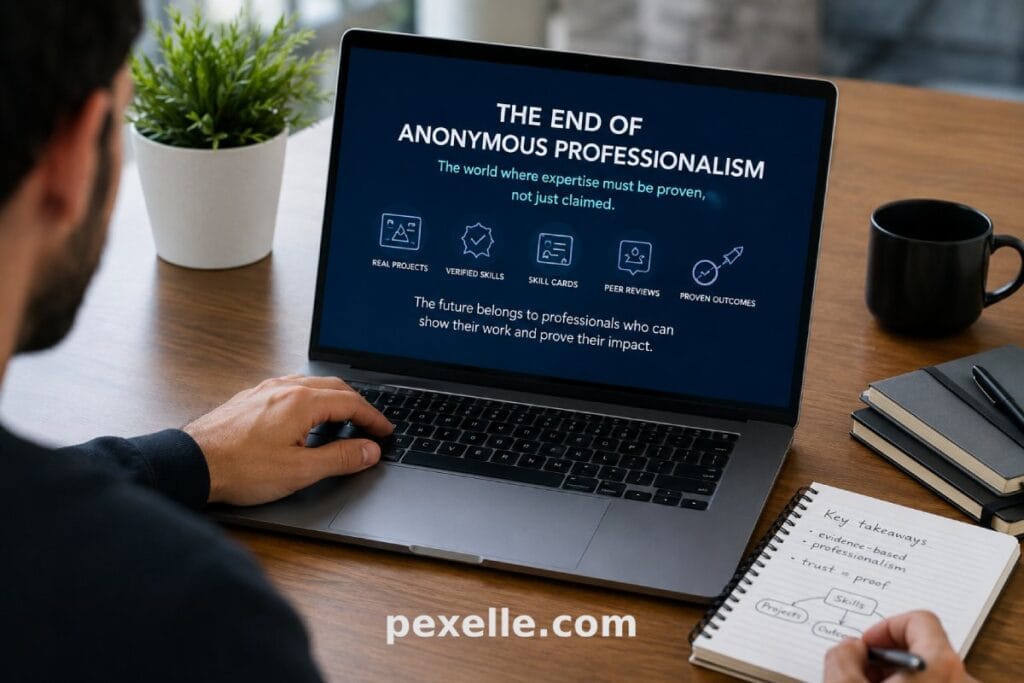
The World Where Expertise Must Be Proven, Not Just Claimed
Introduction: A New Era of Professional Trust
For decades, professional identity has mostly been built on resumes, job titles, company names, certificates, and personal claims. A person could say they were a strategist, developer, designer, consultant, marketer, analyst, or project manager, and the world often had limited ways to verify the depth, quality, and reality of that claim.
This created a professional environment where words often moved faster than evidence. People could present themselves as experts without showing how they think, what they have built, what problems they have solved, or whether their skills had ever been tested in real situations.
But that world is changing.
We are entering a new era where anonymous professionalism is coming to an end. In this new world, expertise will not be accepted simply because someone says they have it. It will need to be demonstrated, verified, and supported by real evidence.
1. The Problem with Claim-Based Professional Identity
Traditional professional identity has always had a weakness: it depends heavily on self-reporting.
A resume is usually written by the person who wants the opportunity. A LinkedIn profile is usually shaped by personal branding. A job title may sound impressive, but it does not always reveal what the person actually did. A certificate may show that someone completed a course, but not necessarily that they can apply the knowledge in real-world conditions.
This has created a gap between claimed expertise and proven capability.
Someone may list “leadership” as a skill, but there may be no evidence of how they handled conflict, guided a team, or made difficult decisions. Someone may claim to know data analysis, but there may be no visible proof of their ability to clean messy data, interpret results, or explain insights clearly. Someone may call themselves an AI expert, but their actual experience may be limited to reading articles and using tools at a surface level.
The modern economy can no longer rely only on claims. As work becomes more complex, remote, global, and technology-driven, organizations need stronger signals of trust.
2. Why Anonymous Professionalism Became Possible
Anonymous professionalism does not mean people hide their names. It means their real capabilities remain hidden behind vague labels.
This became possible because traditional systems were designed around credentials, not evidence.
Universities provide degrees. Companies provide job titles. Platforms provide profile pages. Training providers provide certificates. But very few systems show the full picture of what a person can actually do.
In many cases, professional reputation has been locked inside institutions. If someone worked at a famous company, people assumed they were highly capable. If someone had a prestigious degree, people assumed they had strong knowledge. If someone had many years of experience, people assumed they had deep expertise.
But these assumptions are not always reliable.
A person may have worked at a large company but contributed very little. Another person may have no famous employer on their resume but may have built excellent projects independently. Someone may have ten years of experience, but that does not always mean ten years of growth. It may mean one year of experience repeated ten times.
The old system often rewards signals of status more than signals of real ability.
3. The Rise of Evidence-Based Professionalism
Evidence-based professionalism is the idea that professional identity should be supported by visible, verifiable proof.
This proof can take many forms:
Skills demonstrated through real projects
Code repositories, product launches, research work, or design portfolios
Peer reviews and expert evaluations
Verified badges and skill cards
Work samples with context and outcomes
Client feedback and references
Problem-solving records
Assessments based on practical tasks
Learning progress connected to real evidence
In this model, a person is not only saying “I can do this.” They are showing how, where, and under what conditions they have done it.
This changes the meaning of professional trust.
Trust becomes less dependent on reputation by association and more dependent on transparent capability. A person does not need to rely only on the name of a company, university, or certificate provider. They can build a portable record of evidence that follows them across jobs, platforms, industries, and countries.
4. AI Is Accelerating the Need for Proof
Artificial intelligence is making the problem of claimed expertise more serious.
Today, almost anyone can produce polished writing, professional-looking presentations, business plans, code snippets, marketing strategies, and design concepts using AI tools. This creates value, but it also makes it harder to know who truly understands the work and who is simply generating impressive outputs.
In the past, polished communication was often treated as a sign of expertise. Now, polished communication is becoming easy to produce.
That means the market will shift its attention from surface-level outputs to deeper evidence.
The important questions will become:
Can this person explain their decisions?
Can they solve problems without perfect instructions?
Can they adapt when the situation changes?
Can they show a history of real work?
Can others verify their contribution?
Can they demonstrate judgment, not just production?
AI will not remove the need for professionals. But it will reduce the value of empty claims. As AI-generated content becomes common, real human credibility will depend more on traceable proof, practical judgment, and demonstrated outcomes.
5. The End of the Resume as the Main Source of Truth
The resume will not disappear completely, but it will lose power as the main source of professional truth.
A resume is a summary. It is not evidence.
It tells a story, but it does not prove the story. It lists skills, but it does not validate them. It shows past positions, but it does not always show actual contribution.
The future professional profile will likely be more dynamic. Instead of a static document, people will have evidence-rich skill profiles. These profiles may include verified achievements, work samples, project records, endorsements from credible reviewers, assessment results, and proof of continuous learning.
In this future, hiring managers will not only ask, “Where did you work?” They will ask, “What can you show?”
They will not only ask, “What is your title?” They will ask, “What problems have you solved?”
They will not only ask, “How many years of experience do you have?” They will ask, “What evidence proves your level?”
6. Professional Reputation Will Become Portable
One of the biggest changes will be the rise of portable reputation.
Today, much of a person’s reputation is trapped inside companies, schools, platforms, and private networks. When they leave a company, much of their contribution becomes invisible. When they move to another country, their previous reputation may not transfer easily. When they change industries, their skills may be misunderstood or undervalued.
Evidence-based systems can change this.
A professional should be able to carry proof of their skills across different environments. Their reputation should not disappear because they changed employers, moved countries, switched platforms, or entered a new industry.
Portable reputation gives individuals more power. It helps employers make better decisions. It helps skilled people from underrepresented or non-traditional backgrounds compete more fairly. It also reduces dependence on prestige-based shortcuts.
A person with strong evidence can be evaluated by what they have actually done, not only by where they have been.
7. The Impact on Hiring and Recruitment
Hiring has long suffered from information asymmetry. Employers often do not know whether candidates can truly do the job until after they are hired. Candidates often struggle to prove their real ability beyond interviews and resumes.
Evidence-based professionalism can improve this process.
Instead of filtering candidates only by degrees, job titles, or keywords, employers can review verified skill evidence. They can see practical examples of work. They can evaluate how a person approaches problems. They can compare candidates based on demonstrated ability rather than self-description.
This does not mean hiring will become fully automated or purely data-driven. Human judgment will still matter. Culture, communication, ethics, creativity, and adaptability are difficult to reduce to numbers.
But evidence can make hiring more honest.
It can reduce exaggeration. It can reduce bias toward famous brands. It can help employers discover capable people who might otherwise be ignored. It can also help candidates avoid being judged only by shallow signals.
8. The Impact on Education and Learning
Education will also change.
In the old model, learning often ended with a certificate. In the new model, learning must lead to evidence.
Completing a course will not be enough. Learners will need to show what they can do with the knowledge. A person studying marketing may need to show a campaign analysis, a content strategy, or performance results. A person studying software development may need to show working applications, code quality, and problem-solving ability. A person studying project management may need to show planning documents, risk analysis, and team coordination examples.
This will push education toward practical demonstration.
The best learning systems will not only teach. They will help learners build proof. They will connect lessons to projects, assessments, peer review, expert validation, and real-world outcomes.
In this future, education becomes less about collecting certificates and more about building a credible record of capability.
9. The Risk of Fake Evidence
The shift to evidence-based professionalism will also create new risks.
If evidence becomes valuable, people will try to fake it. They may use AI to generate portfolios. They may exaggerate their role in projects. They may create fake testimonials, fake badges, or fake assessments. They may copy work from others and present it as their own.
This means evidence systems must be designed carefully.
Good evidence must include context. Who created the work? What was the person’s role? What problem were they solving? What constraints existed? Who verified the result? Was the work original? Was it reviewed by someone credible? Can the timeline be trusted?
Evidence without verification can become another form of self-promotion.
The future will require stronger trust infrastructure: verified credentials, identity checks where appropriate, peer validation, audit trails, contribution tracking, expert review, and systems that make manipulation harder.
10. Privacy Still Matters
Ending anonymous professionalism does not mean ending privacy.
Professionals should not be forced to expose every detail of their work, personal life, or employment history. Some projects are confidential. Some industries require discretion. Some people may face risks if too much information is public.
The goal is not total exposure. The goal is trustworthy proof.
A good evidence-based system should allow selective disclosure. A person should be able to prove a skill without revealing sensitive company data. They should be able to show verified achievement without exposing private documents. They should be able to control what is public, what is shared with employers, and what remains private.
The future of professional trust must balance transparency with privacy.
Without privacy, evidence systems can become surveillance systems. Without evidence, professional identity remains too easy to manipulate. The right balance is selective, consent-based, verifiable proof.
11. The Role of Skill Cards, Badges, and Verified Profiles
Skill cards and badges can become important tools in this transformation, but only if they are meaningful.
A badge should not simply mean someone clicked through a course. A skill card should not simply list a skill name. These systems must connect skills to real evidence.
For example, a strong skill card could include:
The skill being demonstrated
The level of proficiency
The evidence supporting the claim
The project or task where the skill was used
The reviewer or verification method
The date of validation
The context and limitations of the evidence
This makes the skill card more than a decoration. It becomes a trust object.
Badges and skill cards can help people communicate their abilities quickly, but they must avoid becoming empty symbols. Their value depends on the quality of verification behind them.
12. Why This Matters for the Global Workforce
The end of anonymous professionalism is especially important for the global workforce.
Millions of skilled people are blocked by weak recognition systems. They may not have degrees from famous universities. They may not have worked for globally known companies. They may live in countries where local credentials are not easily trusted internationally. They may have real skills but limited access to traditional reputation networks.
Evidence-based professionalism can create a more open and fair professional economy.
A developer in Uganda, a designer in Iran, a data analyst in New Zealand, a project manager in Kenya, or a marketer in Brazil should be able to show proof of capability in a way that travels across borders.
This can help companies find talent more accurately. It can help workers access opportunities more fairly. It can reduce dependence on location, institutional prestige, and personal connections.
In a global digital economy, skills need a global language of proof.
13. The Cultural Shift: From Saying to Showing
The deeper transformation is cultural.
Professionals will need to move from saying to showing.
Instead of saying “I am experienced,” they will show the problems they have solved. Instead of saying “I am a leader,” they will show how they created clarity, supported people, and delivered outcomes. Instead of saying “I am innovative,” they will show experiments, prototypes, failures, lessons, and improvements.
This will reward people who do real work.
It will also challenge those who rely mainly on branding, vague language, and inflated claims. Professional identity will become less about appearance and more about substance.
This does not mean everyone must constantly prove themselves in a stressful way. It means the professional world will slowly build better ways to recognize real contribution.
14. Companies Will Also Need Evidence
This shift will not apply only to individuals. Companies will also need to prove their claims.
A company that says it values innovation will need to show how it supports experimentation. A company that says it values employees will need to show retention, growth, fairness, and internal mobility. A company that says it is sustainable will need evidence, not slogans. A company that claims to use AI responsibly will need governance, transparency, and auditability.
The same principle applies: claims are not enough.
As professionals become more evidence-driven, they will expect organizations to be evidence-driven too. This can create healthier markets, better hiring, stronger accountability, and less tolerance for empty corporate messaging.
15. The Future of Professional Identity
The future professional identity will likely combine several layers:
Verified skills
Real project evidence
Learning history
Peer and expert validation
Work outcomes
Ethical behavior
Reputation across communities
Portable credentials
Selective privacy controls
This identity will not be limited to one employer, one platform, or one country. It will be more flexible, more transparent, and more useful.
The best professionals will not only collect titles. They will build evidence trails.
The best platforms will not only host profiles. They will help people prove capability.
The best employers will not only search for keywords. They will evaluate real signals.
The best education systems will not only issue certificates. They will help learners create verified proof of skill.
Conclusion: Expertise Will Need a Foundation
The end of anonymous professionalism is not the end of personal branding. It is the end of unsupported professional claims.
In the coming years, the question will no longer be, “What do you say you can do?”
The question will be, “What evidence supports it?”
This shift will make the professional world more transparent, more merit-based, and more trustworthy. It will challenge empty claims, reduce dependence on prestige, and give real talent a stronger way to be recognized.
The future belongs to professionals who can connect identity with evidence, learning with proof, and reputation with real contribution.
In that future, expertise will not be something people simply declare.
It will be something they can demonstrate.
Source : Medium.com