Can AI Create a Reputation Without Real Skill?
Professional reputation used to be built slowly. A person worked on projects, solved problems, collaborated with teams, earned trust, and accumulated visible proof over time. Their reputation was not only what they claimed about themselves, but what others could observe through their work, behavior, outcomes, and consistency.
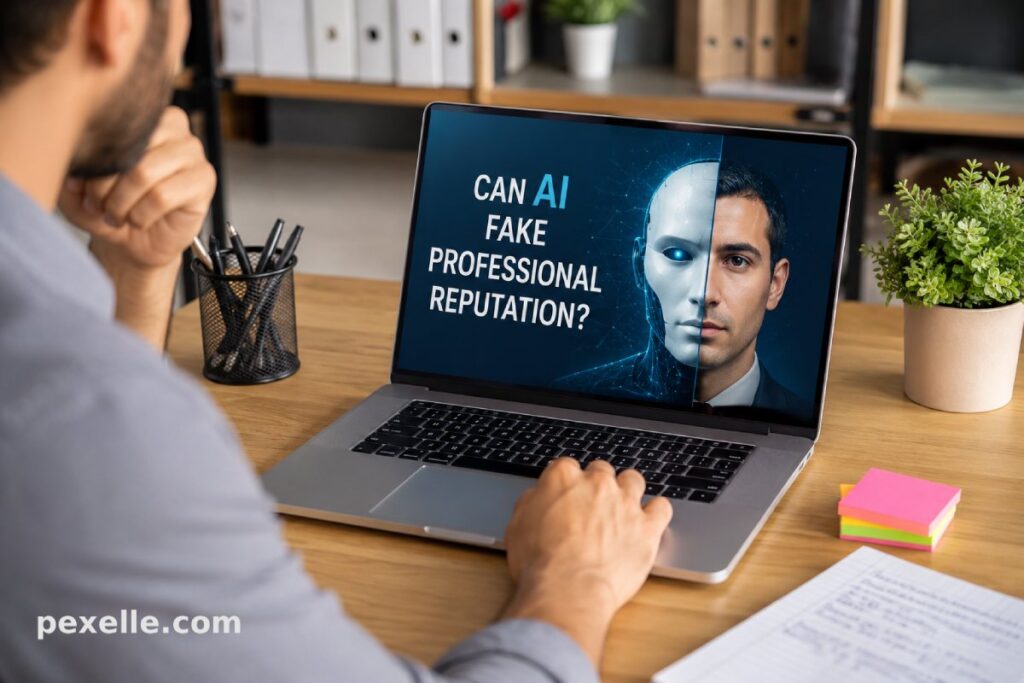
Artificial intelligence is now changing this system. AI can help people write polished resumes, generate impressive portfolios, create professional social media posts, simulate expertise in interviews, produce technical explanations, and even build convincing case studies. This raises an important question: can AI fake professional reputation?
The answer is yes, to some extent. AI can fake the appearance of reputation. But it cannot fully replace real competence, verified work, human judgment, and long-term professional trust. The real danger is not that AI will make everyone an expert. The danger is that AI can make weak evidence look strong.
The Difference Between Reputation and Reputation Signals
To understand the problem, we need to separate real reputation from reputation signals.
Real professional reputation is based on:
- actual skills
- real work history
- measurable outcomes
- trusted references
- consistent performance
- collaboration quality
- problem-solving ability
- ethical behavior
- evidence of impact
Reputation signals are the visible things people use to judge someone quickly:
- resumes
- LinkedIn profiles
- certificates
- portfolios
- GitHub repositories
- testimonials
- personal websites
- social media posts
- interview answers
- online courses completed
AI can easily improve or imitate many of these signals. It can make a person sound more experienced, more strategic, more technical, and more professional than they really are. But signals are not the same as substance.
This is where the modern reputation system becomes fragile.
How AI Can Fake Professional Reputation
AI can create fake or exaggerated professional reputation in several ways.
First, AI can generate highly polished resumes and profiles. A person with limited experience can use AI to rewrite basic responsibilities into impressive business language. For example, “helped with social media posts” can become “led multi-channel digital engagement initiatives to improve brand visibility.” The sentence may sound professional, but it may not represent real strategic ownership.
Second, AI can produce portfolio content. Someone can ask AI to create case studies, project descriptions, product concepts, design rationales, technical documentation, or business strategies. These outputs may look credible even if the person never actually completed the work.
Third, AI can help people perform better in interviews without deeper understanding. A candidate can prepare answers for common questions, generate STAR-format responses, and memorize polished explanations. This does not automatically mean they are unqualified, but it can hide the gap between communication ability and real execution ability.
Fourth, AI can create social proof. Fake testimonials, thought leadership posts, comments, recommendations, and professional updates can be generated quickly. Over time, this can create the illusion of activity, authority, and recognition.
Fifth, AI can simulate expertise in public discussions. A person can publish detailed posts about software architecture, finance, medicine, law, blockchain, AI safety, or business strategy without having meaningful experience in those fields. The writing may sound intelligent, but the person may not be able to apply the knowledge under real conditions.
Why This Is a Serious Problem
The professional world already had a trust problem before AI. Resumes were often exaggerated. Job titles were sometimes inflated. Certificates did not always prove ability. Work history did not always show actual contribution. AI makes this problem faster, cheaper, and harder to detect.
The risk is especially high in fields where reputation influences important decisions:
- hiring
- consulting
- investment
- technical leadership
- medical or legal advice
- cybersecurity
- education
- financial services
- public influence
- startup fundraising
When reputation can be manufactured, decision-makers may reward presentation instead of performance. The people who are best at using AI to appear credible may outperform people who are genuinely skilled but less polished in communication.
This creates an unfair market. Real professionals may need years to build trust, while someone else can generate a convincing professional identity in days.
AI Does Not Only Create Fraud
It is important to be fair. AI is not only a tool for deception. It can also help honest professionals communicate their value more clearly.
Many skilled people are bad at writing resumes, explaining their work, or presenting themselves online. AI can help them organize their experience, describe their projects, translate technical work into business language, and prepare for interviews. In this case, AI does not create fake reputation. It helps reveal real reputation.
The ethical issue is not using AI. The issue is using AI to claim experience, results, or expertise that does not exist.
There is a big difference between:
“AI helped me explain a real project better.”
and:
“AI helped me invent a project I never did.”
The first use improves communication. The second use damages trust.
The Collapse of Traditional Reputation Filters
For decades, companies relied on traditional filters to evaluate people:
- degrees
- previous employers
- job titles
- years of experience
- certificates
- interviews
- references
These filters were already imperfect. AI makes them weaker.
A degree does not prove current ability. A job title does not prove real contribution. Years of experience do not prove high-quality experience. A polished interview does not prove execution. A certificate does not prove practical skill.
AI increases the gap between claimed ability and observable ability.
This means the future of professional reputation cannot depend only on what people say about themselves. It must depend more on what can be verified.
The Rise of Evidence-Based Reputation
The solution is not to ban AI. That would be unrealistic. The better solution is to move from claim-based reputation to evidence-based reputation.
Instead of asking only:
“What do you say you can do?”
we should ask:
“What evidence shows that you can do it?”
Evidence-based reputation may include:
- verified projects
- real work samples
- code contribution history
- peer review
- client feedback
- task completion records
- before-and-after results
- public artifacts
- measurable outcomes
- skill assessments
- expert validation
- version history
- timestamps
- authenticated credentials
For example, a software developer should not only say they know backend development. They should be able to show real APIs, architecture decisions, commits, documentation, tests, debugging history, and production impact.
A designer should not only show beautiful mockups. They should show design reasoning, user research, iteration history, usability improvements, and final product outcomes.
A marketer should not only claim growth experience. They should show campaign data, strategy, execution process, conversion results, and lessons learned.
The future belongs to professionals who can prove what they can do.
Why Work Artifacts Matter More Than Words
AI can generate words. But real work usually leaves deeper traces.
A real professional project often includes:
- messy early drafts
- iterations
- feedback loops
- mistakes and corrections
- collaboration history
- technical constraints
- decision records
- trade-offs
- delivery timelines
- measurable outcomes
These are harder to fake convincingly because they require continuity, context, and interaction with the real world.
A fake case study may look clean, but real work is rarely perfectly clean. Real work has friction. Real work has constraints. Real work has evidence of learning and decision-making.
This is why professional platforms should focus less on polished self-description and more on structured evidence.
The Role of Verification Platforms
As AI-generated content becomes normal, professional platforms will need stronger verification systems.
A modern reputation platform should help answer questions like:
- Did this person actually complete the work?
- What role did they play?
- Who verified the work?
- What skills were demonstrated?
- Was the result measurable?
- Was the evidence reviewed by experts?
- Is the timeline authentic?
- Are the claims connected to real artifacts?
- Can the work be independently checked?
This is where skill verification, expert boards, evidence portfolios, and reputation graphs become important. Instead of trusting a resume, employers and clients can review verified proof of ability.
The professional world needs a shift from:
“Trust me, I can do this.”
to:
“Here is verified evidence that I have done this.”
Can AI Also Fake Evidence?
Yes, and this is an important concern.
AI can generate fake screenshots, fake documents, fake code, fake testimonials, fake certificates, fake videos, and fake project descriptions. Deepfakes and synthetic media make the problem even more serious.
This means evidence systems must also become smarter.
Good verification should not rely on one file or one claim. It should use multiple layers:
- identity verification
- timestamp verification
- source authentication
- peer or expert review
- project history
- platform-level activity records
- cryptographic signatures
- trusted issuer credentials
- cross-checking between claims and artifacts
- human review for high-stakes cases
No system will be perfect. But layered verification is much stronger than trusting resumes or AI-polished profiles.
The New Skill: Proving Your Work
In the AI era, being skilled is not enough. Professionals also need to prove their skill.
This creates a new professional habit: documenting work as evidence.
People should collect:
- project summaries
- screenshots
- links
- repositories
- client approvals
- performance metrics
- learning records
- certificates
- review comments
- design files
- technical decisions
- before-and-after comparisons
This does not mean turning every person into a personal brand machine. It means building a credible record of real contribution.
The professionals who win in the future will not only be those who can do the work. They will be those who can show trustworthy proof of the work.
The Employer’s Responsibility
Companies also need to change how they evaluate talent.
If hiring teams continue to rely on resumes and interviews alone, AI-generated reputation will become a major risk. Employers should move toward practical evaluation methods.
Better hiring processes may include:
- work sample tests
- paid trial projects
- portfolio verification
- structured interviews
- reference checks based on specific work
- technical discussions around real projects
- evidence-based skill scoring
- peer review
- scenario-based problem solving
The goal is not to punish candidates for using AI. The goal is to separate real capability from artificial presentation.
A candidate who uses AI responsibly to communicate real experience should not be rejected. But a candidate who uses AI to fabricate experience should not be rewarded.
AI Will Change Trust, Not Destroy It
AI will not destroy professional reputation. But it will force reputation systems to evolve.
In the past, reputation was often based on institutions: where you studied, where you worked, who endorsed you, and what title you had.
In the future, reputation will become more evidence-based, dynamic, and verifiable. People will be judged less by static claims and more by demonstrated ability.
This could actually make the professional world fairer. Many talented people are ignored because they lack famous degrees, famous employers, or polished networks. Evidence-based systems can help them prove their value directly.
But this only works if platforms, employers, and professionals build better trust infrastructure.
Conclusion: AI Can Fake the Surface, Not the Substance
AI can fake parts of professional reputation. It can create polished profiles, impressive resumes, convincing posts, and professional-looking portfolios. It can make weak experience appear stronger than it is.
But AI cannot fully fake long-term competence, real-world execution, trusted collaboration, verified outcomes, and consistent professional behavior.
The future of reputation will depend on one major shift:
from claims to evidence.
In the AI era, the question is no longer only:
“What can you say about yourself?”
The better question is:
“What can you prove?”
Source : Medium.com