An Economy Where “Verification” Becomes More Valuable Than “Claims”
In the past, economic trust was built on reputation, credentials, branding, and self-reported information. A person claimed they had a skill, a company claimed it followed ethical standards, a product claimed it was sustainable, and an institution claimed it had authority. For decades, markets accepted these claims because there were limited ways to verify them quickly, cheaply, or at scale. But that world is changing.
We are entering what can be called The Verification Economy: an economic environment where verified evidence becomes more valuable than unsupported claims. In this new model, trust is not based only on what someone says, but on what can be proven, checked, traced, validated, and independently confirmed.
This shift is happening across work, education, finance, supply chains, artificial intelligence, digital identity, recruitment, and online reputation. The reason is simple: when information becomes abundant, cheap, and easy to manipulate, verification becomes the scarce resource.
From the Claim Economy to the Verification Economy
For most of the modern economy, people and organizations operated inside a claim-based system. CVs, certificates, marketing messages, LinkedIn profiles, product labels, startup pitch decks, ESG reports, and online reviews all relied heavily on declared information.
A job applicant could claim five years of experience. A company could claim sustainability. A university degree could claim competence. A platform profile could claim expertise. A business could claim strong traction. In many cases, these claims were accepted until proven otherwise.
But the digital age has exposed the weakness of this model. Claims are easy to produce. They are easy to exaggerate. They are easy to copy. With generative AI, they are now even easier to manufacture at scale.
A polished CV no longer proves capability. A beautiful website no longer proves legitimacy. A social media profile no longer proves expertise. A certificate no longer guarantees practical skill. A product label no longer automatically proves ethical sourcing.
The economy is therefore moving from a question of “What do you claim?” to “What can you verify?”
Why Verification Is Becoming More Valuable
Verification becomes valuable when trust becomes expensive. In today’s digital economy, companies spend enormous time and money checking whether people, products, data, and organizations are reliable.
Recruiters must verify skills. Banks must verify identity. Marketplaces must verify sellers. Governments must verify compliance. Platforms must verify users. Businesses must verify suppliers. Investors must verify traction. Consumers must verify product quality. AI systems must verify data sources.
Every unverified claim creates risk. A false skill claim can lead to a bad hire. A fake review can mislead customers. A fraudulent identity can damage a financial system. A misleading sustainability claim can create legal and reputational consequences. A fake professional reputation can distort the labor market.
Verification reduces this risk. It allows decisions to be made with more confidence. That confidence has economic value.
In the Verification Economy, verified information becomes a form of capital. It improves employability, reduces transaction costs, increases trust, speeds up decisions, and creates stronger reputational signals.
The Role of AI in Accelerating the Verification Economy
Artificial intelligence is one of the biggest forces pushing the world toward verification.
AI can generate text, images, videos, resumes, certificates, portfolios, business plans, product descriptions, and even fake conversations. This creates a new trust crisis. When content can be produced instantly, the existence of content itself no longer proves much.
A person can use AI to create a professional-looking portfolio in minutes. A company can produce impressive reports without real operational substance. A fake expert can publish convincing articles. A scam project can generate a polished brand identity.
This does not mean AI is bad. It means AI changes the value of evidence.
In an AI-powered world, the most important question is not whether something looks professional. The question is whether it is connected to real proof.
For example:
- A skill should be connected to completed work.
- A certificate should be connected to verified assessment.
- A professional reputation should be connected to real contributions.
- A company claim should be connected to auditable data.
- A sustainability statement should be connected to supply chain evidence.
- An AI-generated output should be connected to source verification.
AI increases the amount of claims in the world. Verification increases the quality of trust.
Verification in the Future of Work
The labor market is one of the clearest examples of the Verification Economy.
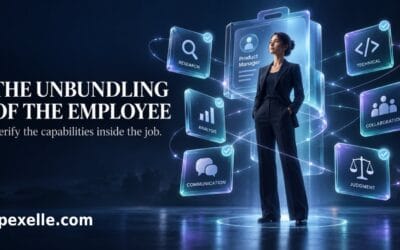
Traditional hiring relies heavily on CVs, interviews, degrees, references, and profile descriptions. These signals are useful, but incomplete. They often show what someone says about themselves, not necessarily what they can do.
A candidate may list “project management”, “Python”, “leadership”, or “AI strategy” on a profile. But the real question is: where is the evidence?
Did they complete a real project?
Was the work reviewed?
Did it create measurable value?
Was the skill used in a practical environment?
Can another expert validate it?
Can the work history be connected to outcomes?
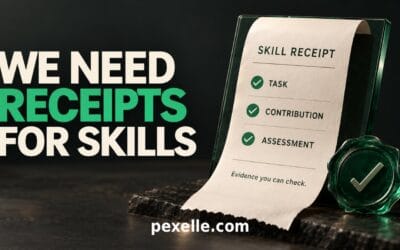
In the Verification Economy, skills become stronger when they are supported by evidence. This could include project submissions, code repositories, peer reviews, expert assessments, task history, work samples, verified learning paths, client feedback, or performance records.
This creates a more honest and efficient labor market. Employers can make better decisions. Workers can prove ability without relying only on degrees or titles. Skilled people from non-traditional backgrounds can compete more fairly.
The future of work may not be dominated by who writes the best CV. It may be dominated by who can show the strongest verified evidence of capability.
Education and Credentials Will Change
Education is also being reshaped by verification.
For a long time, degrees were treated as one of the strongest trust signals in the economy. A university credential suggested that a person had completed structured learning and passed institutional requirements. But degrees do not always show what someone can practically do today.
In fast-changing fields such as AI, cybersecurity , software engineering, climate technology, and data science, skills can become outdated quickly. A degree earned five years ago may not reflect current capability.
This does not make education irrelevant. It changes what education must prove.
The future of learning will likely combine traditional credentials with verifiable evidence. Instead of only asking, “Where did you study?”, employers and institutions will increasingly ask:
- What can you demonstrate?
- What projects have you completed?
- Which skills have been assessed?
- Who verified your work?
Is your learning connected to real-world application?
Micro-credentials, digital badges, skill passports, verified portfolios, and expert-reviewed assessments may become more important. The strongest education systems will not only teach knowledge. They will help learners prove what they know and what they can do.
Verification and Digital Identity
Digital identity is another foundation of the Verification Economy.
As more economic activity moves online, people need ways to prove who they are, what they own, what they have done, and what they are authorized to access. This applies to banking, employment, government services, online marketplaces, healthcare, education, and decentralized platforms.
But digital identity must balance two needs: verification and privacy.
A person should be able to prove a fact without exposing unnecessary personal data. For example, someone may need to prove they are over a required age, certified for a task, eligible for a service, or the owner of a credential without revealing their full identity in every situation.
This is why privacy-preserving verification technologies are becoming important. Concepts such as verifiable credentials, decentralized identifiers, cryptographic proofs, and selective disclosure could help create identity systems that are more secure, portable, and user-controlled.
The future of digital trust will not be based on sharing more personal data everywhere. It will be based on proving the right information at the right time with minimum exposure.
Supply Chains and Product Verification
The Verification Economy also applies to physical products.
Consumers are increasingly exposed to claims such as “organic”, “sustainable”, “ethical”, “carbon neutral”, “locally sourced”, “cruelty-free”, or “fair trade”. But without verification, these claims can become marketing language rather than meaningful proof.
Supply chain verification gives economic value to transparency. A product becomes more trustworthy when its origin, materials, production process, transportation, certifications, and compliance records can be checked.
This matters especially in industries such as food, fashion, agriculture, electronics, medicine, and clean technology.
For example, a coffee brand claiming ethical sourcing should be able to show traceable supplier relationships. A clothing company claiming sustainability should be able to provide evidence about materials and labor conditions. A food company claiming organic production should be able to connect that claim to inspection and certification records.
In the Verification Economy, transparency becomes a competitive advantage. Companies that can prove their claims will be stronger than companies that only advertise them.
Finance, Compliance, and Trust Infrastructure
Financial systems already depend heavily on verification. Identity checks, anti-money laundering controls, transaction monitoring, audit trails, risk scoring, and regulatory reporting are all forms of verification.
But the future financial economy will require even more trusted infrastructure.
As digital assets, fintech platforms, open banking, embedded finance, and cross-border payments expand, the need for verifiable trust increases. Users need to know whether platforms are legitimate. Regulators need to know whether companies are compliant. Businesses need to know whether counterparties are reliable.
Verification reduces fraud, improves compliance, and makes financial networks safer.
At the same time, financial verification must avoid becoming overly invasive. The best systems will combine strong compliance with privacy-aware design, allowing legitimate users to prove eligibility and ownership without unnecessary data exposure.
Online Reputation Will Become Evidence-Based
Online reputation has become one of the most fragile parts of the digital economy.
Followers can be bought. Reviews can be fake. Engagement can be manipulated. AI-generated content can create the appearance of expertise. A person can appear influential without having real domain knowledge. A company can look credible without having real customers.
This creates a gap between visibility and trust.
The Verification Economy will push reputation systems away from surface-level signals and toward evidence-based signals. Instead of measuring only followers, likes, profile descriptions, or content volume, future systems may evaluate verified contributions, peer validation, transaction history, completed work, expert review, and measurable outcomes.
This is especially important for professional networks. A strong professional identity should not only show what someone says they can do. It should show proof of work, proof of learning, proof of contribution, and proof of trust.
In this model, reputation becomes less about self-promotion and more about verified value creation.
The Business Opportunity Behind Verification
Verification is not only a defensive need. It is also a major business opportunity.
New companies will be built around verifying skills, identities, credentials, reviews, supply chains, AI outputs, sustainability claims, professional histories, and organizational performance. Verification-as-a-service may become a major category across industries.
Businesses that provide trusted verification layers can reduce friction in markets. They can help employers hire faster, help platforms reduce fraud, help consumers choose better products, help regulators monitor compliance, and help professionals prove their value.
The companies that win in this space will not simply collect data. They will create trusted systems for validating data.
The most valuable platforms of the future may be those that answer one question better than anyone else:
Can this be trusted?
Risks of the Verification Economy
Although verification has many benefits, it also carries risks.
First, verification systems can become centralized and exclusionary. If only a few institutions control what counts as verified, they may create new gatekeepers. This could disadvantage people from non-traditional backgrounds.
Second, verification can become invasive. If every action is tracked and measured, people may lose privacy and autonomy. A healthy Verification Economy must verify claims without turning society into a surveillance system.
Third, verified data can still be interpreted unfairly. Evidence does not automatically remove bias. Systems must be designed carefully to avoid reinforcing existing inequalities.
Fourth, over-verification can slow innovation. Startups, creators, and independent workers often begin with limited evidence. A good economy should allow people to build credibility over time, not block them before they start.
The goal is not to verify everything about everyone. The goal is to verify important claims where trust, safety, fairness, or economic value depends on evidence.
Principles for a Healthy Verification Economy
A strong Verification Economy should be built on several principles.
First, verification should be evidence-based. Claims should be connected to real data, real actions, real assessments, or real outcomes.
Second, verification should be privacy-preserving. People should not be forced to reveal unnecessary personal information to prove a specific fact.
Third, verification should be portable. A worker, student, customer, or business should not lose their verified reputation when moving between platforms.
Fourth, verification should be transparent. Users should understand what is being verified, how it is verified, and who has authority to validate it.
Fifth, verification should be inclusive. People should be able to prove value through multiple pathways, including formal education, practical work, peer validation, project evidence, and expert assessment.
Sixth, verification should be revocable and updateable. Skills, compliance status, and trust signals can change over time. Verification must reflect current reality, not permanent assumptions.
The Future: Evidence as Economic Currency
In the coming years, evidence may become one of the most important currencies of the digital economy.
Not currency in the narrow financial sense, but currency as a medium of trust.
- A verified skill can unlock a job opportunity.
- A verified identity can unlock access to services.
- A verified product claim can increase consumer confidence.
- A verified supply chain can strengthen brand value.
- A verified professional history can improve reputation.
- A verified AI output can increase reliability.
- A verified business metric can attract investment.
As the internet becomes more crowded with synthetic content and unverified claims, evidence will become the signal that separates trust from noise.
The Verification Economy does not eliminate the need for communication, branding, storytelling, or ambition. People and companies will still need to explain who they are and what they offer. But claims alone will no longer be enough.
The strongest individuals and organizations will be those that can connect their story to proof.
Conclusion
The Verification Economy represents a major shift in how value, trust, and reputation are created. It moves society from a claim-based model to an evidence-based model.
In the old economy, people asked: “What do you say about yourself?”
In the new economy, they will ask: “What can be verified?”
This change will affect hiring, education, finance, supply chains, digital identity, AI, professional reputation, and consumer trust. It will create new opportunities for platforms, workers, institutions, and businesses that can build reliable systems of proof.
But the future of verification must be designed carefully. It should increase trust without destroying privacy. It should reduce fraud without creating unfair gatekeepers. It should reward real value without turning every human action into a monitored data point.
The Verification Economy is not just about technology. It is about rebuilding trust for a world where claims are easy, but proof is rare.
In that world, verification becomes more than a feature.
It becomes infrastructure.
Source : Medium.com