The End of the Degree Monopoly
For decades, earning a university degree was considered the safest path to career success. A degree acted as a signal to employers that a candidate possessed knowledge, discipline, and the ability to learn. It opened doors to stable careers, higher salaries, and social prestige. Parents encouraged their children to pursue higher education because it was widely believed that a degree was the key to a better future.
However, the world of work is changing at a pace that traditional education systems struggle to match. Technology, automation, artificial intelligence, remote work, and the rapid evolution of industries are reshaping what employers truly value. As a result, the economic and professional value of many degrees is declining faster than most people realize.
This does not mean education is becoming useless. Rather, it means that the traditional model of obtaining a degree and relying on it for an entire career is becoming increasingly outdated.
Knowledge Is No Longer Scarce
Universities once held a near monopoly on advanced knowledge. If someone wanted to learn engineering, business, programming, or design, formal education was often the only practical option. Today, knowledge is everywhere.
Online platforms provide access to world-class courses, tutorials, research papers, and practical training at little or no cost. A motivated learner can acquire valuable skills from industry experts without stepping into a classroom. Artificial intelligence tools can act as personal tutors, helping individuals learn faster and more efficiently than ever before.
When information becomes abundant, possessing information alone is no longer enough to create value. What matters now is the ability to apply knowledge effectively in real-world situations.
Employers Are Shifting Toward Skills
Many organizations are gradually moving away from degree-based hiring and toward skills-based hiring. Instead of asking where someone studied, employers increasingly want evidence of what a person can actually do.
A software developer with a strong portfolio of projects may be more attractive than a computer science graduate with little practical experience. A digital marketer who has successfully managed campaigns may outperform someone who only studied marketing theory. A cybersecurity specialist with industry certifications and hands-on experience often holds a competitive advantage over candidates who possess only academic credentials.
In a growing number of industries, demonstrable skills are becoming more important than academic titles.
Artificial Intelligence Is Accelerating the Shift
Artificial intelligence is fundamentally changing the labor market. Tasks that once required years of specialized education can now be performed more efficiently with AI assistance.
Professionals in law, finance, marketing, software development, and content creation are already using AI tools to enhance productivity. This means that employers are placing greater emphasis on problem-solving, creativity, critical thinking, communication, and adaptability rather than memorized knowledge.
The workers who thrive in the AI era will not necessarily be those with the most degrees. They will be the individuals who can effectively combine human judgment with technological tools to produce superior results.
Degrees Age Faster Than Ever
One of the biggest challenges facing higher education is the accelerating pace of change.
A degree earned today may contain knowledge that becomes partially outdated within a few years. Technologies evolve, industries transform, regulations change, and entirely new fields emerge. Skills that are highly valuable today may become less relevant tomorrow.
This creates a situation where graduates can no longer rely on what they learned during university for the remainder of their careers. Continuous learning has become a necessity rather than an option.
The concept of lifelong learning is replacing the traditional model of education followed by decades of work.
The Rising Cost of Traditional Education
The financial burden of higher education is increasing in many countries. Students often invest significant amounts of money and time into obtaining degrees, expecting strong returns on their investment.
Unfortunately, those returns are becoming less predictable. Some graduates enter highly competitive job markets with substantial debt and limited opportunities. Others discover that employers prioritize practical experience over academic achievements.
As tuition costs continue to rise, more people are questioning whether a traditional degree remains the most efficient pathway to career success. Alternative learning routes, including bootcamps, certifications, apprenticeships, and self-directed education, are gaining popularity because they often provide faster and more targeted skill development.
Credentials Are Being Unbundled
Historically, a degree bundled multiple functions together. It represented education, skill verification, networking, and reputation. Today, these functions are increasingly being separated.
Professional certifications validate specific competencies. Online portfolios showcase real work. Industry communities provide networking opportunities. Digital credentials and micro-certifications allow learners to demonstrate expertise in specialized areas.
This trend is creating a more flexible and dynamic talent marketplace where individuals can build credibility through multiple pathways rather than relying solely on a university diploma.
What Employers Really Want
Despite technological disruption, certain qualities remain consistently valuable.
Employers are looking for people who can solve complex problems, communicate effectively, collaborate with teams, adapt to changing environments, and learn new skills quickly. These abilities are difficult to automate and remain essential across industries.
The most successful professionals are combining technical expertise with human-centered skills such as leadership, creativity, emotional intelligence, and strategic thinking.
A degree may help open the first door, but long-term success increasingly depends on continuous growth and practical performance.
The Future Belongs to Adaptive Learners
The question is no longer whether you have a degree. The more important question is whether you can continuously evolve.
The modern economy rewards adaptability. Individuals who regularly update their skills, embrace new technologies, and remain curious about emerging trends will maintain their relevance. Those who stop learning after graduation risk falling behind regardless of how prestigious their degree may be.
Future careers will likely consist of multiple transitions, requiring workers to reinvent themselves several times throughout their professional lives. In such an environment, learning agility becomes one of the most valuable assets a person can possess.
Conclusion
Degrees are not disappearing, and they still provide value in many professions. However, the assumption that a degree alone guarantees career success is becoming increasingly outdated.
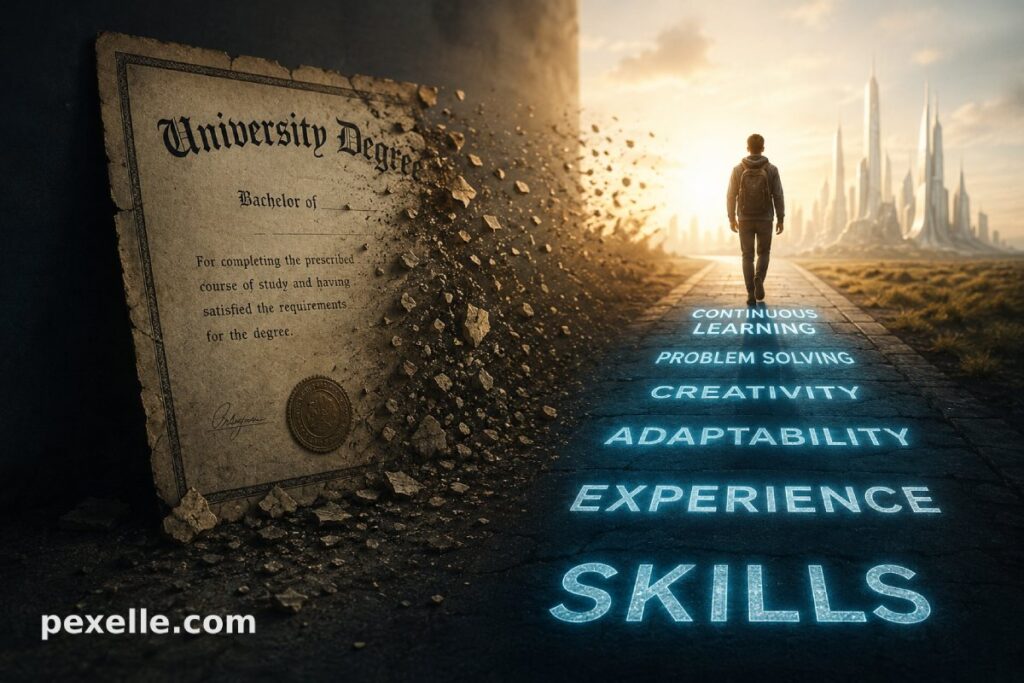
The value of a degree is no longer determined by the diploma itself. It is determined by how effectively individuals combine their education with practical skills, real-world experience, continuous learning, and adaptability.
In a world where knowledge is abundant and technology evolves rapidly, the most valuable credential is no longer what you learned years ago. It is your ability to keep learning tomorrow.
The future belongs not to the most educated people, but to the fastest learners.
Source : Medium.com