
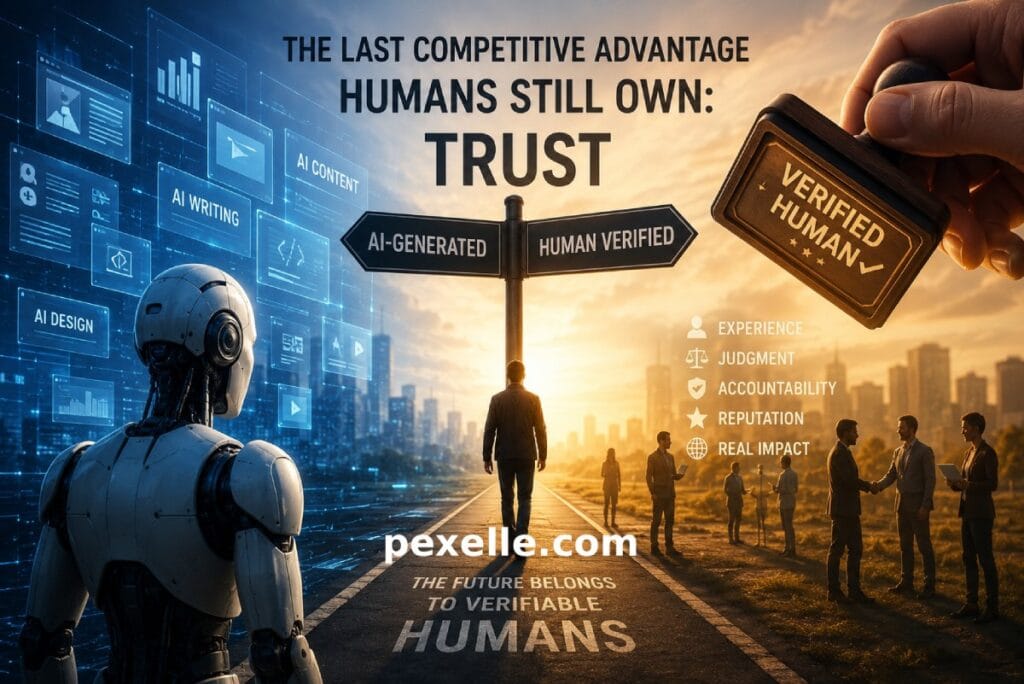
Introduction
For centuries, humanity has maintained a comfortable assumption: no matter how advanced technology becomes, there will always be something uniquely human that machines cannot replicate. Every major technological revolution has challenged that belief, yet people adapted by moving into more creative, strategic, or interpersonal work.
Artificial Intelligence has changed the equation.
Unlike previous automation waves that replaced physical labor, AI increasingly performs intellectual work. It writes software, drafts legal documents, analyzes financial reports, designs products, creates marketing campaigns, diagnoses diseases, and even produces scientific hypotheses. Tasks once considered proof of expertise are becoming commodities.
As AI capabilities continue to accelerate, one critical question emerges:
If machines can perform almost every cognitive task, what competitive advantage do humans still possess?
Ironically, the answer is not intelligence.
It is authenticity.
And authenticity, when it can be verified, may become the most valuable asset in the global economy.
Intelligence Is Becoming Abundant
Throughout history, knowledge has been scarce.
Education created advantage because information was difficult to access. Experts were valuable because acquiring expertise required years of study and experience.
Today, knowledge is nearly free.
AI systems provide instant explanations, summarize complex research, generate production-ready code, create professional designs, and answer questions in seconds.
The cost of generating intelligence is approaching zero.
As supply increases, value decreases.
This does not mean intelligence becomes useless. It means intelligence alone stops being differentiating.
The internet commoditized information.
AI is commoditizing expertise.
The Real Scarcity Is Becoming Human Proof
When everyone has access to AI, outputs begin to look remarkably similar.
The same prompts generate similar reports.
The same models produce similar code.
The same design systems create similar visuals.
The same optimization techniques lead to similar business strategies.
Organizations no longer struggle to generate content.
They struggle to determine:
- Who actually understands it?
- Who made meaningful decisions?
- Who solved real problems?
- Who can perform without AI assistance?
- Who deserves trust?
This represents an entirely different challenge.
The scarce resource is no longer knowledge.
It is proof of genuine capability.
Verification Becomes More Valuable Than Creation
For decades, employers evaluated people based on resumes, degrees, portfolios, and interviews.
These signals were imperfect but generally acceptable because producing convincing evidence required substantial effort.
AI changes that balance.
A polished portfolio can be generated.
Professional writing can be synthesized.
Coding samples can be assisted.
Recommendations can be fabricated.
Even interviews may eventually involve AI augmentation.
As synthetic content becomes indistinguishable from authentic work, traditional credentials lose reliability.
Verification becomes the new currency.
Instead of asking:
“Can you produce this?”
Organizations increasingly ask:
“Can you prove this reflects your own ability?”
Trust Is the Remaining Competitive Advantage
Technology reduces friction.
Trust removes uncertainty.
These are fundamentally different.
Businesses do not fail because they lack information.
They fail because they cannot confidently determine whom to trust.
Hiring.
Freelancing.
Healthcare.
Education.
Consulting.
Finance.
Government.
Every industry depends on making decisions about people.
The better organizations become at verifying human capability, the lower their risk becomes.
In an AI-driven economy, trusted humans become disproportionately valuable.
Authentic Experience Cannot Be Mass Produced
AI can simulate experience.
It cannot actually accumulate it.
Real experience contains context.
Failure.
Adaptation.
Judgment.
Trade-offs.
Responsibility.
These qualities emerge through interaction with reality, not prediction.
An experienced surgeon is valuable not because they know anatomy.
They are valuable because they have made thousands of decisions under pressure.
An experienced entrepreneur is not valuable because they understand business models.
They are valuable because they have survived uncertainty repeatedly.
Experience creates judgment.
Judgment creates trust.
Trust creates value.
Reputation Will Become Portable Infrastructure
Today’s digital identity is fragmented.
LinkedIn stores employment.
GitHub stores code.
Behance stores design.
Google Scholar stores research.
Universities store education.
Employers store performance.
None of these systems communicate effectively.
The future belongs to portable reputation.
Imagine carrying verified records of:
- Projects completed
- Skills demonstrated
- Problems solved
- Teams collaborated with
- Decisions made
- Contributions verified
- Learning history
- Professional growth
Instead of repeatedly proving credibility, individuals would possess continuously updated trust profiles.
This transforms reputation from static documentation into living infrastructure.
Human Signals Become Premium Signals
As AI-generated content floods every platform, audiences naturally begin valuing signals that AI cannot easily fabricate.
These include:
- Live collaboration
- Transparent decision making
- Verified contribution histories
- Peer validation
- Long-term consistency
- Accountability
- Real-world outcomes
The future internet may not reward whoever publishes the most.
It may reward whoever can verify the most.
The Next Economy Runs on Confidence
Every economic transaction involves uncertainty.
Hiring someone.
Investing in a founder.
Choosing a doctor.
Selecting a supplier.
Working with a freelancer.
Admitting a student.
Confidence reduces transaction costs.
Verified humans reduce uncertainty.
Lower uncertainty accelerates decision-making.
Faster decisions increase economic productivity.
Trust, therefore, is not merely a social concept.
It becomes economic infrastructure.
AI Makes Humans More Valuable, Not Less
Many believe AI replaces humans.
A more accurate perspective is that AI changes what humans are valued for.
Routine production becomes automated.
Original judgment becomes premium.
Content becomes abundant.
Credibility becomes scarce.
Information becomes free.
Trust becomes expensive.
Ironically, the better AI becomes, the more valuable authentic human reputation becomes.
Machines create abundance.
Humans create confidence.
The Future Belongs to Verifiable Humans
The coming decade will not simply be defined by artificial intelligence.
It will be defined by artificial abundance.
When intelligence, creativity, writing, coding, design, and analysis become widely accessible, society must answer a different question:
Who can we trust?
That question reshapes hiring, education, finance, healthcare, entrepreneurship, and every digital interaction.
The final competitive advantage humans possess is not thinking faster than machines.
It is being provably authentic.
The winners of the next economy will not necessarily be those who generate the most work.
They will be those who can demonstrate, verify, and continuously earn trust.
Because in a world where AI can create almost anything, the rarest asset is no longer intelligence.
It is a human whose credibility can be proven.
Source : Medium.com