Why Traditional Hiring Misses Extraordinary Talent
For decades, resumes have been the primary tool organizations use to evaluate talent. Recruiters scan educational backgrounds, previous job titles, certifications, and years of experience in an attempt to predict future performance. While resumes can provide useful information, they often fail to identify some of the most capable and innovative individuals in the workforce.
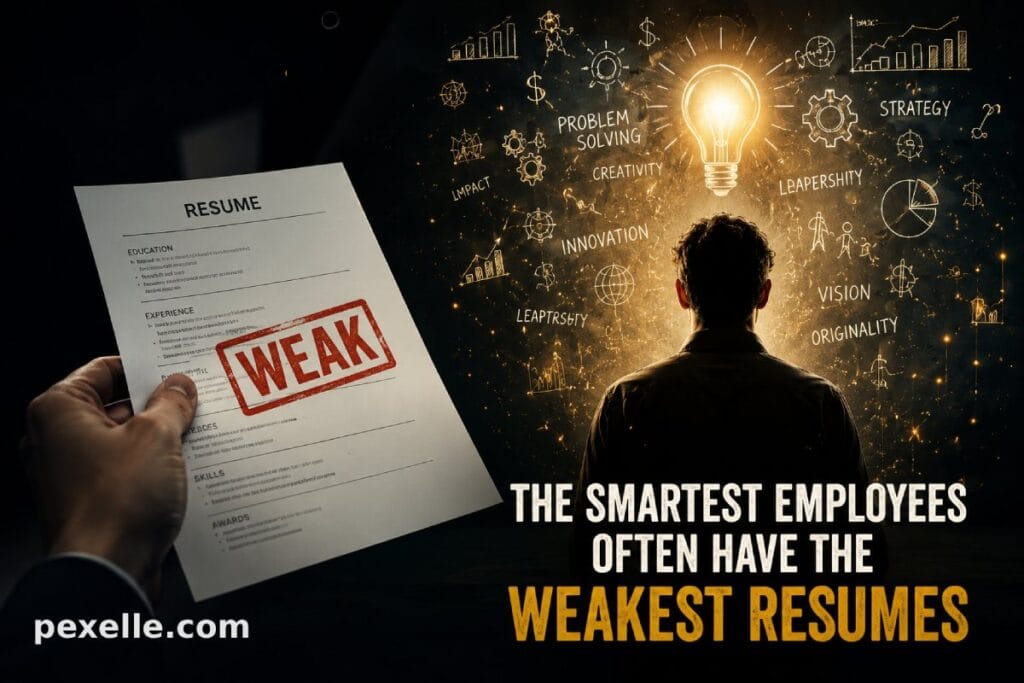
Ironically, many of the smartest employees frequently have the weakest resumes.
This does not mean they lack intelligence, competence, or potential. Instead, it highlights a growing mismatch between how talent is measured and how value is actually created in modern organizations.
The Resume Rewards Predictability
Traditional resumes are designed to showcase structured achievements. Degrees from prestigious universities, recognizable company names, management titles, and industry certifications create an appearance of credibility.
However, intelligence and capability do not always follow predictable paths.
Many exceptional problem-solvers learn independently. They build projects outside formal employment, teach themselves new technologies, experiment with unconventional ideas, and develop expertise through curiosity rather than structured career progression.
Because their journey often looks unusual, their resumes may appear weaker when compared to candidates who followed traditional educational and corporate routes.
As a result, organizations frequently confuse credentials with competence.
Real Intelligence Is Often Invisible
Some of the most valuable workplace skills are difficult to represent on a resume:
- Critical thinking
- Systems thinking
- Creativity
- Adaptability
- Curiosity
- Problem-solving ability
- Learning speed
- Emotional intelligence
- Strategic judgment
These qualities reveal themselves through action rather than documentation.
A candidate may possess five certifications and ten years of experience yet struggle to solve unfamiliar problems. Another candidate may have no formal credentials but consistently produce innovative solutions that save companies millions of dollars.
The difference becomes visible only after they begin working.
Self-Taught Talent Is Frequently Overlooked
The internet has democratized knowledge. Today, individuals can learn software development, artificial intelligence, cybersecurity, design, finance, and entrepreneurship from anywhere in the world.
Many highly skilled professionals acquire expertise through:
- Open-source projects
- Online courses
- Personal experimentation
- Freelance work
- Startup experiences
- Community contributions
Unfortunately, many applicant tracking systems automatically filter out candidates who lack specific degrees or employment histories.
As a result, organizations often reject highly capable individuals before a human ever reviews their work.
The Best Employees Often Have Nonlinear Careers
Traditional hiring models assume that successful careers progress in a straight line.
Education leads to an entry-level position.
Entry-level work leads to promotion.
Promotion leads to management.
Reality is rarely so simple.
Many high-performing individuals have careers filled with unexpected turns. They may switch industries, start businesses that fail, take career breaks, move countries, or pursue personal projects instead of climbing corporate ladders.
These experiences often develop resilience, adaptability, and real-world problem-solving skills that cannot be taught in classrooms.
Yet on paper, these candidates may appear inconsistent or unconventional.
Innovation Rarely Comes From Perfect Resumes
History provides countless examples of innovators who would likely struggle to pass modern hiring filters.
Many entrepreneurs, inventors, programmers, and creators built remarkable achievements without possessing the credentials organizations typically prioritize.
Innovation requires questioning assumptions, challenging established practices, and exploring unfamiliar territory.
Individuals who excel at these activities often spend less time optimizing their resumes and more time building, experimenting, and learning.
Consequently, their achievements may not fit neatly into traditional hiring frameworks.
Why Companies Keep Making This Mistake
Several factors contribute to resume-driven hiring decisions:
Risk Avoidance
Hiring managers often feel safer selecting candidates with recognizable credentials because those choices appear easier to justify.
Time Constraints
Recruiters may review hundreds of applications per role, forcing them to rely on quick filters instead of deeper evaluations.
Legacy Hiring Systems
Many hiring processes were designed decades ago for industrial-era work environments where standardized skills were more common.
Credential Bias
Organizations frequently assume that prestigious educational institutions or well-known employers automatically indicate superior capability.
While these factors simplify hiring, they do not necessarily improve hiring outcomes.
What Smart Organizations Do Differently
Forward-thinking companies increasingly recognize the limitations of resumes.
Instead of relying solely on credentials, they evaluate candidates through:
- Real-world projects
- Portfolio reviews
- Practical assessments
- Problem-solving exercises
- Trial assignments
- Collaborative interviews
- Demonstrated learning ability
These approaches focus on what candidates can actually do rather than where they have been.
As work becomes more knowledge-based and technology-driven, demonstrated capability often predicts performance more accurately than historical credentials.
The Future of Hiring Is Evidence, Not Paper
Artificial intelligence, remote work, and digital collaboration are reshaping the labor market. Organizations increasingly need employees who can learn quickly, adapt continuously, and solve complex problems.
These characteristics cannot always be captured by a traditional resume.
The future belongs to evidence-based hiring, where portfolios, achievements, contributions, and demonstrated skills matter more than credentials alone.
Companies that embrace this shift will gain access to vast pools of overlooked talent that competitors continue to ignore.
Conclusion
A resume is a summary of someone’s past, not a measure of their potential.
Some individuals possess impressive resumes but limited ability to create value. Others possess extraordinary intelligence, creativity, and problem-solving skills while presenting relatively modest credentials on paper.
The smartest employees are not always the ones with the most polished resumes.
They are often the people who spent less time collecting credentials and more time building, learning, experimenting, and solving real problems.
Organizations that learn to recognize this distinction will not only hire better people but will also build stronger, more innovative, and more resilient teams in the years ahead.
Source : Medium.com