The Growing Crisis of Trust in the Modern Workforce
For decades, professional success was built on a simple formula: earn a degree, gain experience, write a strong resume, and apply for jobs. Employers trusted credentials, institutions validated knowledge, and resumes served as evidence of capability. Today, that system is rapidly breaking down.
The uncomfortable reality is that most professionals cannot actually prove their skills.
This does not mean they are unqualified. Many are highly capable and experienced. The problem is that their abilities are often hidden behind job titles, certificates, and vague descriptions that fail to provide measurable evidence of what they can truly do.
As technology transforms industries and artificial intelligence reshapes hiring processes, the ability to demonstrate skills is becoming more important than simply claiming them.
The Resume Problem
Most resumes follow a familiar pattern.
People list their education, previous employers, job titles, and responsibilities. They describe what they were expected to do rather than what they actually accomplished.
Consider two candidates.
The first writes:
“Managed software development projects for three years.”
The second provides:
“Led a team of six developers, delivered twelve production releases, reduced deployment failures by 40%, and maintained 99.95% service uptime.”
Both may possess similar skills, but only one provides evidence.
Employers increasingly struggle to distinguish between individuals who understand a topic and those who can successfully apply that knowledge in real-world situations.
Degrees Are No Longer Enough
Higher education remains valuable, but a diploma alone cannot prove competence.
A degree demonstrates that someone completed a structured educational program. It does not necessarily show how effectively they can solve problems, collaborate with teams, communicate ideas, or adapt to changing technologies.
In fast-moving fields such as software engineering, cybersecurity, artificial intelligence, data science, and digital marketing, practical skills can become outdated within a few years.
As a result, organizations are shifting toward skill-based hiring rather than credential-based hiring.
Many employers now ask:
- What have you built?
- What problems have you solved?
- What measurable impact have you created?
- Can you demonstrate your abilities?
These questions are often more important than where someone studied.
The Rise of Skill Verification
The digital economy is creating new ways to verify professional competence.
Developers can point to open-source contributions, GitHub repositories, deployed applications, and technical portfolios.
Designers can showcase real projects, user research, prototypes, and measurable improvements in user experience.
Writers can present published articles, audience engagement metrics, and content performance data.
Project managers can demonstrate successful deliveries, budgets managed, risks mitigated, and business outcomes achieved.
Instead of relying on claims, professionals are increasingly expected to provide evidence.
This shift mirrors broader changes happening across society. Trust is moving away from institutions and toward transparent, verifiable proof.
Why Employers Care More Than Ever
Hiring mistakes are expensive.
A poor hiring decision can cost companies thousands or even hundreds of thousands of dollars through lost productivity, recruitment costs, training expenses, and project delays.
As remote work expands global talent pools, employers often receive hundreds or thousands of applications for a single role.
Traditional screening methods are no longer sufficient.
Organizations want objective indicators of competence.
This is one reason why technical assessments, portfolio reviews, practical assignments, and skill verification platforms are becoming increasingly common.
Companies are not simply looking for knowledge. They are looking for demonstrated capability.
The Hidden Talent Problem
Ironically, some of the most talented professionals are the least visible.
Many exceptional individuals spend years producing valuable work without documenting it.
They solve difficult problems, improve systems, support teams, and create significant business value. Yet when asked to prove their expertise, they struggle because they have never systematically recorded their achievements.
Meanwhile, others become highly skilled at self-promotion and presentation.
This creates a paradox where visibility sometimes outweighs competence.
The future workforce must learn to combine both.
Real skill remains essential, but the ability to demonstrate that skill is becoming equally important.
AI Is Accelerating the Shift
Artificial intelligence is fundamentally changing how skills are evaluated.
AI systems can generate resumes, write cover letters, complete assignments, and even simulate interviews.
As these tools become more sophisticated, traditional indicators of competence become less reliable.
Employers increasingly recognize that written claims can be automated.
What cannot be easily automated is a proven track record of consistent results.
The question is shifting from:
“Can you describe the skill?”
to:
“Can you show evidence that you have applied the skill successfully?”
This trend will likely accelerate in the coming years.
Building a Verifiable Professional Identity
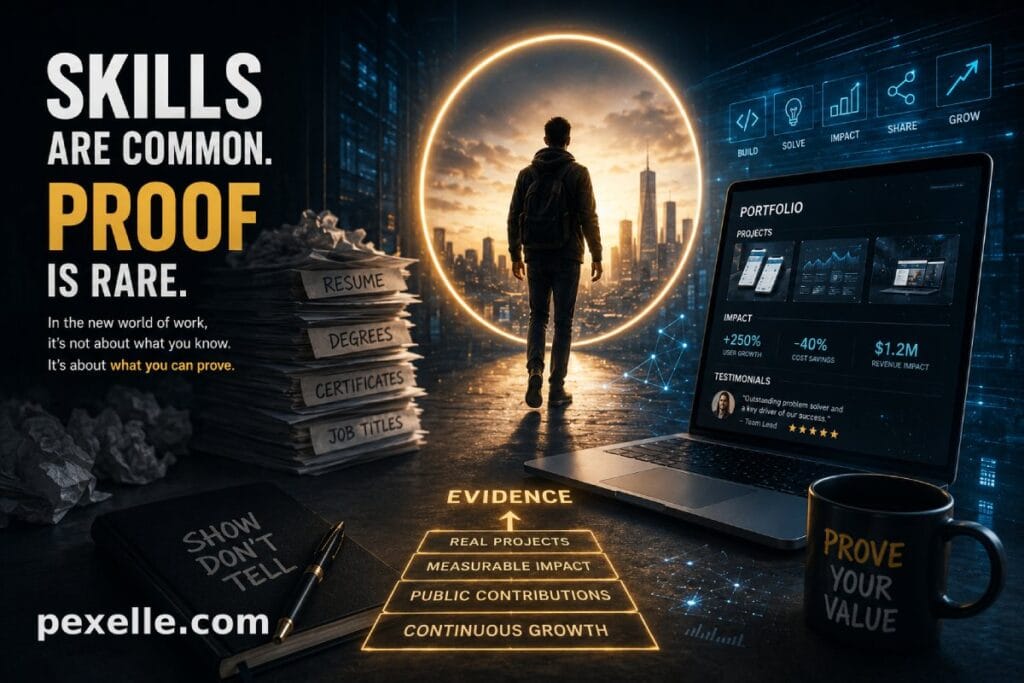
Professionals should begin thinking of their careers as evidence-based portfolios rather than collections of credentials.
A strong professional profile should include:
Demonstrated Projects
Real examples of work, products, research, designs, code, or business initiatives.
Quantifiable Results
Metrics that show impact, efficiency improvements, revenue generation, cost savings, or customer outcomes.
Public Contributions
Articles, presentations, open-source projects, community involvement, and thought leadership.
Continuous Learning
Evidence of adapting to new technologies, tools, and industry developments.
Peer Validation
Recommendations, endorsements, testimonials, and collaborative achievements.
Together, these elements create a much stronger signal than a traditional resume alone.
The Future of Work Is Proof-Based
The labor market is moving toward a model where trust is earned through evidence rather than assumed through credentials.
Digital portfolios, verified achievements, skills databases, blockchain credentials, competency assessments, and AI-driven verification systems will likely become standard components of professional identity.
The professionals who thrive in this environment will not necessarily be those with the longest resumes or the most impressive titles.
They will be the individuals who can clearly demonstrate what they know, what they have done, and the value they can create.
Conclusion
Most professionals possess valuable skills, but many struggle to prove them.
In a world increasingly driven by data, transparency, and artificial intelligence, claims alone are no longer enough. Degrees, certificates, and job titles still matter, but they are becoming only part of the story.
The future belongs to professionals who can transform experience into evidence, achievements into measurable outcomes, and expertise into verifiable proof.
The question is no longer whether you have skills.
The question is whether you can prove them.
Source : Medium.com