Introduction
For decades, the curriculum vitae (CV) has been the primary tool for evaluating job candidates. Employers have relied on documents listing education, work experience, certifications, and skills to make hiring decisions. While the CV has served as a convenient summary of a person’s professional background, it was never designed to accurately measure capability, potential, adaptability, or real-world performance.
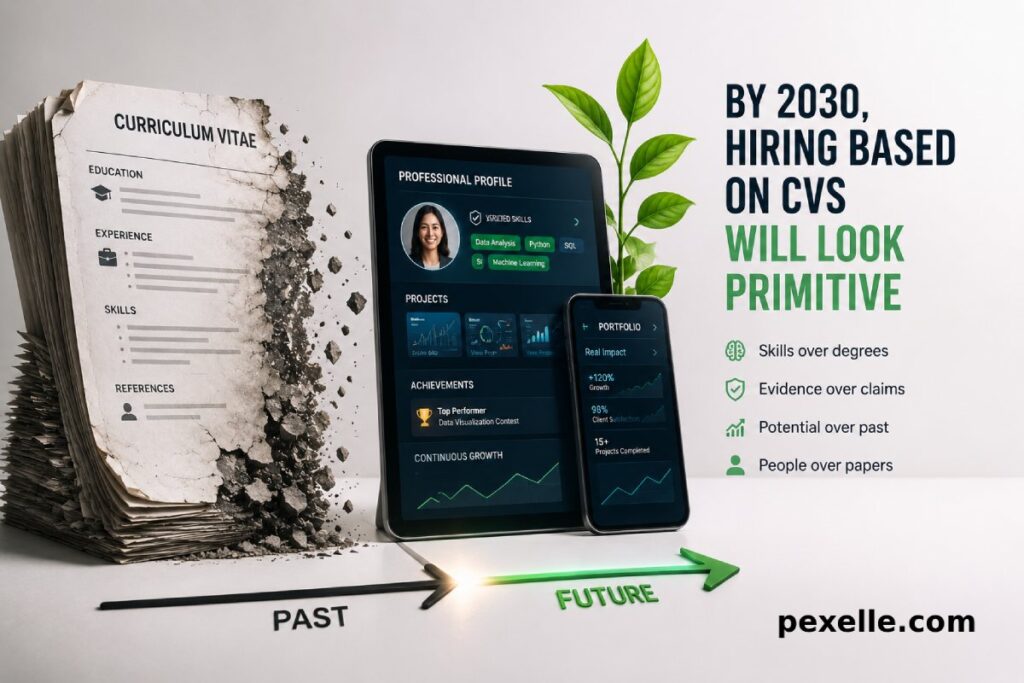
As artificial intelligence, digital portfolios, skill verification systems, and behavioral analytics continue to evolve, the traditional CV is rapidly approaching obsolescence. By 2030, hiring based primarily on resumes may appear as outdated as hiring solely based on handwritten references or paper applications. Organizations will increasingly seek evidence of what people can do rather than what they claim they have done.
The Fundamental Problem with CVs
A CV is essentially a self-reported marketing document. Candidates decide what information to include, what achievements to emphasize, and how to present themselves. As a result, resumes often provide an incomplete and sometimes misleading picture of actual capability.
Two candidates with nearly identical resumes may perform dramatically differently when faced with real-world challenges. One may possess exceptional problem-solving abilities, communication skills, and adaptability, while the other may struggle despite having similar credentials.
The hiring process has long suffered from this information gap. Employers attempt to bridge it through interviews, assessments, and probation periods, but the initial screening stage remains heavily dependent on static documents that reveal little about actual performance.
Skills Are Becoming More Important Than Credentials
The modern economy is changing faster than educational systems can adapt. New technologies emerge every year, creating entirely new professions and skill requirements.
Employers increasingly care about whether a candidate can perform specific tasks rather than where they studied or what title they previously held. A software developer’s ability to build scalable systems matters more than the university listed on a resume. A marketer’s capacity to generate measurable growth outweighs years of experience presented in bullet points.
This shift is driving organizations toward skills-based hiring models. Instead of evaluating credentials first, companies are beginning to assess demonstrated abilities through practical challenges, portfolios, simulations, and real-world evidence.
By 2030, the question will not be “What degree do you have?” but rather “Can you prove you can solve this problem?”
AI Will Transform Candidate Evaluation
Artificial intelligence is already reshaping recruitment processes. Future hiring systems will analyze far more than static resumes.
AI-powered platforms will evaluate:
- Demonstrated project outcomes
- Verified skill assessments
- Portfolio quality
- Collaboration history
- Problem-solving patterns
- Communication effectiveness
- Learning velocity
- Adaptability to changing environments
Rather than reading a two-page document, employers may review dynamic profiles continuously updated with evidence from actual work, certifications, projects, contributions, and verified achievements.
AI systems will help identify talent that traditional hiring methods frequently overlook, including self-taught professionals, career changers, freelancers, and individuals from non-traditional educational backgrounds.
The Rise of Verifiable Digital Credentials
One major weakness of resumes is verification. Employers often spend significant time validating claims regarding education, employment history, and certifications.
By 2030, blockchain-based credentials and trusted digital verification systems may allow individuals to maintain secure, tamper-resistant records of their accomplishments.
Professional achievements, completed training programs, project contributions, and skill certifications could be automatically verified and attached to a person’s professional identity.
Instead of stating “Proficient in Python” on a CV, candidates may provide direct evidence showing successful completion of coding challenges, open-source contributions, project outcomes, and peer reviews.
Trust will increasingly come from verified data rather than self-reported claims.
Portfolios Will Replace Bullet Points
- A resume tells employers what candidates claim to have done. A portfolio shows what they have actually accomplished.
- This distinction becomes increasingly important in knowledge-based industries where creativity, execution, and measurable impact determine success.
- Software developers can showcase applications they built.
- Designers can demonstrate completed projects.
- Writers can display published content.
- Engineers can present technical solutions.
- Marketers can share campaign performance data.
- Product managers can illustrate product outcomes and growth metrics.
- As digital portfolios become richer and easier to verify, the value of static resume descriptions will diminish significantly.
Behavioral Data Will Become a New Hiring Signal
Future hiring systems may analyze behavioral indicators that provide deeper insights into how individuals work.
Learning consistency, collaboration quality, responsiveness, communication patterns, leadership contributions, and problem-solving behavior can reveal far more about future performance than job titles alone.
Many modern work platforms already generate these signals. Professional communities, project management systems, collaborative repositories, learning platforms, and productivity tools collectively create a detailed picture of how individuals contribute and grow.
By 2030, hiring decisions may be informed by a candidate’s demonstrated behaviors across professional ecosystems rather than solely by information manually entered into a resume.
The Emergence of Talent Graphs
Instead of isolated resumes, organizations may utilize comprehensive talent graphs.
A talent graph connects:
- Skills
- Experiences
- Projects
- Learning activities
- Professional relationships
- Industry contributions
- Certifications
- Performance evidence
This interconnected model provides a much richer understanding of an individual’s capabilities and potential.
Employers will be able to identify candidates based on proven skill combinations, learning trajectories, and demonstrated achievements rather than keyword matching within resumes.
The result will be more accurate hiring decisions and reduced dependence on traditional credentials.
Continuous Professional Identity
Today’s resume represents a snapshot in time. It is updated periodically and often becomes outdated shortly after being submitted.
The future professional identity will be dynamic and continuously evolving.
Every completed project, newly acquired skill, certification, contribution, and achievement will automatically enrich an individual’s professional profile.
Employers will no longer evaluate candidates based on a static document created months ago. Instead, they will access a living representation of a person’s professional growth and capabilities.
This approach provides a more accurate reflection of current competence and future potential.
Benefits for Employers
Moving beyond CV-based hiring offers substantial advantages for organizations.
Benefits include:
- Better prediction of job performance
- Reduced hiring bias
- Faster recruitment processes
- Improved workforce quality
- Expanded talent pools
- More objective decision making
- Greater diversity of backgrounds and experiences
Organizations will spend less time filtering resumes and more time evaluating evidence-based indicators of capability.
The result is improved hiring accuracy and stronger organizational performance.
Benefits for Job Seekers
The decline of resume-centric hiring also benefits candidates.
Talented individuals often face barriers due to lack of prestigious degrees, limited work experience, employment gaps, or unconventional career paths.
Skills-based hiring creates opportunities for:
- Self-taught professionals
- Career changers
- Freelancers
- Remote workers
- Individuals from emerging economies
- Non-traditional learners
Success will increasingly depend on demonstrated capability rather than pedigree.
This democratization of opportunity may become one of the most significant workforce transformations of the decade.
Challenges and Ethical Considerations
Despite its promise, the future of hiring presents challenges.
Organizations must ensure transparency in AI-driven evaluations. Privacy concerns must be addressed when analyzing behavioral data. Biases embedded within algorithms must be identified and corrected.
Verification systems must remain secure and trustworthy. Candidates should maintain control over how their professional information is shared and evaluated.
Technology should enhance fairness rather than replace human judgment entirely.
The most effective hiring systems will combine advanced analytics with thoughtful human oversight.
Conclusion
The CV has been a central component of recruitment for generations, but its limitations are becoming increasingly apparent. In a world driven by rapid technological change, employers need better ways to identify talent, measure capability, and predict performance.
By 2030, hiring based primarily on resumes will likely appear primitive compared to systems built around verified skills, dynamic portfolios, behavioral insights, AI-powered assessments, and continuous professional identities.
The future of hiring is not about what candidates claim on paper. It is about what they can prove, demonstrate, and continuously achieve. Organizations that embrace this shift will gain access to deeper talent pools, make better hiring decisions, and build stronger, more adaptable workforces for the future.
Source : Medium.com