
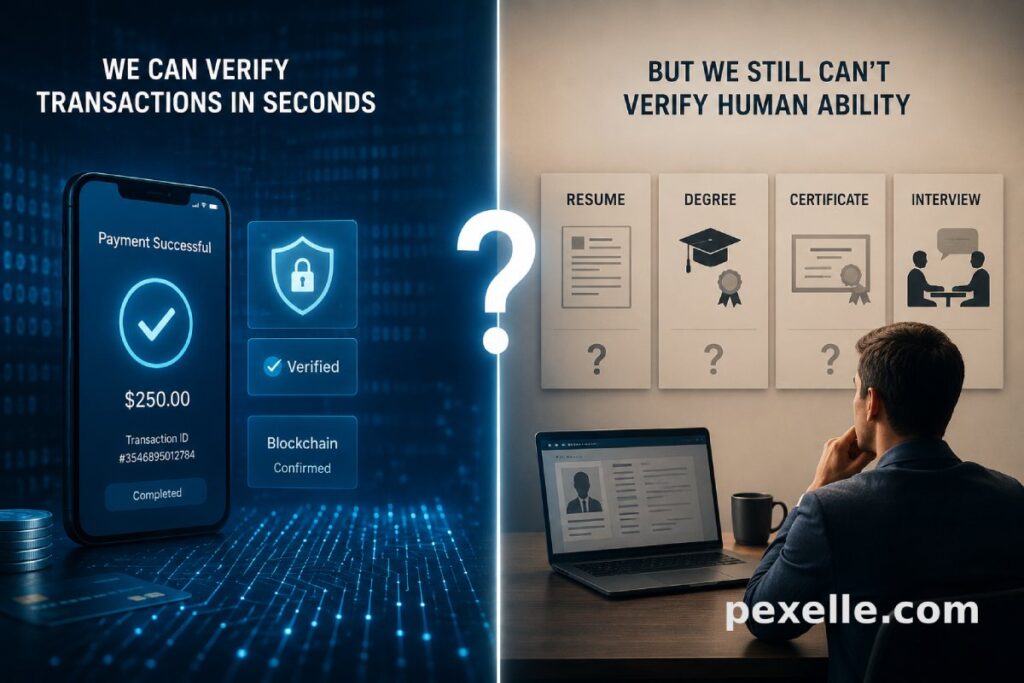
The Strange Contradiction of the Digital Age
Today, a financial transaction can be verified in seconds.
A bank can confirm a payment.
An online platform can instantly determine whether money moved from one account to another.
Yet when it comes to something arguably more valuable than money, human ability, we are still operating with systems that belong to another era.
A company can verify a $10 transaction faster than it can verify whether a software engineer can actually code, whether a designer can actually design, or whether a manager can actually lead a team.
This contradiction sits at the center of one of the biggest inefficiencies in the global workforce.
The problem is not a shortage of talent.
The problem is that talent remains difficult to verify.
The Evolution of Trust
Throughout history, societies have continuously improved the way they establish trust.
Thousands of years ago, trust was personal. People traded only with those they knew.
Later, institutions emerged. Governments, banks, universities, and corporations became trusted intermediaries.
In the digital era, technology transformed trust once again.
Cryptography, digital signatures, and distributed systems made it possible to verify transactions mathematically instead of socially.
When Bitcoin was introduced in 2009, it demonstrated something remarkable: strangers could exchange value without trusting each other because they could trust the verification system.
- Verification became automated.
- Verification became scalable.
- Verification became global.
But this revolution stopped at money.
Human capability remains largely unverifiable.
The Resume Problem
- Consider how most hiring decisions are made today.
- Employers review resumes.
- They evaluate degrees.
- They examine certifications.
- They conduct interviews.
These tools attempt to estimate competence, but none of them directly prove competence.
- A resume describes experience.
- A degree confirms education.
- A certification indicates that someone passed an assessment.
- An interview measures communication and presentation skills.
- None of these provide continuous, real-world evidence of actual performance.
- As a result, hiring often becomes a process of prediction rather than verification.
Companies are not selecting proven ability.
They are selecting signals that they hope correlate with ability.
Sometimes those signals work.
Often they do not.
The Cost of Unverifiable Skills
The inability to verify skills creates enormous inefficiencies.
Organizations spend billions on recruitment.
Candidates spend years accumulating credentials.
Professionals invest significant time building portfolios and personal brands.
Yet despite all this effort, bad hires remain common.
Many talented individuals remain overlooked because they lack prestigious credentials.
At the same time, some individuals successfully market themselves despite possessing limited practical ability.
The result is a labor market filled with uncertainty.
Employers struggle to identify top performers.
Workers struggle to prove their value.
Opportunities are frequently distributed based on perception rather than demonstrated capability.
Why Transactions Are Easier to Verify
The reason financial transactions are easier to verify is simple.
Transactions produce objective evidence.
A payment either occurred or it did not.
Ownership either transferred or it did not.
The outcome is binary and measurable.
Human ability is more complex.
Skills are multidimensional.
Performance varies across contexts.
Knowledge changes over time.
Traditional systems therefore rely on indirect indicators instead of direct evidence.
But technological limitations that once made this unavoidable are rapidly disappearing.
The Rise of Verifiable Work
Artificial intelligence, digital platforms, and online collaboration tools are creating a new reality.
Every day, professionals generate massive amounts of evidence through their work.
Developers write code.
Designers create assets.
Writers publish content.
Marketers run campaigns.
Data analysts generate insights.
Project managers coordinate outcomes.
Unlike traditional credentials, these activities produce measurable artifacts.
For the first time in history, it is becoming possible to evaluate capability based on actual outputs rather than static credentials.
The focus shifts from:
“What qualifications do you have?”
to
“What have you demonstrably accomplished?”
This represents a fundamental transformation in how trust is established.
The Future of Professional Reputation
In the future, professional reputation may resemble financial reputation.
Instead of relying primarily on resumes, individuals may possess dynamic records of verified achievements.
These records could include:
- Completed projects
- Demonstrated competencies
- Peer validations
- Performance metrics
- Real-world outcomes
- AI-assisted skill assessments
Just as financial systems maintain transaction histories, professional systems may maintain achievement histories.
The emphasis moves from claimed ability to proven ability.
Trust becomes evidence-based.
AI Changes the Equation
Artificial intelligence is accelerating this transition.
AI systems can increasingly analyze outputs rather than credentials.
- They can evaluate code quality.
- They can assess written communication.
- They can compare performance against industry benchmarks.
- They can identify patterns that traditional hiring processes often miss.
This does not mean AI will perfectly judge human capability.
However, it means verification can become significantly more objective than today’s resume-driven methods.
The future may involve continuous assessment rather than one-time credentialing.
Instead of proving skills once through a degree earned years ago, professionals may continuously demonstrate competence through verified contributions.
A New Trust Infrastructure
The next major innovation in the digital economy may not be about moving money.
It may be about verifying human potential.
Just as blockchains created infrastructure for trusted transactions, new systems may create infrastructure for trusted capability.
These systems could reduce hiring uncertainty.
They could improve talent discovery.
They could unlock opportunities for individuals regardless of geography, background, or traditional credentials.
Most importantly, they could create a world where ability becomes visible.
Conclusion
Human civilization has spent centuries improving the way we verify value.
Today, we can instantly verify financial transactions across the globe.
Yet we still struggle to verify whether someone can perform the work they claim to be able to do.
This gap represents one of the largest unsolved trust problems of the modern economy.
The future belongs to systems that make human capability as verifiable as financial transactions.
When that happens, the workforce will undergo a transformation as profound as the one that transformed finance.
The question is no longer whether this shift will happen.
The question is who will build the infrastructure that makes it possible.
Source : Medium.com