
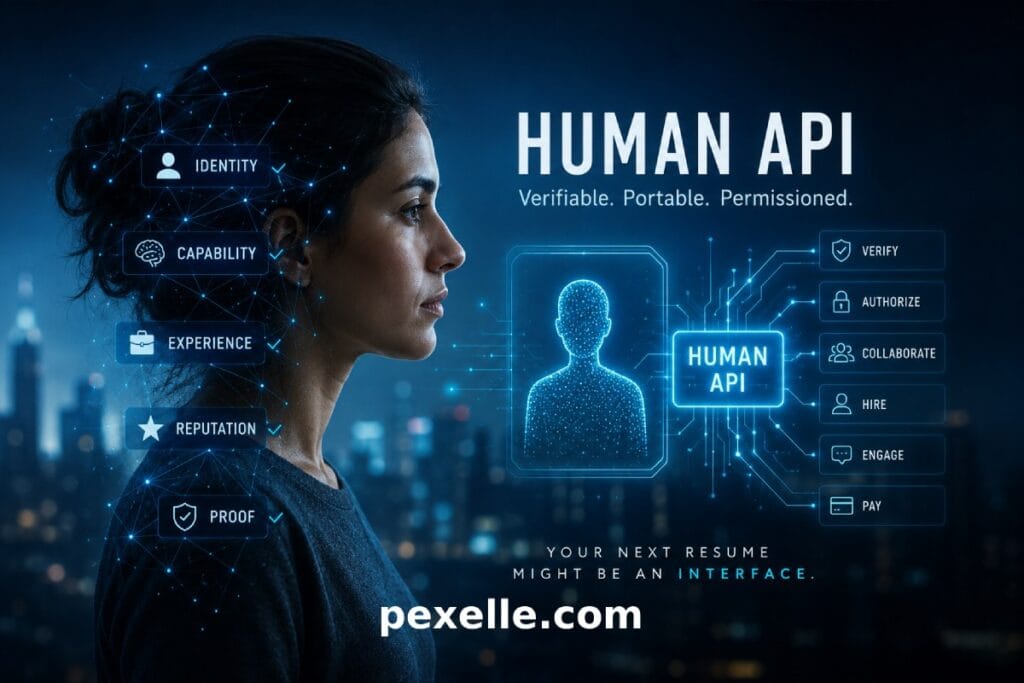
Software has APIs.
Banks have APIs.
Companies have APIs.
AI models have APIs.
Even machines, vehicles, and infrastructure increasingly expose standardized interfaces through which other systems can understand what they can do and interact with them.
Humans do not.
If a company wants to know whether an API can perform a particular operation, it can inspect its documentation, permissions, authentication, responses, and execution history.
If an AI agent wants to know whether another system is authorized to perform an action, it can verify credentials.
But if a company, platform, or AI agent wants to answer a much more fundamental question:
Can this human actually do what they claim they can do?
The digital world still has surprisingly primitive answers.
We rely on resumes.
Profiles.
References.
Interviews.
Followers.
Recommendations.
And ultimately, trust.
These mechanisms were designed for a world in which humans evaluated other humans.
The next internet may work differently.
As AI agents begin discovering talent, assembling teams, assigning work, purchasing services, verifying results, and coordinating economic activity, humans may need something radically different:
A trusted, machine-readable interface for human capability.
In other words, humans may eventually need an API.
Not an API that exposes everything about us.
An API that allows us to prove the things that matter.
The Internet Can Read Software Better Than It Can Read People
Consider how easily software systems communicate.
An API can declare:
GET /capabilities
GET /permissions
GET /status
GET /history
POST /execute
A machine can determine what another machine supports before interacting with it.
Humans are much harder to interpret.
Imagine an AI system trying to find someone capable of designing a production-ready PCB.
It may find thousands of profiles containing words such as:
“PCB Designer”
“Electronics Engineer”
“Hardware Expert”
“Embedded Systems Developer”
But these are claims.
The AI still needs to determine:
Has this person actually designed boards?
How complex were those boards?
Were they manufactured?
Did they work?
What tools were used?
How recently was the skill demonstrated?
Who can verify the work?
How reliable was the person across previous projects?
Today, answering those questions requires collecting fragmented evidence from many different systems.
A trusted Human API could change that.
What Would a Human API Actually Look Like?
A Human API should not be a giant database containing someone’s life.
That would be both dangerous and unnecessary.
Instead, imagine a permissioned interface capable of returning cryptographically verifiable claims.
A request might conceptually look like:
GET /human/capabilities
And instead of returning self-declared profile text, it could return something closer to:
Capability: PCB Design
Verification: Strong
Evidence Sources: 14
Verified Projects: 9
Production Deployments: 6
Last Demonstrated: 18 days ago
Independent Attestations: 4
Another request could ask:
GET /human/reliability
And receive:
Completed Commitments: 47
Verified Outcomes: 43
Disputed Outcomes: 1
Evidence Confidence: 94%
The important difference is not the API syntax.
The important difference is what sits behind it:
evidence instead of claims.
Identity Is Not Enough
The first generation of digital identity infrastructure focused primarily on answering:
Who are you?
That remains important.
But the emerging digital economy needs answers to much more complicated questions:
What can you do?
What have you done?
What are you authorized to do?
What evidence supports those claims?
How reliable have you been?
Is that information still valid?
These are different problems.
Someone can have a perfectly verified identity and still falsely claim to be an expert software architect.
Identity proves the person.
It does not automatically prove capability.
The next generation of trust infrastructure therefore needs to move from:
Identity Verification
toward:
Capability Verification
and eventually:
Continuous Human Verification.
From Resume to Query
The resume is fundamentally a document.
It was designed to be read.
A Human API would be designed to be queried.
That distinction becomes extremely important when AI becomes responsible for discovering and coordinating talent.
Instead of an AI agent reading 20,000 resumes, it could theoretically ask:
Find humans where:

Python capability > verified threshold
Distributed systems experience = proven
Production projects >= 5
Availability = next 30 days
Evidence confidence > 90%
The system would not simply search keywords.
It would search verified capability.
This could fundamentally change recruiting.
But recruiting may only be the beginning.
The same infrastructure could support freelance marketplaces, professional networks, education, project formation, decentralized organizations, financial services, insurance, scientific collaboration, and eventually autonomous AI economies.
The Rise of Machine-Readable Humans
For most of internet history, humans created information for other humans.
Websites were readable by humans.
Profiles were readable by humans.
Resumes were readable by humans.
Portfolios were readable by humans.
But AI changes the primary consumer of information.
Increasingly, machines will read first.
An AI recruiter may evaluate a candidate before a hiring manager does.
An AI procurement agent may evaluate a contractor before anyone schedules a meeting.
An AI project manager may assemble a temporary team based on capabilities.
An autonomous marketplace may match millions of tasks with humans and agents simultaneously.
In such an economy, having a beautiful profile may matter less.
Being machine-verifiable may matter more.
Proof Becomes the Response Format
This creates a deeper shift.
Today’s professional internet is largely based on statements.
“I know Python.”
“I managed a team.”
“I designed this product.”
“I worked at this company.”
“I delivered this project.”
The future may increasingly require proof attached to those statements.
A capability request would therefore not return only:
PCB Design: Expert
It could return evidence.
For example:
Claim:
Advanced PCB Design

Evidence:
9 verified projects

Attestations:
2 manufacturers
3 collaborators
1 employer

Artifacts:
Schematics
Manufacturing files
Project records

Confidence:
High
The response becomes independently verifiable.
The difference is enormous.
A profile tells you what someone says about themselves.
A trust layer tells you what can be demonstrated.
Reputation Must Become Portable
There is another major problem with today’s internet.
Reputation is trapped inside platforms.
A developer may spend ten years building credibility on one platform.
A freelancer may complete hundreds of successful projects on another.
A seller may accumulate thousands of positive transactions somewhere else.
But when they move platforms, much of that reputation disappears.
The platform owns the context.
The human does not fully own the proof.
A Human API could reverse this relationship.
Instead of platforms owning reputation, humans could carry verifiable evidence across platforms.
Your professional history could become portable.
Your verified capabilities could move with you.
Your reputation could become infrastructure rather than a platform feature.
That would represent a significant redistribution of power across the digital economy.
But Trust Cannot Become a Single Score
There is an obvious danger.
If Human APIs emerge, the easiest implementation would be something like:
Human Trust Score: 87/100
That would also be one of the most dangerous implementations.
Humans are multidimensional.
Someone can be an extraordinary engineer and an inexperienced manager.
Someone can be highly reliable in one domain and completely unqualified in another.
Someone’s capability can improve rapidly.
Context matters.
Therefore the future of human trust should probably not resemble a universal credit score.
It should resemble a graph of verifiable capabilities, relationships, evidence, permissions, and outcomes.
Trust should be contextual.
Queryable.
Explainable.
And challengeable.
Privacy Must Be Part of the Architecture
A Human API cannot mean unrestricted access to human information.
The opposite model is more interesting.
Imagine proving:
“I am legally allowed to perform this work.”
without exposing your passport.
Or:
“I have more than five years of verified experience.”
without revealing every employer.
Or:
“I have successfully completed more than 50 relevant tasks.”
without exposing the clients.
This is where technologies such as verifiable credentials, selective disclosure, and zero-knowledge proofs become important.
The goal should not be:
Expose more information about humans.
The goal should be:
Require less information to establish more trust.
That distinction could determine whether Human APIs become liberating infrastructure or surveillance infrastructure.
AI Agents Make This Much More Urgent
Humans have historically tolerated uncertainty.
- We interview.
- We ask questions.
- We build relationships.
- We develop intuition.
Machines operate differently.
An autonomous agent needs structured answers.
If an AI agent controls a budget and needs to hire someone to complete a task, it may need to know:
Is this person real?
Can they perform the task?
What evidence supports that capability?
Are they authorized?
What is their execution history?
What happened when they performed similar work previously?
Can payment be released automatically when verified conditions are satisfied?
This requires something much closer to an API than a profile.
Interestingly, similar problems are already emerging for AI agents themselves. Researchers and infrastructure builders are exploring verifiable identities, credentials, execution histories, authorization and portable reputation for autonomous agents.
The logical next question is unavoidable:
If machines need verifiable identities to interact with each other, how will they establish trust with humans?
Human APIs Could Become the Bridge Between Human and Agent Economies
Imagine the internet ten years from now.
A company needs a temporary engineering team.
Its AI operations agent defines the required capabilities.
It discovers qualified humans and specialized AI agents.
Instead of reading resumes, it requests capability proofs.
Instead of calling references, it verifies signed attestations.
Instead of trusting portfolio descriptions, it verifies project evidence.
Instead of negotiating every administrative detail manually, permissions and contracts are digitally structured.
The resulting team might contain:
three humans,
seven specialized AI agents,
two robotic systems,
and several external services.
To the orchestration system, each participant exposes capabilities.
Machines expose APIs.
Agents expose capabilities and permissions.
Humans expose verified proofs.
The boundaries between “workforce” and “software infrastructure” begin to change.
Your Professional Identity Becomes Infrastructure
This could fundamentally change what a professional profile means.
Today your professional identity is largely something people view.
Tomorrow it may become something systems query.
Instead of asking:
“Where is your resume?”
organizations may ask:
“Where can I verify your capabilities?”
Instead of:
“Send me your portfolio.”
the request may become:
“Authorize access to the relevant proof.”
Instead of:
“Who recommends you?”
the system may ask:
“Which trusted entities attest to this capability?”
Your professional identity stops being a page.
It becomes infrastructure.
The Human API Is Not About Turning People Into Machines
The phrase “Human API” can sound dystopian.
But the objective should not be to reduce humans to endpoints, scores, or datasets.
It should be the opposite.
Today humans repeatedly surrender enormous amounts of personal information simply because digital systems lack better mechanisms for establishing trust.
We upload identification documents.
Repeat background checks.
Rebuild reputation on every platform.
Rewrite resumes.
Re-enter qualifications.
Ask previous employers for references.
Re-prove the same facts again and again.
A properly designed trust infrastructure could reduce this repetition.
Instead of constantly exposing information, humans could provide narrowly scoped proof.
Instead of platforms deciding who we are, individuals could carry their evidence with them.
The Human API should therefore not be an API to the human.
It should be an API to their proofs.
That distinction matters.
The Internet Has APIs for Everything Except Trust
The internet became enormously powerful when software systems learned how to communicate through standardized interfaces.
The next transformation may happen when trust becomes equally interoperable.
Identity.
Capability.
Experience.
Authority.
Reputation.
Evidence.
All could eventually become portable and machine-verifiable.
The technological foundations are beginning to appear. W3C’s work on Digital Credentials already describes APIs through which user agents can mediate the presentation and issuance of digital credentials. Privacy-oriented systems are also experimenting with models in which users hold credentials and services verify only the necessary cryptographic proof rather than maintaining another centralized copy of personal information.
But the larger transformation is not technical.
It is conceptual.
For decades, the internet asked humans to create profiles so other humans could decide whether to trust them.
The AI internet may require something different.
It may require humans to become verifiable participants in a machine-readable economy.
- Not through surveillance.
- Not through universal scoring.
- Not through centralized ownership of identity.
But through portable, permissioned, cryptographically verifiable proof.
Software has APIs for capabilities.
AI agents are beginning to develop identity and trust protocols.
Humans may be next.
And when that happens, the most important professional asset may no longer be what your profile says about you.
It may be what the network can verify.
Source : Medium.com