
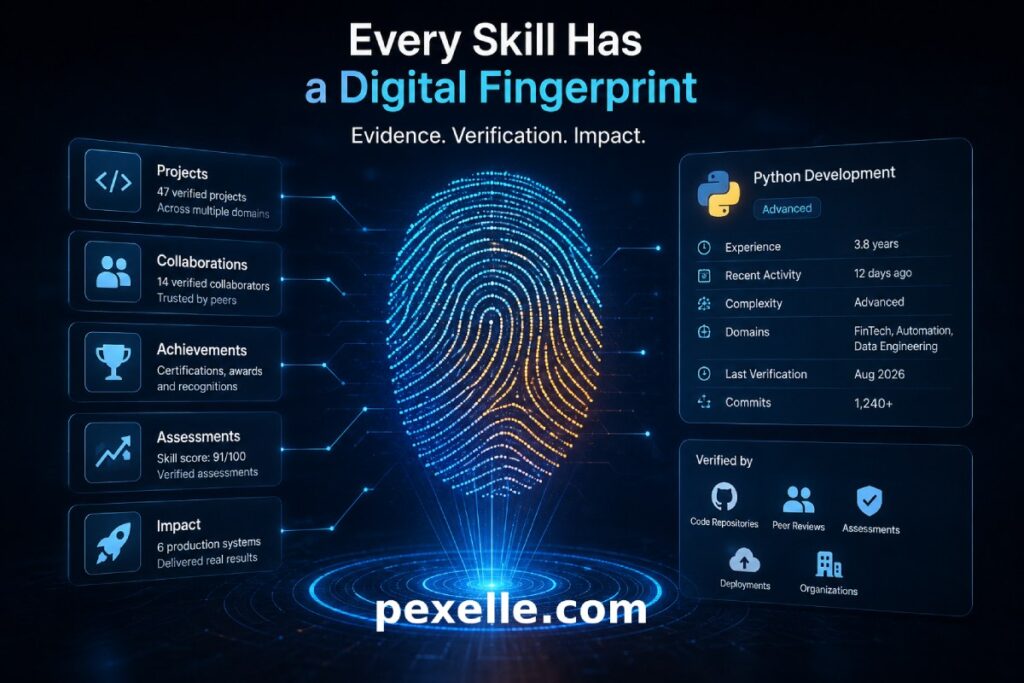
Why the Future of Talent Will Be Built on Evidence
For decades, professional skills have existed largely as claims.
- A résumé says someone knows Python.
- A profile says someone is an experienced designer.
- A certificate says someone completed a cybersecurity course.
- A recommendation says someone is a great project manager.
But none of these necessarily tells us the most important thing:
What has this person actually done that proves the skill?
As artificial intelligence makes it increasingly easy to create polished résumés, portfolios, applications, reports, code samples, and even interview answers, the difference between claiming a skill and demonstrating one becomes much more important.
The next evolution of professional identity may therefore not be a better résumé.
It may be something much deeper:
a digital fingerprint for every skill.
A persistent, evidence-based record showing how a skill was acquired, demonstrated, verified, improved, and applied in the real world.
What Is a Skill’s Digital Fingerprint?
A fingerprint is valuable because it is not simply a description of a person. It is a distinctive pattern that can be examined and compared.
A digital skill fingerprint could work in a similar way.
Instead of representing a skill with a single label:
Python: Advanced
a digital skill fingerprint could contain multiple dimensions:
Skill: Python Development
Evidence: 47 verified projects
Experience: 3.8 years
Recent activity: 12 days ago
Complexity: Advanced
Domains: FinTech, automation, data engineering
Peer validation: 14 verified collaborators
Assessment: 91/100
Production usage: 6 deployed systems
Contribution history: 1,240 verified commits
Last verification: August 2026
The skill stops being a sentence.
It becomes a data structure.
And more importantly, it becomes something that can potentially be verified.
From Skill Claims to Skill Evidence
Today’s professional internet is largely built around self-declared information.
People tell platforms what they know.
Tomorrow’s professional infrastructure could increasingly rely on evidence generated by activity.
Consider two candidates.
Candidate A writes:
Advanced React Developer
Candidate B has a digital skill record containing evidence from:
- production applications
- verified repositories
- code reviews
- technical assessments
- collaborative projects
- client outcomes
- deployment history
- peer verification
Both candidates claim the same skill.
But they carry very different amounts of information.
This represents a fundamental transition:
Claimed Skill → Demonstrated Skill → Verified Skill
Once this transition happens at scale, professional profiles could become much harder to exaggerate and much more useful to evaluate.
A Skill Is Not a Binary Attribute
One of the biggest problems with today’s professional profiles is that skills are usually represented as binary attributes.
You either have “JavaScript” on your profile or you do not.
But real competence does not work that way.
Two people can both know JavaScript while having dramatically different capabilities.
One may have completed a course.
Another may have maintained production systems serving millions of users for seven years.
The label is identical.
The underlying capability is not.
A digital fingerprint could represent those differences through multiple signals:
Depth
How difficult are the problems the person has successfully solved?
Breadth
How many contexts has the skill been applied in?
Recency
When was the skill last demonstrated?
Frequency
How often is the skill actually used?
Reliability
How consistently does the person produce successful outcomes?
Independence
Can the person perform the work independently?
Collaboration
Can the person apply the skill effectively within teams?
Verification
Who or what confirms the evidence?
Impact
What happened because the skill was applied?
Together, these signals produce something far richer than a skill keyword.
They create a skill identity.
The Evidence Graph Behind Every Skill
The most interesting part of this idea is not the badge displayed on a profile.
It is the evidence underneath it.
Imagine a software engineer has a skill card for:
Distributed Systems
Behind that card might exist an evidence graph connecting:
Person → Project → Task → Contribution → Outcome → Validator → Skill
For example:
A person contributed to a production project.
- The project required designing a distributed queue architecture.
- The person’s contribution can be identified.
- The architecture was deployed.
- The system operated successfully under a measurable workload.
Other verified participants confirm the person’s role.
That entire chain contributes evidence toward the skill.
Now repeat this process across dozens or hundreds of professional activities.
The result becomes increasingly difficult to replicate through simple self-promotion.
Your professional identity becomes connected to what you have actually done.
Skills Could Become Living Objects
Traditional certificates are usually static.
You earn them once.
They remain on your résumé for years.
Skills, however, are dynamic.
A developer who was excellent at a framework six years ago but has not touched it since may not have the same capability today.
A digital skill fingerprint could therefore evolve continuously.
Every new verified activity could update it.
New evidence strengthens the fingerprint.
More complex work increases demonstrated depth.
Repeated successful outcomes increase confidence.
Long periods without evidence reduce recency.
New assessments add additional validation.
The result is not a certificate.
It is a living representation of capability.
The Infrastructure Is Beginning to Exist
Parts of the technical foundation for this future already exist.
The World Wide Web Consortium published the Verifiable Credentials 2.0 family as W3C Recommendations in May 2025. These standards provide mechanisms for representing credentials digitally in ways designed to be cryptographically secure, privacy-respecting, and machine-verifiable.
Open Badges 3.0 is another important development. The standard allows credentials to include information such as achievement criteria, evidence, issuance information, recipient references, and cryptographic verification. It also aligns Open Badges with the W3C Verifiable Credentials model.
These technologies do not automatically create universal skill fingerprints.
But they demonstrate something important:
the infrastructure for portable and verifiable digital evidence is becoming real.
The next challenge is connecting credentials to continuously generated evidence of actual capability.
AI Makes Skill Verification More Important, Not Less
Artificial intelligence introduces an interesting paradox.
AI makes humans dramatically more capable.
But AI also makes professional claims harder to interpret.
- If someone submits excellent code, how much did they write?
- If someone produces an impressive design, what was their contribution?
- If someone publishes an outstanding article, what capability does it actually demonstrate?
- If AI helped complete the work, does the output still represent human competence?
The answer cannot simply be to reject AI-assisted work.
AI will become part of normal professional workflows.
Instead, skill systems will need to capture how humans work with AI.
A future skill fingerprint might distinguish between:
Independent execution
The person completed the task primarily through their own expertise.
AI-assisted execution
The person used AI tools but demonstrated judgment, validation, and control.
Agent orchestration
The person successfully coordinated multiple AI systems to produce an outcome.
Human verification
The person reviewed, corrected, or approved AI-generated work.
That means AI itself creates entirely new dimensions of professional competence.
From Résumés to Proof Portfolios
The résumé was designed for an information-scarce world.
Employers had limited information about candidates, so people summarized their careers onto one or two pages.
But digital systems can represent much richer professional histories.
Instead of writing:
5 years of product management experience
a professional identity system could show verified evidence across:
- products launched
- teams coordinated
- decisions made
- milestones achieved
- budgets managed
- customer outcomes
- stakeholder evaluations
- failed projects and subsequent improvements
The résumé compresses experience into claims.
A proof portfolio connects claims to evidence.
That distinction could become extremely important.
Machines Will Need Skill Fingerprints Too
There is another reason structured skill evidence matters.
Future hiring decisions will increasingly involve machines.
AI agents may search for specialists.
Companies may automatically assemble temporary teams.
Platforms may match people to tasks in real time.
Organizations may search millions of professionals for highly specific combinations of capabilities.
Imagine an AI system receiving this request:
Find someone with advanced Python experience, verified computer vision work, at least three production deployments, recent Raspberry Pi experience, and evidence of leading a technical team.
A traditional résumé database might perform keyword matching.
A structured skill-evidence network could perform something closer to capability matching.
That difference could fundamentally change recruitment.
Skills Could Become Portable
Today, professional reputation is fragmented.
- Your work history exists in one system.
- Your education exists somewhere else.
- Your certifications exist across multiple providers.
- Your projects live on different platforms.
- Your reviews belong to marketplaces.
- Your contributions belong to collaboration tools.
- Your reputation is trapped inside databases owned by other organizations.
A mature skill infrastructure could make professional evidence portable.
The individual could carry verified proof between platforms instead of rebuilding credibility every time they join a new one.
This concept already appears in modern digital credential systems, where portability and verification are core goals.
That would create an important shift:
Platforms would no longer own your professional credibility.
You would carry it with you.
Privacy Must Be Built Into the System
A world of measurable skills also creates serious risks.
A skill fingerprint should not become a permanent surveillance record.
People should not be forced to expose every project, employer, mistake, or professional interaction simply to prove competence.
The system therefore needs privacy at its foundation.
Individuals should be able to prove specific claims without necessarily exposing all underlying information.
For example, someone might prove:
“I have completed more than five verified enterprise cybersecurity projects.”
without revealing:
- the clients
- confidential project details
- proprietary documents
- internal communications
Modern verifiable credential architectures are explicitly being designed around privacy and controlled disclosure, which makes this distinction technically important.
The future of verification cannot simply be about collecting more data.
It must be about producing better proofs from less exposed data.
Reputation and Skill Are Different
Another important distinction must be preserved.
Skill is not reputation.
Popularity is not competence.
Followers are not evidence.
Connections are not expertise.
A person could have little online presence while possessing extraordinary professional capability.
A credible skill fingerprint should therefore minimize vanity metrics and prioritize evidence.
The strongest signals would come from demonstrated outcomes, verified participation, assessments, trusted issuers, and repeated performance.
The goal should not be to measure how visible someone is.
The goal should be to understand what they can reliably do.
Every Skill Could Eventually Have Its Own Identity
Imagine opening someone’s professional profile in the future.
Instead of seeing a long list of keywords, you see individual skill cards.
Product Strategy
Confidence: 94%
Verified evidence: 38 activities
Professional usage: 6.2 years
Recent demonstration: 4 days ago
Independent validations: 17
Python
Confidence: 89%
Verified projects: 31
Production deployments: 8
Recent demonstration: 2 weeks ago
Leadership
Confidence: 86%
Verified teams: 7
People collaborated with: 42
Projects delivered: 18
Each skill becomes independently inspectable.
Clicking it reveals the evidence behind the score.
The profile is no longer asking:
“Do you believe this person?”
It is asking:
“Would you like to inspect the evidence?”
The Economic Impact Could Be Enormous
If reliable skill verification becomes possible, many systems built around professional trust could change.
Recruitment could become faster.
Freelance marketplaces could reduce uncertainty.
Companies could identify internal talent more accurately.
Universities could connect learning outcomes with demonstrated capabilities.
Professional licensing could become more portable.
AI agents could discover qualified humans programmatically.
Teams could form dynamically around verified capability.
Compensation could become more closely connected to demonstrated expertise.
Even professional lending, insurance, contracting, and workforce planning could eventually use verified professional capability as an input.
Skills would stop being merely descriptive information.
They could become part of economic infrastructure.
The Most Valuable Professional Data May Be Proof
For much of the internet era, platforms competed to collect identity data.
Who are you?
Where do you live?
Where did you study?
Where have you worked?
The next generation of professional platforms may compete around a different question:
What can you prove you can do?
That changes the value of professional data.
- A job title tells us where someone worked.
- A degree tells us what someone studied.
- A résumé tells us what someone claims.
But a skill fingerprint could connect capability directly to evidence.
And evidence compounds.
- Every verified project adds another signal.
- Every successful collaboration strengthens the graph.
- Every assessment adds confidence.
- Every real-world outcome increases credibility.
Over time, this produces something far more powerful than a static profile:
a continuously evolving map of human capability.
The Future Professional Profile
The professional profile of the future may not look like a résumé at all.
It could look like a network:
Identity
connected to
Skills
connected to
Evidence
connected to
Projects
connected to
People
connected to
Organizations
connected to
Outcomes
with cryptographic verification providing trust between them.
AI could analyze this network.
Employers could query it.
Platforms could verify portions of it.
Individuals could control access to it.
And every skill would carry its own history.
- Its own evidence.
- Its own credibility.
- Its own digital fingerprint.
Conclusion: From “Trust Me” to “Verify Me”
The internet gave everyone the ability to describe themselves.
AI is giving everyone the ability to describe themselves extraordinarily well.
That makes description less valuable.
Evidence becomes more valuable.
The future of professional identity may therefore move beyond profiles, endorsements, certificates, and résumé keywords toward something more fundamental:
proof of capability.
- Every meaningful project leaves evidence.
- Every collaboration creates signals.
- Every successful outcome strengthens credibility.
- Every verified contribution adds another layer.
- Eventually, those signals could form a unique digital fingerprint around each professional skill.
And when that happens, the most important question in hiring may no longer be:
“What skills do you have?”
It may become:
“What does the evidence say you can do?”
Source : Medium.com