
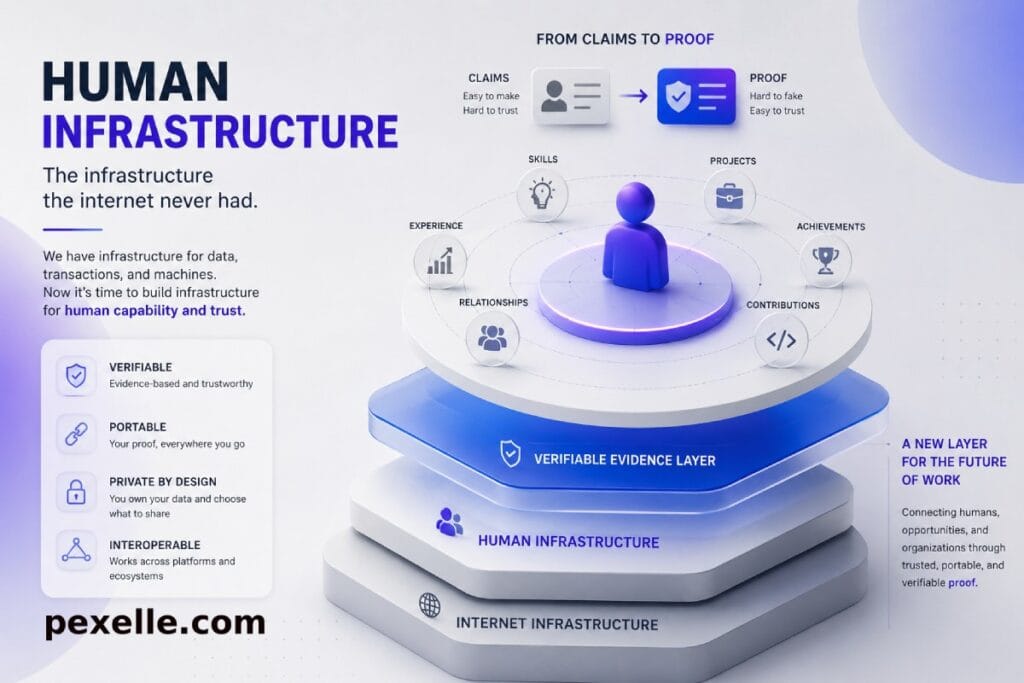
The Infrastructure the Internet Never Had
The internet was built to connect machines.
It learned how to move information across continents, route billions of requests, authenticate devices, encrypt transactions, store enormous amounts of data, and coordinate systems operating thousands of kilometers apart.
What it never truly learned was how to understand the humans using it.
Today, almost every important digital interaction eventually encounters the same problem:
Who is this person, what can they actually do, and why should we trust them?
We have built sophisticated infrastructure for data, payments, applications, and machines. Yet the human layer of the digital world remains surprisingly primitive.
- A website can prove that its connection is encrypted.
- A blockchain can prove that a transaction occurred.
- A payment network can prove that money moved.
- A cloud platform can prove that a server executed a request.
But when a person claims:
“I know how to build this.”
“I completed this project.”
“I have this experience.”
“I contributed to this product.”
“I am qualified for this opportunity.”
the internet often has no native way to verify those claims.
Instead, we rely on resumes, profiles, references, certificates, followers, recommendations, interviews, and increasingly sophisticated algorithms attempting to infer credibility from incomplete information.
This is one of the internet’s oldest architectural gaps.
And as artificial intelligence transforms the digital economy, that gap is becoming impossible to ignore.
The next major layer of the internet may not be another infrastructure for machines.
It may be Human Infrastructure.
The Internet Has Infrastructure for Almost Everything Except People
Modern digital life depends on invisible infrastructure.
DNS helps computers find destinations.
TCP/IP moves information between machines.
Cloud infrastructure provides computing power.
Payment networks move money.
Identity systems manage authentication.
APIs allow software to communicate.
Blockchains provide decentralized mechanisms for recording and verifying transactions.
These systems create standardized ways for machines to understand one another.
Humans never received an equivalent layer.
Instead, information about people became fragmented across thousands of platforms.
- Your professional history may exist on one platform.
- Your code contributions on another.
- Your certificates somewhere else.
- Your freelance projects in another database.
- Your reputation inside individual marketplaces.
- Your academic credentials inside institutional systems.
- Your work may be spread across emails, documents, repositories, project-management systems, portfolios, and private company databases.
Each platform sees a fragment.
Almost nobody sees the complete picture.
The internet knows enormous amounts about people.
But it understands remarkably little about what those people have actually proven.
That distinction matters.
Identity Is Not the Same as Capability
The first generation of digital identity focused on a relatively simple question:
Are you the person you claim to be?
That problem produced passwords, authentication systems, identity verification, biometrics, digital IDs, and Know Your Customer systems.
These technologies are important.
But knowing someone’s identity tells us almost nothing about their capability.
Knowing that someone is really Jane Smith does not prove that Jane can manage a construction project, design a distributed system, perform financial analysis, operate specialized machinery, lead a team, or build a production-ready application.
The digital economy increasingly needs to answer a second question:
What has this person actually demonstrated?
That requires something beyond identity.
It requires evidence.
From Profiles to Proof
The professional internet was largely built around self-declared information.
- People create profiles.
- People list skills.
- People describe experience.
- People write resumes.
- People select job titles.
- People request endorsements.
For decades, this model was sufficient because producing convincing professional information required effort.
AI changes that assumption.
- A polished resume can now be generated in seconds.
- A professional biography can be generated instantly.
- A portfolio description can be rewritten beautifully.
- A cover letter can be personalized automatically.
Even sophisticated technical explanations can increasingly be produced without the person possessing deep expertise in the subject.
The cost of producing convincing claims is approaching zero.
That means the value of the claim itself is falling.
The important question is moving from:
What do you say you can do?
to:
What can you prove you have done?
This is a fundamental shift.
The professional internet is moving from an economy of claims toward an economy of evidence.
Human Infrastructure would provide the foundation for that transition.
What Is Human Infrastructure?
Human Infrastructure is a digital layer that allows human capabilities, contributions, experiences, achievements, reputation, and professional relationships to become structured, portable, and verifiable.
It is not simply another social network.
It is not another resume database.
And it is not a universal score assigned to every person.
It is closer to a trust and evidence layer for human activity.
Imagine a system where professional claims could be connected to evidence.
- A skill could be connected to projects where it was demonstrated.
- A project could be connected to organizations and collaborators who participated.
- An achievement could be connected to measurable outcomes.
- A credential could be connected directly to its issuer.
- A contribution could carry information about when, where, and under what context it occurred.
- A reputation could emerge from a history of verified activity rather than popularity.
Instead of creating another profile that says:
“This person is a software engineer.”
Human Infrastructure could help answer:
“What evidence demonstrates that this person can engineer software?”
That is a much more powerful question.
The Human Graph
Search engines built graphs of information.
Social networks built graphs of relationships.
Financial systems built graphs of transactions.
The next important graph may be a graph of human capability and contribution.
Consider a professional who has worked across multiple companies and projects.
Their digital history might contain relationships between:
Person → Skill
Person → Project
Person → Organization
Person → Contribution
Person → Credential
Person → Collaborator
Skill → Evidence
Project → Outcome
Contribution → Verification
When these relationships become structured, something important happens.
Professional identity stops being a static document.
It becomes a living network of evidence.
A resume says what happened.
A Human Infrastructure system could potentially show how those claims are connected, where they originated, and what evidence supports them.
AI Makes Human Infrastructure Necessary
Artificial intelligence is often described as a productivity revolution.
But it is simultaneously creating a credibility problem.
- AI can generate code.
- AI can generate research.
- AI can generate presentations.
- AI can generate business plans.
- AI can generate designs.
- AI can generate professional communication.
- AI can even simulate expertise remarkably well.
As AI becomes better at producing professional outputs, the existence of an output becomes weaker evidence that a particular person possesses the capability traditionally associated with producing it.
This creates a paradox.
The more capable AI becomes, the more important reliable human evidence becomes.
The internet will contain more content than ever.
But determining who actually knows what, who contributed what, and who should be trusted may become significantly harder.
In that environment, professional credibility cannot depend entirely on content.
It must increasingly depend on provenance, history, context, contribution, and evidence.
That is precisely the territory Human Infrastructure would occupy.
Skills Must Become Verifiable Objects
Today, skills are usually represented as words.
Python.
Leadership.
Construction Management.
Machine Learning.
Financial Analysis.
Product Design.
But a word provides very little information.
Two people can list the same skill while possessing radically different levels of experience.
A more useful digital model would connect skills to evidence.
Instead of:
Skill: Machine Learning
the system might understand:
Skill → Projects → Contributions → Outcomes → Evidence
This changes the meaning of a skill.
It stops being something someone simply adds to a profile.
It becomes something accumulated through demonstrated activity.
Over time, professional identity could become less about describing yourself and more about the evidence your work continuously produces.
Reputation Must Become Portable
Another weakness of today’s internet is that reputation is usually trapped inside platforms.
A freelancer can complete hundreds of successful projects on one marketplace and still begin almost from zero somewhere else.
A developer may have years of meaningful contributions distributed across repositories that are difficult for employers to interpret.
A contractor may have an excellent record with multiple organizations without having a standardized mechanism for carrying that reputation into a new relationship.
Platforms own fragments of professional trust.
Humans rarely do.
Human Infrastructure could change that model.
Reputation could become more portable.
Evidence could follow the individual.
Professional history could exist independently of any single platform.
Instead of repeatedly rebuilding credibility, people could carry a structured history of demonstrated trust across the digital economy.
Human Infrastructure Is Not a Social Network
This distinction is critical.
Social networks optimize for attention.
Human Infrastructure would optimize for credibility.
Social platforms ask:
Who follows you?
Human Infrastructure asks:
What supports your claims?
Social platforms measure engagement.
Human Infrastructure measures evidence.
Social platforms encourage visibility.
Human Infrastructure enables verification.
These systems may coexist, but they solve fundamentally different problems.
One manages attention.
The other manages trust.
The Missing Layer Between Humans and AI Agents
There is another reason this infrastructure may become important.
AI agents are beginning to make decisions and perform actions on behalf of humans and organizations.
They may eventually help companies discover talent, assemble teams, select contractors, evaluate suppliers, assign tasks, and coordinate complex projects.
But agents need structured information.
An AI agent cannot reliably build a high-performing team from vague profile descriptions alone.
It needs machine-readable evidence about people.
Who has performed similar work?
What skills were demonstrated?
Under what conditions?
Who verified the work?
What outcomes resulted?
How recent is the evidence?
How reliable is the source?
Human Infrastructure could become the interface between humans and an increasingly agent-driven economy.
AI would not merely search profiles.
It could reason over structured histories of human capability.
From Search for People to Search for Capability
This could fundamentally change recruitment.
Today, companies often search for people using proxies:
keywords,
degrees,
years of experience,
companies previously worked for,
and geographic location.
These signals are useful, but imperfect.
Human Infrastructure could enable a different model.
Instead of searching for:
“Senior backend engineer with 7 years of experience.”
an organization might search for:
“People who have demonstrated the ability to design and operate high-volume distributed systems in production environments.”
The difference is significant.
One searches descriptions.
The other searches evidence.
This could eventually affect recruiting, freelancing, professional marketplaces, education, internal mobility, and project formation.
Proof Could Become More Valuable Than Credentials
Credentials will continue to matter, particularly in regulated professions.
But in many fields, the relationship between credentials and actual capability is becoming more complicated.
Learning increasingly happens through work, online education, open-source communities, independent projects, AI-assisted experimentation, and practical experience.
Human Infrastructure could allow these experiences to become part of a structured professional record.
Instead of forcing every capability into the traditional language of degrees and certificates, the internet could recognize multiple forms of credible evidence.
A certificate says:
“This person completed a program.”
Evidence can potentially say:
“This person demonstrated this capability under these conditions.”
Both are valuable.
But they answer different questions.
Trust Should Be Contextual, Not Universal
Human Infrastructure should not create a single number representing the value of a human being.
That would be both technically misleading and socially dangerous.
Trust is contextual.
Someone may be highly credible in cybersecurity and completely inexperienced in structural engineering.
Someone may be an exceptional individual contributor but an inexperienced manager.
Someone may have extensive experience in one industry and almost none in another.
The infrastructure therefore should not ask:
“How trustworthy is this person?”
It should ask more precise questions:
“What claims about this person are supported by evidence?”
“How strong is that evidence?”
“Who or what produced it?”
“In what context was the capability demonstrated?”
This produces something far more useful than a universal reputation score.
It produces a map of demonstrated capability.
Privacy Must Be Part of the Architecture
There is an obvious danger in building richer infrastructure around human activity.
Verification can easily become surveillance.
Human Infrastructure should therefore not mean collecting everything a person does.
The architecture should prioritize ownership, consent, selective disclosure, provenance, and privacy.
People should be able to control what evidence becomes visible.
Sensitive information should not automatically become public.
Organizations should not need access to an individual’s complete history simply to verify one specific claim.
The goal should be:
minimum necessary disclosure with maximum possible verification.
Without strong privacy principles, Human Infrastructure could become another centralized system that extracts value from human data.
With the right architecture, it could do the opposite.
It could give individuals greater ownership over their professional identity and evidence.
A New Digital Primitive: Proof of Human Capability
The internet has developed powerful primitives.
Links connect information.
Accounts represent identities.
Transactions represent economic activity.
Tokens represent digital assets.
APIs represent machine capabilities.
Human Infrastructure may introduce another important primitive:
verifiable human capability.
Once capability becomes structured and portable, entirely new applications become possible.
Recruiting platforms could match opportunities using demonstrated capabilities.
Education platforms could connect learning directly to evidence of application.
Companies could discover hidden internal talent.
Professional marketplaces could reduce dependence on platform-specific reputation.
AI agents could assemble teams based on verified experience.
Workers could carry their professional history across organizations and platforms.
The result would not simply be a better resume.
It would be a different architecture for the professional internet.
The Internet’s Next Layer May Be Human
The first internet connected computers.
The web connected information.
Social networks connected people.
Cloud platforms connected software.
Blockchains connected digital ownership and transactions.
Artificial intelligence is connecting intelligence to almost every digital process.
But something is still missing.
A trusted infrastructure connecting people, skills, contributions, evidence, and opportunity.
For decades, we built increasingly sophisticated systems around humans while leaving the humans themselves represented by profiles, documents, and self-declared claims.
That model is reaching its limits.
In a world where machines can generate convincing content, professional credibility cannot depend entirely on what someone writes about themselves.
It must increasingly depend on what can be demonstrated.
The next evolution of the internet may therefore be less about creating another place for people to communicate.
It may be about creating the infrastructure through which human capability can be understood.
Not another profile.
Not another follower count.
Not another database of resumes.
A persistent, portable, evidence-based layer connecting humans to what they have actually done.
Human Infrastructure.
The infrastructure the internet never had.
Source : Medium.com