
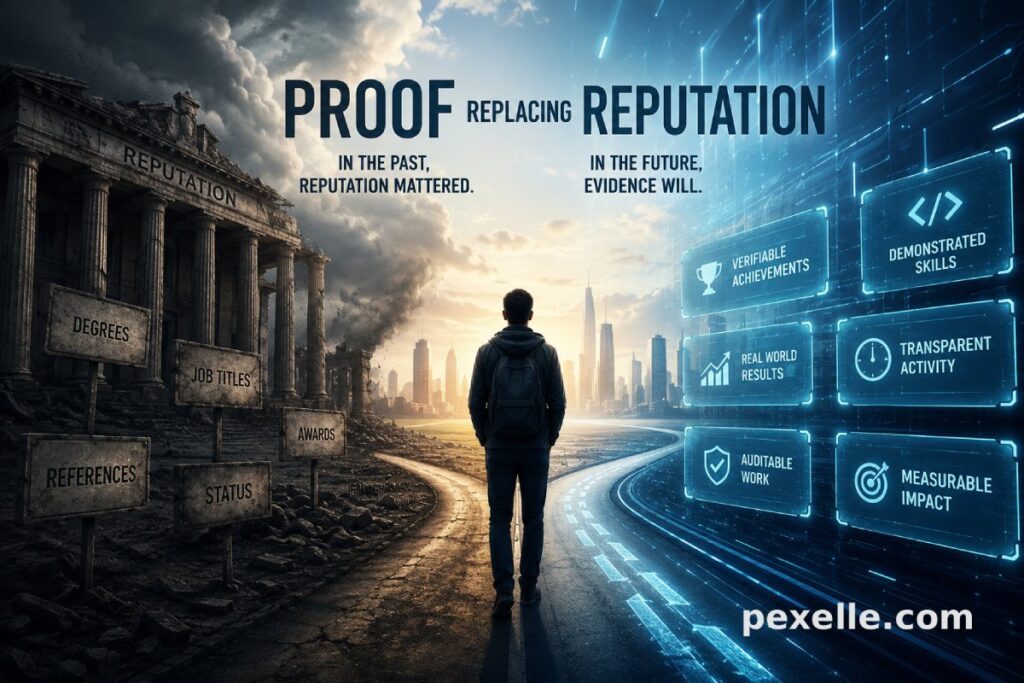
In the Past, Reputation Mattered. In the Future, Evidence Will
For centuries, human societies have relied on reputation as a shortcut for trust.
A respected university degree suggested competence. A prestigious job title implied expertise. A well-known company logo on a résumé signaled capability. Recommendations, references, awards, and social status all served as proxies for credibility.
Reputation was the infrastructure of trust.
But we are entering a new era where reputation alone is becoming insufficient. As artificial intelligence accelerates the creation of content, credentials, portfolios, and even entire digital identities, society is shifting toward a fundamentally different model:
Proof is replacing reputation.
The Reputation Economy
Historically, verifying someone’s abilities was difficult.
If a company wanted to hire a software engineer, it could not easily observe years of coding work. Instead, it relied on indirect signals:
- Degrees from respected institutions
- Previous employers
- Industry certifications
- Recommendations
- Personal networks
- Public reputation
The same principle existed everywhere.
Investors trusted founders based on previous exits.
Universities admitted students based on grades and recommendations.
Customers bought products because of brand reputation.
In a world where information was scarce, reputation acted as an efficient trust mechanism.
The problem is that reputation has always been a proxy, not proof.
AI Is Breaking Traditional Signals
Artificial intelligence is rapidly reducing the reliability of many traditional indicators of credibility.
Today AI can generate:
- Professional résumés
- Recommendation letters
- Portfolios
- Cover letters
- Academic essays
- Marketing content
- Design concepts
- Software code
- Research summaries
The quality is often good enough to pass initial human evaluation.
As a result, the cost of appearing competent is approaching zero.
- A candidate can present a polished portfolio without creating most of the work.
- A founder can generate investor materials in hours.
- A student can produce assignments that appear impressive.
- A consultant can create sophisticated reports without deep expertise.
This does not mean everyone is cheating.
It means the traditional signals that once represented capability are becoming easier to imitate.
And when imitation becomes cheap, reputation loses value.
The Rise of Verifiable Proof
The next trust economy will not be built on claims.
It will be built on evidence.
Instead of asking:
“Where did you work?”
Organizations will increasingly ask:
“What can you demonstrate?”
Instead of evaluating credentials, they will evaluate outcomes.
Instead of trusting reputation, they will verify performance.
The future belongs to people who can provide proof.
Examples include:
- Real project contributions
- Verifiable work history
- Public performance records
- Auditable achievements
- Demonstrated skills
- Measurable results
- Transparent activity logs
The question is shifting from:
“Who says you are good?”
to
“What evidence shows you are good?”
The Internet Is Becoming a Giant Verification System
Many of the most successful digital platforms already operate on proof rather than reputation.
Developers demonstrate skills through public code repositories.
Creators prove value through engagement metrics.
Drivers prove reliability through ride history.
Sellers prove trustworthiness through transaction records.
Freelancers prove capability through completed projects.
In each case, evidence matters more than claims.
The trend is clear:
Trust is moving from identity to performance.
Why Degrees and Résumés Will Matter Less
This does not mean degrees disappear.
It means they become one data point among many.
For decades, educational credentials acted as a proxy for potential.
But employers increasingly care about demonstrated capability.
- Can the candidate solve real problems?
- Can they collaborate effectively?
- Can they deliver measurable outcomes?
- Can they learn quickly?
A degree may suggest the answer.
Proof can confirm it.
As verification systems improve, organizations will favor direct evidence over indirect indicators.
The Future of Hiring
Hiring may become one of the industries most transformed by this shift.
Instead of evaluating applicants primarily through CVs and interviews, companies may increasingly assess:
- Real-world simulations
- Live problem solving
- Continuous skill assessments
- Portfolio verification
- Project-based evaluations
- On-chain or cryptographically verifiable credentials
- AI-assisted performance analysis
The strongest candidates will not necessarily be those with the best résumés.
They will be those with the strongest evidence.
This creates opportunities for talented individuals who may lack traditional credentials but can clearly demonstrate value.
Digital Proof and the Next Generation of Trust
Emerging technologies are making proof more scalable than ever.
Blockchain systems can verify ownership and history.
AI systems can analyze performance data.
Digital credentials can be cryptographically validated.
Work histories can become more transparent and portable.
Reputation will not disappear.
But it will increasingly be backed by evidence.
In the future, a reputation without proof may be viewed the same way we view an unsupported claim today:
Interesting, but not sufficient.
A More Merit-Based Future
One of the most promising aspects of this transition is that it can create fairer opportunities.
Traditional reputation systems often favor:
- Established institutions
- Existing networks
- Geographic advantages
- Social status
- Historical privilege
Proof-based systems have the potential to focus more directly on demonstrated capability.
A talented person from anywhere in the world can showcase evidence of skill.
A newcomer can compete with established players.
Results become more important than credentials.
Achievement becomes more important than appearance.
Conclusion
The world is moving from an era of assumed credibility to an era of verified credibility.
For generations, reputation served as the foundation of trust because evidence was difficult to obtain.
Today, technology is changing that equation.
As AI makes it easier to create convincing appearances, society will increasingly demand verifiable proof.
The future will belong to individuals, organizations, and systems that can demonstrate capability rather than merely claim it.
Because in the age of artificial intelligence, reputation can be manufactured.
Proof cannot.
And that is why proof is replacing reputation.
Source : Medium.com