
Introduction
The internet is often celebrated as one of humanity’s greatest inventions. It connected billions of people, removed geographical barriers, democratized access to information, and transformed how we work, learn, and interact.
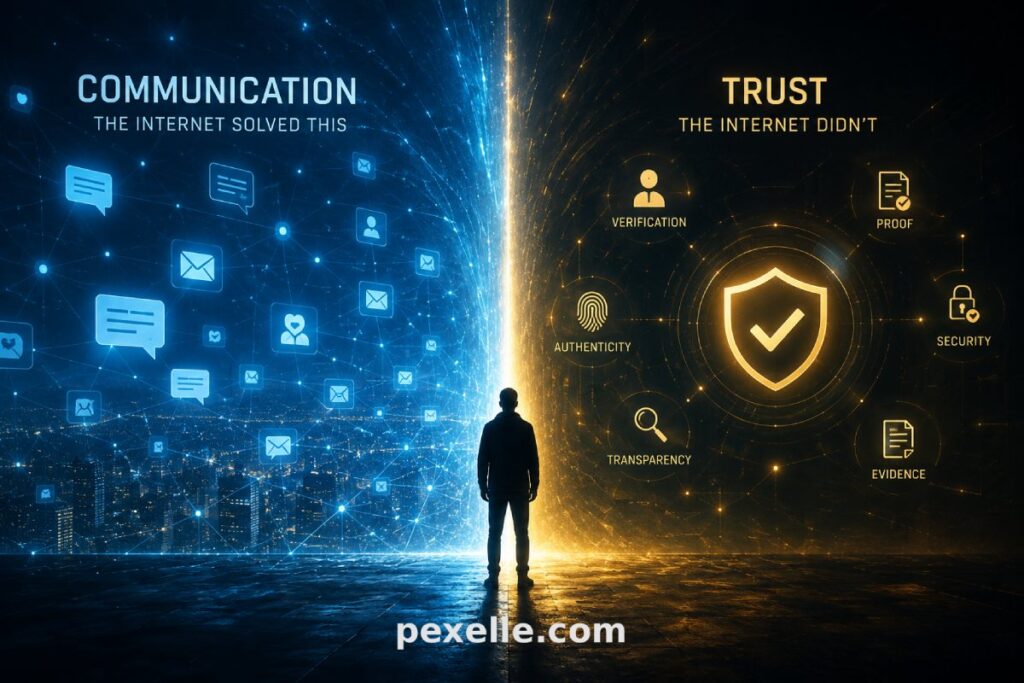
In many ways, the internet solved communication.
A message that once took weeks to cross continents now arrives in milliseconds. A startup in New Zealand can collaborate with developers in India, designers in Europe, and customers in the United States in real time. Information flows faster than ever before.
Yet despite all these advances, one fundamental problem remains unsolved:
Trust.
The internet made communication global, but it did not make communication trustworthy.
In fact, by reducing the cost of communication to nearly zero, it also reduced the cost of deception.
Communication Became Free
Before the internet, communication had natural barriers.
Sending letters cost money.
Making international phone calls was expensive.
Publishing information required access to newspapers, television stations, or printing presses.
These barriers created friction.
The internet removed nearly all of that friction.
Today anyone can:
- Create a website
- Publish content
- Send emails
- Launch advertisements
- Build social media accounts
- Reach millions of people instantly
The result was an unprecedented explosion of communication.
For the first time in history, information became abundant.
Unfortunately, abundance created a new challenge:
How do we know what is true?
The Trust Crisis
The internet dramatically increased the volume of information but did not improve our ability to verify it.
Every day we encounter:
- Fake reviews
- Fake followers
- Fake news
- Fake identities
- Fake credentials
- Fake screenshots
- Fake promises
Communication became easy.
Verification remained difficult.
The problem is not that information is unavailable.
The problem is that information can be manufactured.
A professional-looking website no longer proves legitimacy.
A large social media following no longer proves influence.
A polished resume no longer proves competence.
A viral post no longer proves accuracy.
The signals we once used to establish trust became increasingly unreliable.
Reputation Was the Old Trust Layer
Historically, trust was built through reputation.
People trusted:
- Established institutions
- Recognized brands
- Local communities
- Long-term relationships
- Personal recommendations
Reputation worked because information traveled slowly.
A person’s history was difficult to fake.
A company’s credibility took years or decades to build.
Trust accumulated over time.
However, the internet changed the economics of reputation.
Today anyone can manufacture the appearance of credibility:
- Buy followers
- Purchase reviews
- Generate content with AI
- Create fake testimonials
- Build convincing digital identities
Reputation signals became easier to manipulate than ever before.
AI Makes the Problem Bigger
Artificial intelligence is accelerating this challenge.
AI can now generate:
- Articles
- Images
- Videos
- Voice recordings
- Customer reviews
- Social media profiles
Soon, almost any digital content can be produced at near-zero cost.
As generation becomes cheaper, authenticity becomes more valuable.
The question shifts from:
“Can this be created?”
to
“Can this be verified?”
The future will not be limited by content production.
It will be limited by trust verification.
The Rise of Proof-Based Systems
The next phase of the internet is moving from communication toward verification.
Instead of trusting claims, people increasingly demand evidence.
Examples already exist:
In Commerce
Customers want verified purchases rather than anonymous reviews.
In Hiring
Employers increasingly value demonstrated skills over self-reported credentials.
In Finance
Blockchain systems verify transactions through cryptographic proof rather than institutional trust.
In Media
Fact-checking, source verification, and authenticity tracking are becoming critical.
In Artificial Intelligence
Users increasingly ask not only for answers but also for sources and evidence.
Across industries, proof is becoming more important than promises.
Trust Is Becoming Infrastructure
Most people think of trust as a social concept.
Increasingly, trust is becoming technical infrastructure.
The next generation of systems will rely on:
- Cryptographic verification
- Digital signatures
- Verifiable credentials
- Transparency logs
- Blockchain records
- Proof-of-origin systems
- Reputation linked to evidence
These technologies are not simply improving security.
They are creating new trust layers for the internet.
The original internet allowed information to move.
The next internet will allow information to be verified.
Proof Is Replacing Reputation
One of the most important shifts of the coming decade is the transition from reputation-based trust to proof-based trust.
In the past:
“I trust you because people say you are trustworthy.”
In the future:
“I trust you because the evidence is verifiable.”
This distinction is profound.
Reputation depends on opinions.
Proof depends on facts.
Reputation can be manipulated.
Proof can be audited.
Reputation is subjective.
Proof is measurable.
The organizations that understand this shift early will gain a significant advantage.
The Future Internet
The future internet will not merely connect people.
It will connect proofs.
Every important digital interaction will increasingly require verification:
- Identity
- Ownership
- Experience
- Skills
- Transactions
- Content authenticity
Trust will become programmable.
Verification will become automated.
Evidence will become portable.
The internet’s first era connected information.
The second era connected people.
The next era will connect truth to evidence.
Conclusion
The internet achieved something extraordinary.
It solved communication at a global scale.
Billions of people can now exchange information instantly and almost for free.
But communication alone is not enough.
When anyone can say anything, the real challenge becomes knowing what to believe.
The defining technological challenge of the next decade is not faster communication.
It is trustworthy communication.
The winners of the future will not be those who communicate the most.
They will be those who can prove what they communicate.
Because the internet solved communication.
The next generation of technology must solve trust.
Source : Medium.com