Why Location Still Limits Professional Opportunities, and How We Can Build a World Where Ability Matters More Than Address
For decades, geography has quietly determined who gets access to the best professional opportunities.
Where someone was born, where they studied, which city they live in, and which companies operate nearby have all influenced the trajectory of their careers. A talented software engineer in a small town might never meet the right employer. An exceptional designer in a developing country might never get an opportunity to work with a global team. A highly skilled professional might spend years competing for a limited number of local positions, simply because the organizations that need their abilities are thousands of kilometres away.
But something fundamental is changing.
Remote work, digital collaboration, global talent platforms, artificial intelligence, and decentralized professional networks are challenging the traditional relationship between geography and career opportunity.
The world is moving toward an economy where talent can contribute across borders without physically relocating.
Yet there is an important distinction between making work location-independent and making opportunity genuinely accessible.
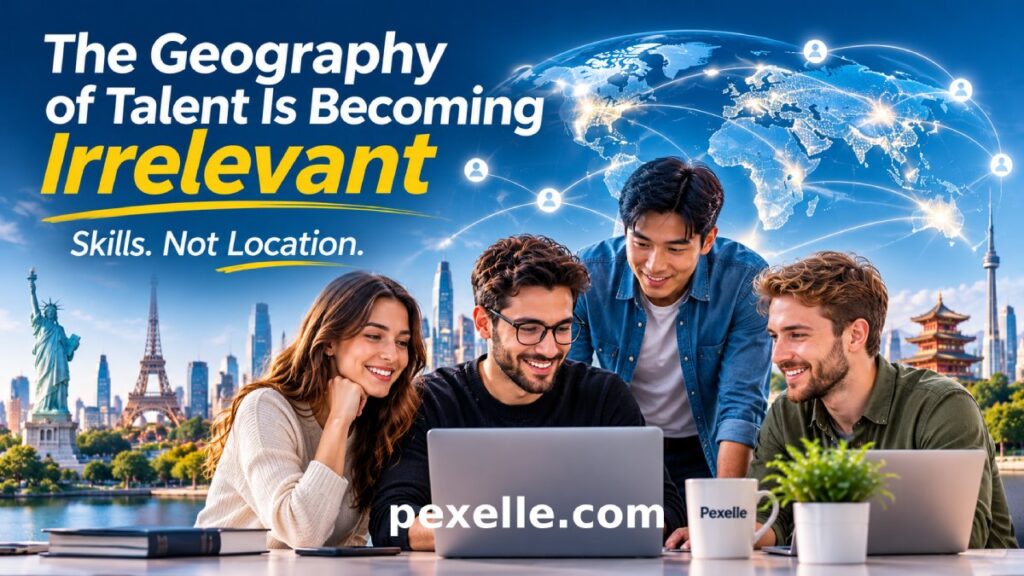
The geography of talent is becoming irrelevant, but the geography of opportunity has not disappeared.
Understanding this difference is essential to building a more inclusive, efficient, and evidence-driven professional economy.
1. The Geography of Opportunity Was Never Equal
Professional opportunity has never been distributed evenly across the world.
Some cities have become powerful centers of innovation, investment, education, and employment. Silicon Valley, London, New York, Singapore, Berlin, and other major economic hubs attract companies, investors, universities, and highly skilled professionals.
For people living in these ecosystems, opportunity is often physically accessible.
They can attend industry events, meet potential employers, participate in professional communities, connect with investors, and discover opportunities through informal networks.
For someone living outside these centers, accessing the same opportunities can require significantly more effort.
Consider two professionals with identical technical abilities:
- One lives in a major technology hub, surrounded by startups, established companies, investors, and professional networks.
- The other lives in a smaller city where relevant employers are limited and international professional connections are difficult to establish.
Despite having equivalent capabilities, their career opportunities may look completely different.
The difference is not necessarily talent, education, or ambition.
It is access.
This creates a structural inefficiency in the global labor market: organizations may overlook exceptional people simply because those individuals are not located within the traditional geography of recruitment.
The result is a global economy that often searches for talent in the places where it is easiest to find, rather than everywhere talent actually exists.
2. Remote Work Removed One Barrier, Not All of Them
The expansion of remote work has been one of the most significant changes in the modern employment landscape.
Organizations can now collaborate with professionals across different countries, time zones, and economic environments. Many responsibilities that once required physical presence can be performed entirely online.
This has created new possibilities for professionals who previously had to relocate to access better employment.
However, remote work alone does not create equal access to opportunity.
Several barriers remain.
Hiring networks are still geographically concentrated.
Many companies continue to recruit through local professional communities, university networks, referrals, and established regional talent pools. Remote positions may be advertised globally, but the actual recruitment process can still favor candidates who are already connected to the employer’s ecosystem.
Professional visibility remains unequal.
A skilled professional may have an impressive portfolio but lack the professional connections needed to make that work visible to international employers.
Credentials are not universally understood.
Educational qualifications, professional certifications, and employment histories can carry different levels of recognition across countries. Employers may struggle to evaluate experience gained in unfamiliar educational or professional systems.
Time zones and working conditions still matter.
International collaboration introduces practical challenges involving communication, availability, employment regulations, payment infrastructure, and contractual arrangements.
Trust remains a major obstacle.
An employer hiring someone they have never met, from a country where they have no existing professional network, needs reliable ways to understand that person’s actual capabilities.
Remote work made physical distance less important. It did not automatically make professional credibility, visibility, and trust equally accessible.
3. The Real Problem Is Not Finding Talent. It Is Recognizing It.
The global economy does not necessarily suffer from a shortage of capable people.
It suffers from inefficient ways of discovering, evaluating, and connecting them.
Traditional recruitment systems rely heavily on signals that are relatively easy to collect:
- University names and educational qualifications.
- Previous employers and job titles.
- Years of professional experience.
- Geographic location.
- Professional references.
- Familiar certifications and credentials.
These signals can provide useful information, but they are incomplete representations of human capability.
A job title does not reveal everything someone can do.
A university degree does not necessarily demonstrate practical competence.
Years of experience do not automatically indicate current expertise.
And a professional’s location says very little about their ability to solve a complex problem.
Imagine a developer who has spent five years building sophisticated software products for small businesses in a country with limited international technology connections.
Their work might be more relevant to a global employer than the experience of someone with a prestigious job title at a well-known organization.
But if their experience is difficult to verify, their projects are invisible, and their professional history does not match familiar recruitment expectations, they may never reach the interview stage.
This is where the professional economy needs a fundamental change.
Instead of asking where someone studied, worked, or lives, organizations should increasingly ask what they can demonstrate, what they can contribute, and what evidence supports their capabilities.
The future of global recruitment depends on better ways to recognize ability, not simply broader ways to advertise vacancies.
4. The Rise of a Borderless Capability Economy
A new model of professional participation is emerging.
In this model, individuals are not defined exclusively by their location, employer, or job title. Their professional value is increasingly represented by the capabilities they possess and the evidence supporting those capabilities.
We can call this the Capability Economy.
In a Capability Economy, professional opportunity becomes more closely connected to four elements:
What can an individual actually do?
This includes technical expertise, communication, leadership, problem-solving, creativity, and other capabilities that contribute to meaningful work.
Can those capabilities be demonstrated and evaluated?
Evidence may include completed projects, verified work experience, assessments, certifications, contributions, practical demonstrations, and professional attestations.
Contribution
How has the individual applied their capabilities in real situations?
Building a product, solving a business problem, mentoring a team, contributing to an open-source project, or delivering measurable results provides a clearer picture of professional ability.
Impact
What changed because of that contribution?
The strongest professional signals are not simply statements about what someone knows. They demonstrate what someone has achieved and the value their work has created.
This creates a different way of understanding professional identity:
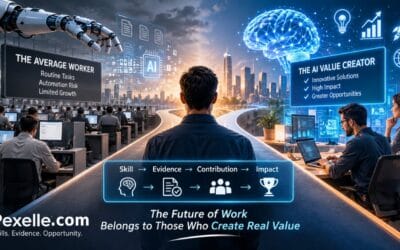
Skill → Evidence → Contribution → Impact
Geography becomes less important when professional capabilities can be discovered, evaluated, and trusted independently of physical location.
A company in Germany could identify a cybersecurity specialist in New Zealand. A startup in Singapore could collaborate with a product designer in Brazil. An organization in Canada could recruit an exceptional engineer in a region that was previously outside its traditional hiring network.
The connection becomes possible because professional value is represented through more meaningful signals.
5. Artificial Intelligence Is Accelerating the Shift
Artificial intelligence is changing how organizations discover talent and how individuals develop their professional capabilities.
AI-powered systems can help identify skill relationships, analyze professional experience, match capabilities to job requirements, and uncover opportunities that traditional keyword-based recruitment systems might miss.
For example, a company searching for a specific job title might overlook someone whose experience is described differently.
A professional might never have held the title of Product Manager, but their documented experience could demonstrate product strategy, stakeholder management, user research, prioritization, and delivery.
AI can help identify these relationships.
It can also help individuals understand which capabilities are missing from their professional profiles, identify relevant learning opportunities, and build development roadmaps aligned with real market requirements.
However, there is an important risk.
AI can make talent discovery faster without necessarily making it fairer.
If an AI recruitment system is trained on historical hiring patterns, it may reproduce the same geographic and institutional biases that already exist in traditional recruitment.
If it evaluates candidates primarily through online visibility, familiar institutions, or employment histories, professionals outside established networks may remain disadvantaged.
There is also a growing problem involving synthetic professional identities and AI-generated credentials.
As AI makes it easier to produce convincing portfolios, documents, and professional claims, organizations need stronger ways to distinguish between what someone claims to know and what they can actually demonstrate.
The solution is not simply more AI-powered recruitment.
It is better evidence, transparent evaluation, and more reliable professional verification.
AI should help people discover opportunities and understand capabilities. It should not become an unquestionable authority over human potential.
6. Professional Credibility Must Become Portable
One of the biggest challenges in a borderless labor market is professional trust.
Imagine that an employer in New Zealand wants to hire a specialist from Argentina.
The candidate has excellent experience, several successful projects, and strong technical abilities. However, the employer has never worked with them, does not recognize their previous organizations, and cannot easily verify the claims in their profile.
The candidate may be perfectly qualified, but the employer faces uncertainty.
This is not simply a recruitment problem. It is a professional identity problem.
In traditional employment systems, credibility is often attached to institutions.
A well-known university, recognized employer, established professional association, or respected industry reference can provide an initial level of trust.
But these signals are not equally available to everyone.
A more inclusive professional ecosystem requires credibility that can travel with the individual.
This means developing portable professional records that can contain:
- Verified skills and competencies.
- Evidence of completed projects and practical work.
- Confirmed employment and contribution histories.
- Professional attestations from qualified individuals.
- Relevant certifications and assessments.
- Records of achievements and measurable outcomes.
- Updated information reflecting the development of professional capabilities.
The important principle is that professional credibility should not depend entirely on the reputation of an institution or the location of an employer.
It should also be supported by verifiable evidence of individual ability.
A portable professional identity allows people to carry their achievements across organizations, industries, and national borders.
It also gives employers a more consistent foundation for evaluating candidates from unfamiliar professional environments.
7. The Hidden Barriers That Still Divide Global Talent
Even as the world becomes more digitally connected, several structural barriers continue to limit professional mobility.
Understanding them is necessary if we want to move beyond the idea of a completely borderless workforce.
Economic Inequality
Access to reliable internet, modern devices, professional education, and specialized software remains uneven.
A talented individual may have the ability to perform highly complex work but lack the infrastructure needed to compete internationally.
Language and Communication
Technical expertise does not automatically translate into effective international collaboration.
Language expectations, communication styles, and cultural differences can influence hiring decisions, even when candidates have equivalent professional capabilities.
Payment and Employment Infrastructure
International payments, taxation, employment classification, legal compliance, and cross-border contracts can make hiring difficult.
A company may want to hire someone remotely but lack the infrastructure or legal arrangements to do so.
Credential Recognition
Professional qualifications are not always transferable between countries.
Some employers may struggle to understand foreign educational systems, professional licenses, or industry-specific certifications.
Algorithmic Bias
Recruitment algorithms can unintentionally reinforce geographic preferences by prioritizing candidates from familiar institutions, countries, or professional networks.
Unequal Professional Visibility
People with strong networks often gain access to opportunities through referrals and private communities.
Those without these connections may have to rely on public recruitment channels, where their work can be difficult to distinguish.
Removing these barriers requires more than remote collaboration software.
It requires a professional infrastructure that makes ability easier to discover, evaluate, verify, and trust.
8. What Organizations Must Change
Companies that want to access global talent need to rethink how they define and evaluate professional suitability.
The traditional approach often begins with a location, a job title, a degree, and a specific employment history.
A capability-oriented approach starts with the actual requirements of the work.
Organizations should consider several important changes.
Hire for demonstrated capability, not just familiar credentials.
Degrees and professional qualifications can remain valuable, but they should be considered alongside practical evidence and relevant experience.
Separate essential requirements from geographic preferences.
If a role can genuinely be performed remotely, geographic restrictions should have a clear operational or legal justification.
Make skills more important than job titles.
Two professionals with different career histories may possess exactly the capabilities required for a position.
Build structured and consistent evaluation systems.
Practical assessments, project reviews, verified experience, and competency-based interviews can help reduce reliance on subjective impressions.
Recognize contributions beyond traditional employment.
Open-source development, independent projects, consulting, volunteering, entrepreneurship, and community contributions can all demonstrate valuable professional capabilities.
Invest in cross-border collaboration.
Organizations need appropriate communication practices, clear expectations, suitable employment arrangements, and systems that support distributed teams.
The goal is not to hire globally simply because it is possible.
It is to ensure that the best available talent can compete fairly, regardless of where that talent happens to be located.
9. What Professionals Can Do to Become Globally Discoverable
The transformation of the labor market also creates new responsibilities for individuals.
Professionals can no longer assume that qualifications, job titles, or years of experience will communicate their full value to a global audience.
They need to make their capabilities visible and understandable.
Here are several practical steps.
Build an Evidence-Based Professional Identity
Create a professional profile that goes beyond a list of previous positions.
Include real projects, measurable achievements, practical demonstrations, certifications, and verified contributions.
Instead of simply writing that you have strong problem-solving skills, show examples of problems you have solved.
Develop Skills That Transfer Across Industries
Technical expertise is valuable, but transferable capabilities are increasingly important.
Critical thinking, communication, adaptability, analytical reasoning, collaboration, and problem-solving can create opportunities across different industries and geographical markets.
Participate in Global Professional Communities
Contribute to open-source projects, professional discussions, international communities, and collaborative initiatives.
These environments provide opportunities to demonstrate expertise beyond the boundaries of a local employment market.
Make Your Work Verifiable
Where possible, document the origin, ownership, scope, and outcome of your contributions.
Maintain project records, request professional attestations, and collect evidence that can help others evaluate your work.
Build a Skills-Based Professional Profile
Think beyond your current job title.
Identify the capabilities you have developed through employment, education, independent projects, and personal initiatives.
A broader representation of your professional capabilities can reveal opportunities that traditional job-title matching might overlook.
Stay Relevant
Professional capabilities evolve.
A skill that was valuable several years ago may need updating, while new combinations of existing skills can create entirely different career opportunities.
Continuous learning and evidence of current competence are essential in a rapidly changing professional environment.
The objective is simple: make it possible for an organization anywhere in the world to understand what you can do without needing to know where you come from.
10. The Future of Talent Platforms: From Job Boards to Capability Infrastructure
Traditional job boards were designed primarily to connect vacancies with applicants.
They made job discovery easier, but they did not fundamentally solve the problem of evaluating human capability.
A job board can tell an employer who applied for a position.
It cannot necessarily tell them who has the strongest relevant skills, who has demonstrated those skills, or who could succeed in a role that does not match their previous job title.
The next generation of professional platforms needs to move beyond vacancy-based matching.
Imagine a system where:
- Professionals maintain continuously updated capability profiles.
- Skills are connected to practical evidence and verified achievements.
- Employers describe opportunities through required competencies rather than rigid job titles.
- AI identifies relevant capabilities across different industries and professional backgrounds.
- Professional contributions become discoverable beyond traditional employment records.
- Organizations can evaluate candidates through transparent and consistent evidence.
- Individuals can identify skill gaps and discover learning opportunities based on actual market requirements.
Such a system would change the relationship between professionals and employers.
Instead of waiting for the right job advertisement, individuals could become discoverable through their capabilities.
Instead of searching exclusively for candidates with familiar career histories, organizations could identify people whose demonstrated abilities match their actual needs.
This is where platforms such as Pexelle see an important opportunity.
Pexelle is built around the idea that professional value should be more than a job title or a collection of self-reported claims.
By connecting skills, evidence, professional verification, and contributions, the vision is to help create a more transparent and accessible professional ecosystem.
The objective is not simply to help people find jobs.
It is to make human capabilities easier to recognize, validate, and connect with meaningful opportunities.
11. A World Without Geographic Limits Still Needs Trust
It is tempting to imagine that technology will eventually eliminate geographical barriers entirely.
But a borderless digital economy does not mean a world without constraints.
Some professions will continue to require physical presence, local licenses, specialized equipment, or knowledge of regional regulations.
Healthcare, construction, manufacturing, transportation, and many other industries will always have responsibilities that cannot be performed entirely remotely.
Even within digital industries, legal jurisdictions, data residency requirements, security obligations, and time-zone considerations will remain important.
Therefore, the future is not necessarily a world where location becomes meaningless.
It is a world where location becomes a more precise requirement rather than an automatic limitation.
If a job genuinely requires someone to be physically present, geography matters.
If a role can be performed effectively from anywhere, geography should not become an unnecessary filter.
The distinction is important.
The objective should be to remove artificial barriers, not ignore legitimate operational requirements.
Most importantly, a global talent economy must be built on trust.
The easier it becomes to connect with professionals across the world, the more important it becomes to understand who they are professionally, what they can do, and whether their achievements are genuine.
Access without trust creates uncertainty.
Trust without access creates exclusivity.
A better professional ecosystem needs both.
Conclusion: Your Address Should Not Define Your Professional Potential
For generations, geography has influenced professional destiny.
Being born in the right city, attending the right university, joining the right organization, and knowing the right people could create advantages that were difficult for others to overcome.
Technology is gradually challenging that structure.
Remote collaboration is expanding access to international work. AI is improving how capabilities can be discovered and connected. Digital credentials and professional verification are creating opportunities to make achievements more portable.
But the transformation is incomplete.
The biggest challenge is no longer simply connecting people to the internet or allowing companies to hire remotely.
It is creating a system where human capabilities can be recognized, evaluated, and trusted regardless of geographic origin.
The next generation of professional infrastructure must shift attention away from where people are located and toward what they can demonstrate and contribute.
Because the world does not lack talent.
It lacks efficient ways to recognize talent everywhere.
Your location may determine where you start, but it should not determine how far your abilities can take you.
The future of work belongs to an economy where opportunity follows capability, evidence builds trust, and professional potential is no longer limited by an address.
The geography of talent is becoming irrelevant. The real question is whether our professional systems are ready to catch up.
Source : Medium.com