
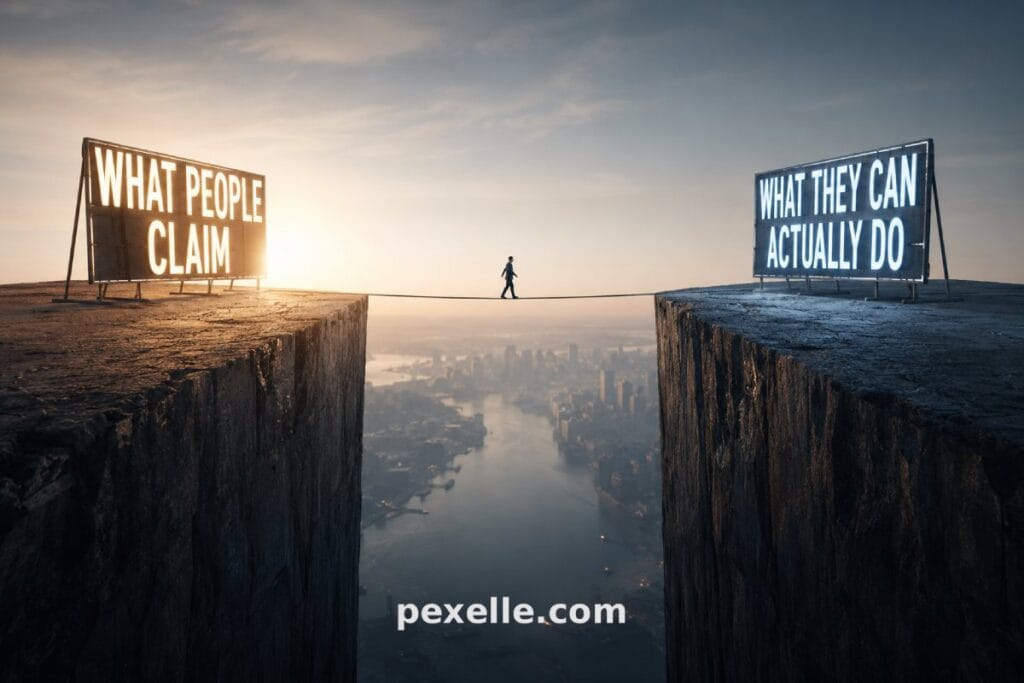
The Distance Between What People Claim and What They Can Actually Do
For centuries, society has relied on claims.
Resumes claim experience. Companies claim expertise. Influencers claim authority. Governments claim achievements. Individuals claim skills.
The modern world is built on statements, credentials, and reputation.
But a growing problem has emerged:
The gap between what people say they can do and what they can actually deliver.
This is the Verification Gap.
As digital communication expands and artificial intelligence makes content creation easier than ever, the ability to make convincing claims has become almost unlimited. Meanwhile, verifying those claims remains difficult, expensive, and time consuming.
The result is a world where information is abundant, but trust is increasingly scarce.
The Age of Easy Claims
Creating a claim has never been easier.
- A person can build a professional looking website in hours.
- A startup can publish impressive marketing materials without having a working product.
- A job applicant can generate a polished resume with AI.
- A social media account can appear influential through purchased followers and engagement.
The internet dramatically reduced the cost of communication.
It did not reduce the cost of verification.
In fact, as communication became easier, verification became more important.
Every new platform increased the number of claims being made while verification mechanisms struggled to keep up.
This imbalance created the Verification Gap.
Why Trust Is Becoming More Expensive
In the past, reputation often served as a shortcut.
A university degree, a famous company, or a respected institution provided signals that helped people make decisions.
These signals still matter, but they are becoming less reliable.
Skills change rapidly.
Technologies evolve.
Industries transform.
Someone who was highly qualified five years ago may not be qualified today.
A certificate shows that a person passed an assessment at a specific point in time.
It does not necessarily prove current capability.
As a result, organizations spend increasing amounts of money verifying talent, vendors, partners, and information sources.
Trust is no longer assumed.
Trust must be continuously validated.
The Impact on Hiring
Hiring is one of the clearest examples of the Verification Gap.
Candidates often list skills, technologies, and achievements on their resumes.
Companies must determine whether those claims reflect reality.
Traditional interviews are often poor verification tools.
People can memorize answers.
They can rehearse stories.
They can optimize for interview performance without possessing real expertise.
This is why practical assessments are becoming more common.
Instead of asking what someone knows, organizations increasingly want evidence of what someone can produce.
The focus is shifting from credentials to demonstrated outcomes.
From promises to proof.
The Business Verification Challenge
Businesses face the same problem.
Marketing teams can create impressive narratives.
Sales teams can make ambitious promises.
Websites can showcase carefully selected success stories.
But customers increasingly want evidence.
They want reviews.
Case studies.
Performance metrics.
Independent validation.
Real customer experiences.
The most successful companies are learning that trust is earned through transparency rather than persuasion.
Verification becomes a competitive advantage.
Artificial Intelligence and the Verification Crisis
AI amplifies the Verification Gap.
AI can generate articles, presentations, reports, code, images, videos, and marketing materials at incredible speed.
As content becomes easier to create, appearance becomes a weaker signal of quality.
A beautifully written report no longer proves expertise.
A professional looking website no longer proves capability.
A polished presentation no longer proves execution.
The ability to produce convincing outputs has become democratized.
Therefore, verification must move deeper.
Organizations must evaluate outcomes, performance, and measurable results rather than appearances.
The question is no longer:
“Can this person create a convincing presentation?”
The question becomes:
“Can this person consistently produce the desired result?”
The Rise of Proof-Based Systems
The future belongs to proof-based systems.
Instead of relying primarily on claims, these systems rely on evidence.
Examples include:
• Public portfolios
• Open source contributions
• Verified transaction histories
• Performance records
• Customer reviews
• On-chain activity
• Real world outcomes
• Verifiable credentials
In these systems, trust is built through observable actions rather than declarations.
The focus shifts from who you say you are to what you can repeatedly demonstrate.
Verification as Infrastructure
Most people think of verification as a feature.
In reality, it is becoming infrastructure.
Just as the internet became infrastructure for communication, verification will become infrastructure for trust.
Future platforms will increasingly answer questions such as:
What has this person actually accomplished?
Can these results be independently verified?
How recent is the evidence?
How consistent is the performance?
What proof supports the claim?
The organizations that solve these problems effectively will shape the next generation of digital trust.
Closing Thoughts
The Verification Gap is one of the defining challenges of the digital age.
Every day, billions of claims compete for attention.
Some are true.
Some are exaggerated.
Some are completely false.
As information becomes easier to create, verification becomes more valuable.
The future will not belong to those who make the biggest claims.
It will belong to those who can provide the strongest proof.
Because in a world overflowing with promises, evidence becomes the ultimate currency of trust.
Source : Medium.com