
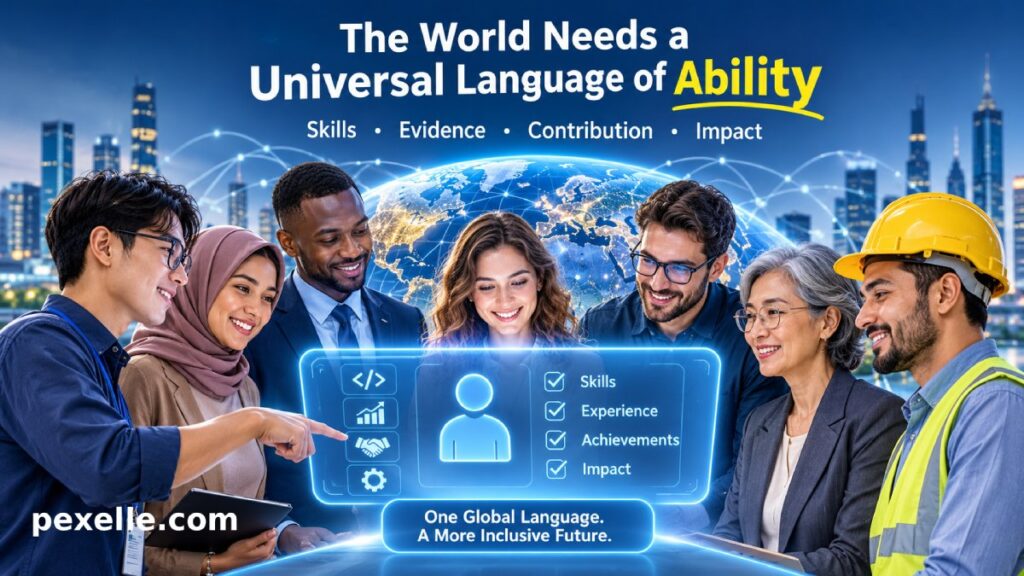
Why Human Capabilities Should Be Understood Beyond Countries, Industries, and Job Titles
Imagine a software engineer in India applying for a position in Germany. She has spent eight years building complex systems, leading technical teams, solving architectural problems, and delivering products used by thousands of people. Yet, when her application reaches an international employer, much of her experience must be translated into unfamiliar job titles, local qualifications, and industry-specific terminology.
Now imagine a construction manager moving into renewable energy, a teacher transitioning into corporate training, or a military professional entering the private sector. Each has valuable capabilities, but their experience is often difficult to recognize outside the environment in which it was developed.
The problem is not necessarily a lack of talent. It is a lack of a common language for describing it.
Around the world, millions of people possess valuable abilities that employers, institutions, and professional networks struggle to understand. Their capabilities exist, but the systems used to describe and evaluate them remain fragmented.
What if human ability could be described in a universal language, one that works regardless of where someone lives, what industry they work in, or what their job title says?
This is not simply an improvement to recruitment. It could fundamentally change how the world recognizes, compares, develops, and connects human potential.
1. The World Has a Language Problem, Not Just a Skills Problem
The global workforce is more connected than ever. People work remotely, move between countries, change industries, and collaborate across cultural and professional boundaries.
However, the language used to describe their abilities has not evolved at the same pace.
One country may recognize a profession through formal qualifications. Another may prioritize years of experience. A third may rely heavily on professional licensing. Even when two people perform almost identical work, their job titles, credentials, and career descriptions may look completely different.
Consider the following examples:
- A Project Coordinator in one country may perform responsibilities similar to a Project Manager elsewhere.
- A Technical Support Specialist may possess the diagnostic and problem-solving abilities required for a Systems Administrator position.
- A teacher may have exceptional communication, facilitation, assessment, and leadership capabilities that are rarely visible in traditional corporate recruitment.
- A construction supervisor may have transferable planning, risk management, team coordination, and operational leadership skills.
The terminology changes, but the underlying human capabilities may remain remarkably similar.
This creates a significant disconnect between what people can actually do and what professional systems recognize them for.
A global workforce needs more than standardized job descriptions. It needs a shared framework for understanding the abilities behind those descriptions.
2. Job Titles Are Labels, Not Definitions of Human Ability
Job titles are useful organizational tools, but they are poor representations of everything a person can do.
A title describes a position within a particular organization or industry. It does not necessarily explain the complete range of capabilities a person has developed.
Two employees with the same title can have dramatically different strengths. One may excel at strategic thinking, while another is particularly strong in execution, communication, or technical problem-solving.
Likewise, two people with completely different titles may possess highly comparable capabilities.
The problem becomes even more significant when someone changes careers.
A person who has spent ten years managing construction projects does not suddenly lose their planning, budgeting, negotiation, leadership, or risk management abilities when moving into another industry.
Yet traditional recruitment systems frequently treat professional transitions as if people must start from zero.
A universal language of ability would shift the focus from:
What was your previous job?
To:
What can you demonstrate that you are capable of doing?
This distinction could make professional experience more portable, meaningful, and valuable.
3. What Would a Universal Language of Ability Look Like?
A universal language of ability would be a structured system for describing human capabilities using consistent definitions, regardless of geographical or professional context.
It would not require everyone to have the same education, career path, or professional identity.
Instead, it would establish a shared foundation for interpreting what people know, what they can do, and how effectively they can apply their capabilities.
Such a framework could include several interconnected dimensions.
Technical Capabilities
These describe practical and specialized abilities that allow someone to perform specific tasks.
Examples include:
- Software development
- Data analysis
- Financial modeling
- Electrical installation
- Mechanical engineering
- Cybersecurity
- Digital design
Cognitive Capabilities
These describe how people process information, understand situations, and solve problems.
Examples include:
- Critical thinking
- Analytical reasoning
- Strategic planning
- Decision-making
- Problem-solving
- Systems thinking
Interpersonal Capabilities
These describe how individuals interact and collaborate with others.
Examples include:
- Communication
- Negotiation
- Conflict resolution
- Collaboration
- Mentoring
- Relationship management
Operational Capabilities
These describe the ability to organize, coordinate, and deliver work effectively.
Examples include:
- Project management
- Resource allocation
- Process optimization
- Risk management
- Quality assurance
- Operational planning
Adaptive Capabilities
These describe how individuals respond to changing environments and unfamiliar challenges.
Examples include:
- Learning agility
- Adaptability
- Resilience
- Creative thinking
- Working across disciplines
- Applying existing knowledge in new situations
These categories would provide a starting point, not a fixed or exhaustive classification of human potential.
The real objective would be to create a common structure in which capabilities can be identified, described, connected, and evaluated consistently.
4. The Challenge Is Not Defining Skills. It Is Making Them Comparable.
The world already has several frameworks designed to classify occupations, qualifications, and skills.
For example, the European Skills, Competences, Qualifications and Occupations framework (ESCO) provides a multilingual classification of skills, competences, qualifications, and occupations.
The O*NET database in the United States provides detailed information about occupations, including the skills, knowledge, abilities, and activities associated with different roles.
These systems represent important progress toward a more structured understanding of work.
However, classification alone does not solve the entire problem.
Knowing that two people list the same skill does not necessarily mean they possess it at the same level or can apply it in the same circumstances.
Consider two individuals who both claim to have project management skills.
One has completed an introductory course. Another has managed a multimillion-dollar project involving multiple teams, complex dependencies, and significant operational risks.
The skill label is identical. The demonstrated capability is not.
A meaningful universal language must therefore go beyond naming abilities.
It needs a way to describe their context, proficiency, application, and supporting evidence.
Without these elements, a universal skills vocabulary risks becoming another database of self-reported claims.
5. From Skills to Evidence: The Missing Layer
If a universal language of ability is going to be trusted, it must distinguish between what people say they can do and what they can actually demonstrate.
A capability should not exist only as a word on a profile.
It should be connected to evidence.
For example:
Capability: Software Development
Evidence: A completed software project.
Context: Developed a production application for a financial services company.
Contribution: Designed backend architecture and implemented API integrations.
Outcome: Delivered a system supporting thousands of transactions.
Verification: Confirmed by a project stakeholder or independent technical assessment.
This approach creates a more meaningful representation of professional ability.
Instead of simply collecting skills, the system connects capabilities to real-world applications.
A person might demonstrate the same capability through different forms of evidence:
- Professional experience
- Completed projects
- Practical assessments
- Academic work
- Professional certifications
- Community contributions
- Independent endorsements
- Verified work outcomes
Not all evidence carries the same weight. A certificate, for example, may demonstrate knowledge acquisition, while a completed project may demonstrate practical application.
A trustworthy framework should preserve these distinctions rather than treating every credential or claim as equivalent.
The objective is not to eliminate qualifications or professional experience. It is to make them more informative.
6. Why Geography Should Not Determine the Value of Human Ability
One of the biggest barriers in the global workforce is the geographical interpretation of professional experience.
People moving between countries often discover that their previous careers are difficult to translate into local employment systems.
A qualification may not be recognized. A job title may not exist in the destination country’s occupational classification. An employer may be unfamiliar with the organization where someone previously worked.
This can create a situation where an experienced professional is evaluated primarily through the limitations of their documentation rather than the substance of their capabilities.
A universal language could help reduce this disconnect.
Imagine a healthcare administrator moving from New Zealand to Canada, or an engineer relocating from Brazil to Germany.
Instead of relying exclusively on previous job titles, employers could examine a structured capability profile showing:
- What the individual can do.
- At what level they can perform.
- Where and how they have applied those abilities.
- What evidence supports their claims.
- Which capabilities transfer to the new environment.
This would not automatically replace immigration rules, professional licensing, or local qualification requirements.
Certain occupations require country-specific legal authorization for good reasons.
However, it could make transferable capabilities easier to recognize before, during, and after professional relocation.
Geographical mobility should not mean the disappearance of professional identity.
7. Industries Need to Understand Each Other
The same problem exists between industries.
Professional sectors often develop their own terminology, standards, and definitions.
A capability that is highly valuable in one industry may be described using completely different language in another.
For example, risk assessment in construction, cybersecurity, healthcare, and financial services involves different technical knowledge. Yet all four fields require the ability to identify potential threats, evaluate consequences, prioritize responses, and reduce exposure.
Similarly, resource management in logistics may share important underlying capabilities with workforce planning in healthcare or operations management in manufacturing.
A universal capability framework could reveal these connections.
It would allow employers to distinguish between:
- Industry-specific knowledge that requires specialized experience.
- Transferable capabilities that can be applied across sectors.
- Capabilities that need further development before someone can perform a new role.
This distinction is important because career opportunities are not always found within the industry where someone started.
The next generation of employment systems should recognize potential across professional boundaries, rather than limiting people to the occupations they have already held.
8. AI Makes a Universal Language of Ability More Important
Artificial intelligence is changing how organizations identify talent, evaluate applications, and allocate work.
AI systems can process enormous amounts of professional information, identify relationships between occupations, and compare candidate profiles with job requirements.
But these systems are only as meaningful as the information they interpret.
If one profile describes a person using a local job title, another uses an industry-specific certification, and a third lists dozens of loosely defined skills, comparing them accurately becomes difficult.
A shared capability structure could provide a more consistent foundation for these systems.
Instead of matching candidates primarily through keywords and job titles, AI could help identify relationships between:
- Demonstrated capabilities and job requirements.
- Previous experience and new career opportunities.
- Existing strengths and development needs.
- Verified contributions and organizational challenges.
- Learning activities and emerging professional demands.
However, AI should not become the final authority on human ability.
Automated systems can misinterpret evidence, reproduce historical biases, or overlook capabilities that are difficult to quantify.
A responsible framework must support transparency, explainability, human review, and the ability to challenge incorrect assessments.
The purpose of AI should be to improve the understanding of human potential, not reduce people to algorithmic scores.
9. A Universal Language Must Be Dynamic, Not Permanent
Human capabilities are not static.
People learn new technologies, develop expertise, change professional environments, and gain experience through practice.
Some abilities improve through repeated application. Others become less relevant as industries and technologies evolve.
A universal language should therefore describe not only what someone can do today, but also how their capabilities develop over time.
Consider a cybersecurity professional.
Five years ago, their experience may have focused on traditional network security. Today, they may have developed expertise in cloud security, AI-related threats, and advanced incident response.
A profile that simply preserves an old list of skills cannot accurately represent this development.
A more useful model would connect capabilities to:
- Development history
- Recent practical evidence
- Current proficiency
- Relevant experience
- Professional achievements
- New learning activities
- Changes in industry requirements
This creates a living representation of professional ability rather than a document that becomes outdated shortly after it is written.
Importantly, not every capability should automatically expire. Some foundational abilities remain valuable for decades. Others require frequent reassessment.
The framework should reflect the nature of each capability rather than applying one universal expiration rule.
10. The Risks of Creating a Universal Standard
The idea of a universal language is powerful, but it also introduces serious challenges.
A system designed to describe human ability could become harmful if it is implemented without appropriate safeguards.
Cultural Bias
Communication, leadership, collaboration, and professional behavior can be expressed differently across cultures.
A universal framework must avoid treating one country’s professional expectations as the global definition of competence.
Overstandardization
Not every valuable human capability can be reduced to a fixed category or measurable score.
Creativity, judgment, empathy, and innovation may require contextual evaluation.
Credential Inequality
If the system gives excessive weight to formal certifications, it may reproduce the same barriers that prevent talented individuals from receiving recognition today.
Practical experience, independent work, and alternative learning pathways must also have legitimate ways of being represented.
Privacy and Ownership
A person’s professional capability profile contains valuable personal information.
Individuals should have meaningful control over their data, including who can access it, how it is used, and how evidence is shared.
Algorithmic Discrimination
If organizations use capability data to make employment decisions, inaccurate classifications or biased evaluation models could create new forms of discrimination.
A universal language must therefore be designed around human rights, transparency, fairness, and individual control.
The goal should be to make ability more visible, not make people more easily controlled.
11. From a Universal Language to a Global Capability Economy
What happens when people, employers, educational institutions, and professional communities begin using a common way to describe human ability?
The implications extend far beyond recruitment.
For individuals, professional identity becomes more portable. People can demonstrate capabilities developed through employment, education, personal projects, and community contributions.
For employers, recruitment can become more focused on actual requirements and demonstrated abilities rather than narrow title matching.
For educational institutions, learning pathways can be connected more directly to the capabilities people need to develop.
For governments, workforce planning can become more informed by actual capability gaps instead of relying exclusively on occupational categories.
For professional communities, individuals with complementary capabilities can discover opportunities to collaborate regardless of their location or industry.
Over time, this could support a more connected capability economy.
In such an economy, opportunities would increasingly be connected to what people can demonstrate and contribute, rather than being determined exclusively by their previous job titles or institutional affiliations.
This does not mean qualifications, experience, or professional credentials become irrelevant.
It means they become part of a broader picture of human capability.
12. Building the Infrastructure for Verifiable Human Ability
A universal language cannot succeed through terminology alone.
It requires infrastructure capable of connecting capability definitions, evidence, verification, and professional identity.
This is where a new generation of professional platforms can play an important role.
The objective should be to create systems where:
- Capabilities have consistent and understandable definitions.
- Different international frameworks can be mapped to a shared structure.
- Individuals can connect claims to supporting evidence.
- Verification sources and evidence quality remain visible.
- Professional achievements can be represented across industries.
- Individuals retain control over their professional information.
- Employers can discover transferable capabilities without depending exclusively on job titles.
The infrastructure should also support interoperability.
A person’s professional identity should not become trapped inside one platform or database.
If the universal language is genuinely intended to serve people globally, capability records should be understandable and transferable between compatible systems.
This is a foundational requirement for building long-term trust.
13. Pexelle: Moving Toward a World Where Ability Can Be Understood
At Pexelle, we believe professional identity should represent more than a job title, a collection of qualifications, or a list of self-reported skills.
Human capability deserves a more structured, transparent, and verifiable representation.
The future of professional recognition should connect four essential elements:
Skill → Evidence → Contribution → Impact
A skill describes an ability.
Evidence demonstrates that the ability exists.
Contribution shows how it is applied in a real context.
Impact helps explain the value created through that application.
Together, these elements provide a richer understanding of what an individual can actually bring to an opportunity.
This vision also requires a shared language.
When capabilities can be described consistently, evidence can be understood across professional boundaries, and achievements can be connected to a person’s identity, the limitations of traditional career descriptions begin to disappear.
Pexelle’s vision is to contribute to this transition by helping build a professional ecosystem where human abilities become more visible, verifiable, and discoverable.
Not simply another place to list skills, but a step toward making demonstrated capability a meaningful part of how the world recognizes people.
Conclusion: The Future of Work Needs a Common Language for Human Potential
The world has developed universal systems for exchanging money, communicating information, and connecting digital services.
Yet we still lack a sufficiently connected way to describe and understand human ability across borders and industries.
This gap affects millions of people.
It makes international careers harder to navigate, transferable experience harder to recognize, and professional opportunities harder to discover.
Creating a universal language of ability will not be easy. It requires international cooperation, shared definitions, reliable evidence, ethical standards, and interoperable infrastructure.
It must also recognize that human potential is more complex than any classification system can fully capture.
But the direction is clear.
The future should not depend entirely on where someone studied, which country issued their qualification, or what title appeared on their last employment contract.
It should increasingly recognize what they know, what they can do, what they have demonstrated, and what they can contribute.
A job title tells the world where you worked. A universal language of ability could help the world understand what you are capable of.
And perhaps that is the foundation of a fairer, more connected global workforce.
Pexelle | Making Human Ability Visible, Verifiable, and Discoverable.
Source : Medium.com