Why Trust Will Become the Most Valuable Resource of the AI Era
Introduction
For centuries, society has relied on a simple assumption: when someone claims to be capable of doing something, there is usually a reasonable way to verify it.
Degrees, resumes, references, interviews, portfolios, certifications, licenses, publications, and work history have served as proxies for human capability. They were never perfect, but they were sufficient for a world where information moved slowly and identities were relatively difficult to fake.
That world no longer exists.
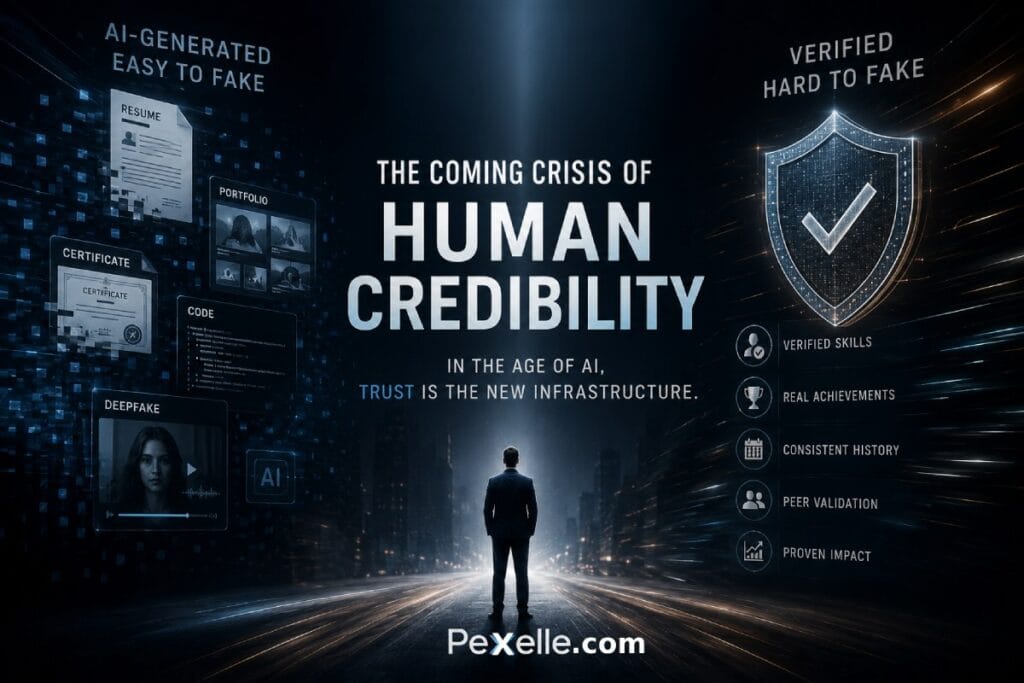
Artificial intelligence is changing not only how work is performed, but also how difficult it is to distinguish genuine human ability from synthetic competence. Deepfakes imitate faces and voices with astonishing accuracy. Large language models generate essays, code, business plans, research summaries, marketing campaigns, and even scientific reasoning in seconds. Automated agents can complete interviews, answer technical questions, and produce portfolios that appear indistinguishable from those created by experienced professionals.
The next global crisis will not be a shortage of information.
It will be a shortage of credibility.
The Age of Infinite Content
Throughout history, creating knowledge required effort.
Writing a book required months.
Designing software required years of learning.
Producing artwork demanded skill.
Recording a convincing video required equipment, planning, and expertise.
Today, nearly all of these barriers have disappeared.
AI can generate:
- Articles
- Videos
- Voice recordings
- Images
- Computer code
- Legal documents
- Financial analysis
- Educational material
- Entire business strategies
The cost of producing convincing information is rapidly approaching zero.
But while information becomes abundant, trust becomes scarce.
When everyone can create professional-looking work instantly, appearance no longer proves competence.
The Collapse of Traditional Signals
Modern hiring still depends heavily on signals rather than direct evidence.
Recruiters evaluate:
- CVs
- Degrees
- Certifications
- LinkedIn profiles
- GitHub repositories
- Personal websites
- Recommendation letters
Every one of these can now be manipulated.
AI writes resumes.
AI creates portfolios.
AI generates recommendation letters.
AI completes coding challenges.
AI produces interview answers in real time.
Even video interviews are becoming vulnerable through real-time voice cloning and visual enhancement technologies.
The problem is no longer detecting fake documents.
The problem is that traditional proof itself is losing meaning.
The Verification Gap
Digital systems have become remarkably good at verifying machines.
Banks verify transactions.
Blockchains verify ownership.
Payment networks verify financial transfers.
Servers verify encryption keys.
Browsers verify website certificates.
Cloud infrastructure verifies billions of digital interactions every second.
Ironically, the most important component of every digital system remains largely unverifiable:
The human being.
We know a payment occurred.
We know a file was uploaded.
We know a message was signed.
But we rarely know whether the individual behind those actions truly possesses the skills they claim.
This growing disconnect creates what can be called the Verification Gap:
The difference between what technology can verify digitally and what it cannot verify about people.
Why AI Accelerates the Crisis
Artificial intelligence does not simply create fake content.
It dramatically reduces the cost of deception.
Historically, deception required expertise.
Now it requires prompting.
A convincing software portfolio can be generated overnight.
Professional design work can appear within minutes.
Research papers can be synthesized in hours.
Presentation slides can be created instantly.
Even highly technical conversations can be simulated.
This changes incentives.
Dishonesty becomes cheaper.
Verification becomes more expensive.
That imbalance scales globally.
The Economic Cost of Uncertainty
Trust has always been an invisible economic engine.
Whenever trust declines, costs rise.
Companies spend more on:
- Recruitment
- Compliance
- Auditing
- Background checks
- Interviews
- Security
- Quality assurance
- Legal protection
Every additional layer exists because uncertainty exists.
Imagine a future where every applicant could produce an extraordinary portfolio using AI.
Hiring becomes slower.
Risk increases.
False positives become more common.
Great candidates become harder to recognize.
The world’s talent problem shifts.
It is no longer finding skilled people.
It becomes identifying them.
Human Capital Becomes Invisible
Perhaps the greatest tragedy is not fraud.
It is invisible talent.
Millions of capable individuals around the world lack elite universities, famous employers, or recognizable brands on their resumes.
Their abilities exist.
Their credibility does not.
Meanwhile, others with polished AI-generated profiles gain opportunities despite weaker capabilities.
The labor market becomes increasingly noisy.
Real excellence struggles to stand out.
Verification is no longer merely a security problem.
It becomes an equality problem.
Trust Is Becoming Infrastructure
Every technological revolution creates new infrastructure.
Industrialization required roads.
Global trade required shipping networks.
The internet required communication protocols.
Cloud computing required massive data centers.
Artificial intelligence requires trust infrastructure.
Without scalable trust, AI cannot safely integrate into:
Healthcare
Education
Government
Hiring
Freelancing
Finance
Professional licensing
Scientific collaboration
Digital democracy
Verification becomes infrastructure rather than administration.
From Identity Verification to Capability Verification
Today, digital identity systems answer questions like:
“Who are you?”
Tomorrow, society must answer a more difficult question:
“What can you reliably do?”
Identity verification alone cannot solve the coming credibility crisis.
A verified passport does not verify engineering skills.
A government ID does not prove programming ability.
A verified email does not demonstrate medical competence.
Future verification systems must evolve beyond identity.
They must verify capability.
Continuous Credibility
Traditional credentials are static.
A degree earned twenty years ago remains unchanged.
A certificate may never expire.
A recommendation letter reflects only one moment in time.
Human capability is dynamic.
People learn.
Improve.
Forget.
Specialize.
Adapt.
The future requires living credibility.
Continuously updated.
Continuously demonstrated.
Continuously verifiable.
Just as software receives updates, human credibility may eventually become an evolving digital record rather than a fixed collection of documents.
The Role of AI
Ironically, AI may also become part of the solution.
Instead of merely generating content, AI can help analyze long-term behavioral evidence.
Patterns across projects.
Consistency across work.
Collaboration history.
Learning progression.
Skill evolution.
Real contribution.
Rather than asking whether one document appears authentic, future systems may evaluate thousands of independent signals over years.
Trust becomes probabilistic rather than binary.
The Global Opportunity
Every crisis creates an opportunity.
The credibility crisis will create entirely new industries.
Verifiable hiring.
Verifiable freelancing.
Verifiable research.
Verifiable creator economies.
Verifiable professional licensing.
Verifiable entrepreneurship.
Organizations capable of building trusted verification infrastructure will shape the next generation of digital society.
Just as payment networks transformed commerce, trust networks may transform human opportunity.
A Future Worth Building
Imagine a world where every person’s abilities can be demonstrated through trusted evidence instead of reputation alone.
Where brilliant individuals from any country can compete on verified capability rather than famous institutions.
Where employers spend less time filtering noise and more time discovering genuine talent.
Where AI amplifies human potential instead of obscuring it.
That future is possible.
But only if credibility itself becomes part of our digital infrastructure.
The internet connected billions of people.
Artificial intelligence connected billions of ideas.
The next great challenge is connecting billions of people with trustworthy evidence of what they can actually do.
Because in the coming decade, the most valuable asset will not be information.
It will be credibility.
And the societies that learn how to verify it will define the future of the digital economy.
Source : Medium.com