
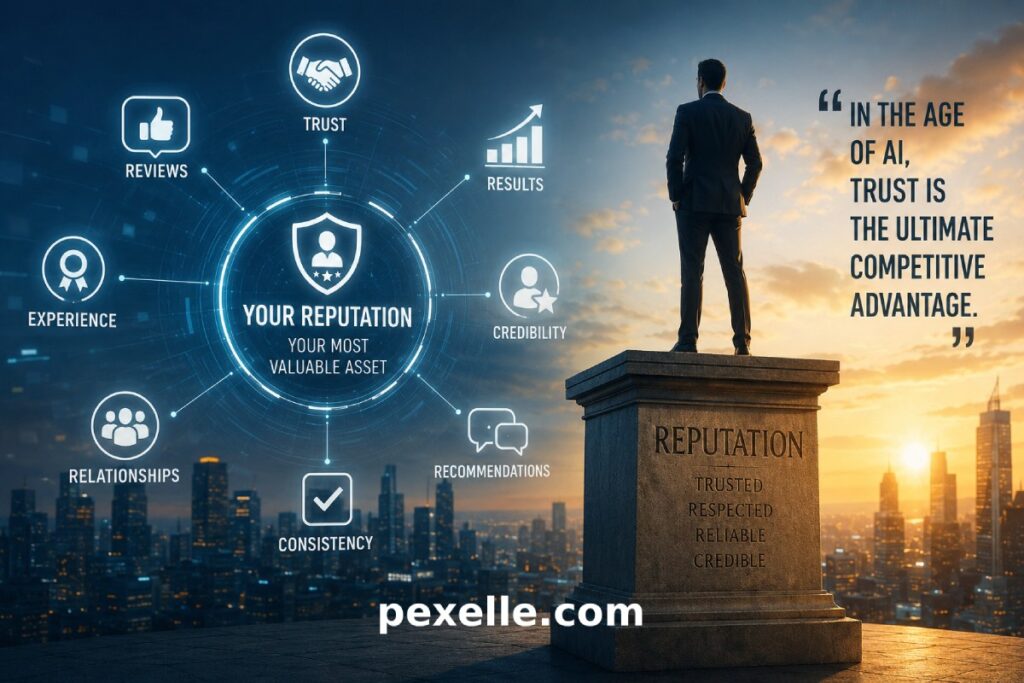
The New Currency of the Digital Economy
For decades, people measured success by what they owned. Companies competed through capital, infrastructure, and distribution. Individuals built careers by collecting degrees, certifications, and years of experience.
Artificial Intelligence is changing all of that.
As AI automates knowledge work and creates content, software, code, images, and even entire businesses in seconds, one resource becomes increasingly difficult to manufacture:
Reputation.
The future economy will not simply reward people who know more. It will reward people whom others trust more.
Your reputation is quietly becoming your most valuable asset.
We Are Entering the Reputation Economy
Throughout history, every technological revolution changed what society valued most.
- The Industrial Revolution rewarded physical labor.
- The Internet rewarded access to information.
- The Mobile Revolution rewarded convenience.
- The AI Revolution rewards credibility.
When almost anyone can generate an impressive presentation, build a professional website, write an article, or create realistic videos using AI, technical execution alone is no longer enough.
People begin asking different questions:
- Who actually built this?
- Can this person deliver?
- Have they done it before?
- Can I trust them?
These questions are all about reputation.
AI Creates Infinite Content. Reputation Creates Scarcity.
AI has dramatically reduced the cost of creating content.
Millions of articles are published every day.
Thousands of new applications appear weekly.
Code generation has become almost instantaneous.
Professional designs can be created in minutes.
Information is no longer scarce.
Attention is scarce.
Trust is scarce.
Reputation is scarce.
This changes the economics of digital value.
When everyone can create, the differentiator becomes whether people believe you.
Why Traditional Credentials Are Losing Their Power
For decades, resumes and university degrees acted as trust signals.
They helped employers estimate capability.
But AI has exposed their limitations.
A resume tells people what you claim.
Reputation shows people what you have repeatedly proven.
Companies increasingly evaluate candidates through:
- Public work
- Open-source contributions
- Community recognition
- Recommendations
- Portfolio quality
- Problem-solving history
- Online interactions
- Consistency over time
Evidence is replacing claims.
Proof is replacing promises.
Every Digital Interaction Builds Your Reputation
Most people think reputation is created only through major achievements.
In reality, it is built through thousands of small signals.
- Every email.
- Every GitHub commit.
- Every LinkedIn post.
- Every customer interaction.
- Every support ticket.
- Every interview.
- Every conference presentation.
- Every product launch.
- Every review.
- Every recommendation.
Together, these create your digital reputation graph.
In an AI-driven world, this graph becomes one of your strongest competitive advantages.
Companies Will Hire Reputation Before Resumes
Recruitment is changing rapidly.
Instead of asking candidates to describe themselves, companies increasingly analyze evidence.
Imagine two software engineers.
The first has an excellent resume.
The second has:
- Five years of open-source contributions
- Public technical articles
- Community recognition
- Verified project history
- Strong peer recommendations
- Hundreds of solved engineering discussions
Who appears less risky?
The answer is obvious.
Reputation reduces uncertainty.
Businesses love reducing uncertainty.
Customers Buy Trust Before Products
Consumers rarely purchase products based solely on specifications.
They purchase confidence.
- A restaurant with thousands of authentic positive reviews attracts more customers than one with no history.
- A startup with respected founders raises capital more easily.
- A freelancer with verified client testimonials wins contracts faster.
- An online educator with years of valuable content builds an audience without aggressive advertising.
Reputation lowers the perceived risk of every transaction.
That makes it incredibly valuable.
Reputation Compounds Like Interest
Money grows through compound interest.
Reputation compounds through repeated positive experiences.
One satisfied customer leads to referrals.
Referrals lead to larger opportunities.
Larger opportunities create stronger credibility.
That credibility attracts better partnerships.
Better partnerships generate more success.
Unlike many assets, reputation often accelerates over time.
The longer you consistently create value, the faster trust grows.
AI Agents Will Evaluate Reputation Automatically
The next generation of digital systems will not rely solely on human judgment.
AI agents will evaluate people before humans even become involved.
Imagine requesting an AI assistant:
“Find the best cybersecurity consultant.”
The assistant may analyze:
- Verified project outcomes
- Customer satisfaction
- Public contributions
- Technical publications
- Industry recognition
- Identity verification
- Fraud indicators
- Community reputation
- Historical consistency
The recommendation will depend less on marketing and more on measurable trust.
Your reputation becomes machine-readable.
Reputation Is Becoming Infrastructure
Today we have infrastructure for:
- Payments
- Identity
- Communication
- Cloud computing
- Logistics
Tomorrow, reputation itself becomes infrastructure.
Businesses will integrate reputation APIs.
Marketplaces will calculate dynamic trust scores.
Recruitment platforms will verify real achievements.
Financial institutions may incorporate reputation into lending decisions.
Professional networks will emphasize verified expertise instead of self-declared skills.
Trust becomes programmable.
Protecting Reputation Will Become a Strategic Priority
As reputation gains value, protecting it becomes essential.
Organizations should invest in:
- Transparent communication
- Ethical AI usage
- Strong cybersecurity
- Verified digital identities
- Consistent customer experience
- Public accountability
- Authentic content creation
Reputation can take years to build.
It can disappear in hours.
In a world where information travels instantly, resilience matters as much as visibility.
Building a Reputation That AI Cannot Replace
AI can generate text.
- It can generate software.
- It can generate images.
- It can imitate voices.
- It cannot genuinely earn long-term trust.
That still requires humans.
The strongest reputations will belong to people who consistently:
- Deliver real results
- Keep their promises
- Admit mistakes
- Continue learning
- Help others succeed
- Share knowledge openly
- Demonstrate integrity
- Build lasting relationships
These qualities cannot be manufactured overnight.
They emerge through repeated actions over time.
The Competitive Advantage of the Future
In the coming decade, technical skills will remain important.
Creativity will remain valuable.
AI literacy will become essential.
But one asset will quietly outperform them all.
Reputation.
Because technology evolves rapidly.
Products become obsolete.
Business models change.
Algorithms improve.
Markets shift.
Trust endures.
People remember who solved their problems.
They remember who delivered under pressure.
They remember who acted with integrity.
In an era where artificial intelligence makes creation effortless, credibility becomes priceless.
The individuals and organizations that intentionally build authentic, verifiable, and trustworthy reputations today will own one of the most valuable competitive advantages of the next digital economy.
Your reputation is no longer just part of your career.
It is becoming one of your greatest long-term assets.
Source : Medium.com