
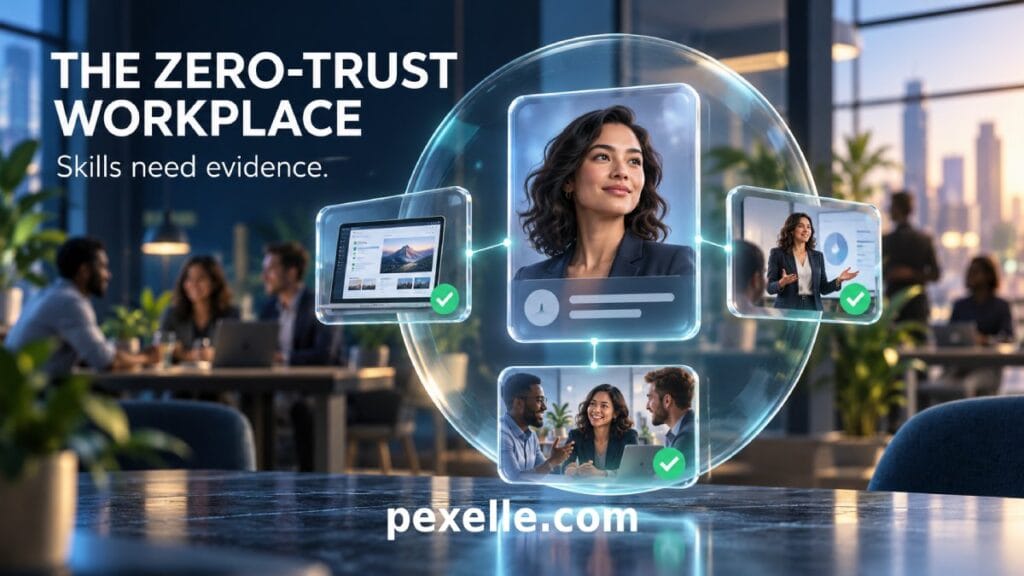
What If Zero Trust Came to Professional Skills?
A candidate submits an impressive résumé. Their experience matches the role. Their portfolio looks polished. Their interview answers sound convincing.
But what has actually been verified?
Their identity? Their contribution to the projects they describe? Their ability to perform the work? Or simply their ability to present a persuasive professional story?
These questions become harder when AI can help produce every visible part of an application.
The problem is not that using AI makes someone dishonest. It is that professional presentation and professional capability can now be separated more easily.
In a September 2026 article, SmartRecruiters describes the pressure this creates for hiring teams: polished application materials cannot serve as standalone proof of experience, skills, or identity. Its discussion highlights a recruitment challenge, although it should not be mistaken for an independent measurement of how widespread fraud has become. smartrecruiters.com
That challenge raises a bigger question:
What if the principle behind zero trust became part of how we evaluate professional skills?
Not a workplace where everyone is treated as suspicious.
A workplace where important decisions rely on evidence that is relevant, explainable, and open to review.
What Zero Trust Actually Means
In cybersecurity, zero trust removes assumptions of trust based merely on where a user or device sits within a network. NIST describes an architecture in which access requires explicit authentication and authorization, rather than being granted automatically because something is already inside an organizational boundary. NIST
Applied to professional skills, this is an analogy, not an established hiring standard.
The useful idea is straightforward:
A familiar signal should not automatically prove an unrelated claim.
A prestigious employer does not establish every skill a person possesses. A job title does not reveal exactly what they can do. A certificate may confirm completion of an assessment without establishing readiness for every situation in which that knowledge could be used.
These signals still have value. They provide context and help guide further questions.
But context and proof serve different purposes.
A workplace built around verified capability would ask: what evidence supports this particular decision?
Separate Identity, Credentials, and Capability
One weakness in professional verification is that several different questions are often compressed into one.
Identity verification asks: Is this person who they claim to be?
Credential verification asks: Was this qualification or employment record issued by the claimed organization?
Capability assessment asks: Can this person perform the relevant work under the conditions that matter?
Answering one does not automatically answer the others.
A verified identity does not establish technical competence. An authentic qualification does not establish current proficiency. A strong work sample may demonstrate capability while leaving its authorship or the candidate’s specific contribution unclear.
Consider someone applying to manage a software migration.
Confirming their previous employment is useful. But the decision also depends on whether they can identify dependencies, plan a rollback, communicate operational risks, and respond when the migration fails.
The evidence should follow the responsibility.
Verify Claims at the Level of the Work
“Excellent problem solver” is difficult to evaluate.
“Diagnosed a production failure, identified the underlying cause, and validated a fix” is more specific.
Even then, the next questions matter:
What did the person do themselves? What support did they receive? What constraints shaped their decisions? How was the result checked?
A useful capability record connects several elements:
| Element | Question it answers |
|---|---|
| Skill claim | What can the person do? |
| Evidence | What demonstrates it? |
| Contribution | Which part did they personally perform? |
| Context | Under what conditions was it demonstrated? |
| Assessment | How was the work evaluated, and by whom? |
| Date | When was the capability demonstrated? |
This structure avoids turning a broad label into an unlimited promise.
Someone may have demonstrated financial modelling for a small business without having demonstrated it for a complex multinational organization. Someone may write effective code with supervision while still developing the judgment needed to approve production changes independently.
Both are meaningful capabilities. Their boundaries should be visible.
AI Changes What Assessments Need to Measure
An AI-assisted submission should prompt a better assessment question:
What does this work demonstrate about the person using the tool?
If AI use is permitted in the job, an assessment that permits it can be appropriate. The candidate might be asked to explain the result, identify mistakes, test assumptions, and adapt the work when requirements change.
For a developer, generating a functioning application is only part of the picture. Understanding its dependencies, evaluating security decisions, and diagnosing unexpected behaviour may reveal more about readiness for the role.
For an analyst, producing a polished report is different from checking source quality, recognizing uncertainty, and defending a recommendation.
An assessment should make its tool rules explicit. Some tasks may reasonably require unaided performance; others should evaluate responsible use of available tools.
The goal is to understand capability under stated conditions.
Verification Should Be Proportionate to Responsibility
A zero-trust approach becomes counterproductive if every claim triggers an investigation.
The practical question is how much evidence a decision needs.
Assigning a supervised introductory task may require a brief demonstration. Giving someone responsibility for a high-consequence decision requires stronger evidence and appropriate oversight.
For example, a hypothetical organization might distinguish between:
- Preparing a draft for review.
- Completing routine work independently.
- Handling unfamiliar exceptions.
- Reviewing or approving another person’s work.
These are different responsibilities, even when they share a skill label.
This approach can support development as well as risk management. A person does not need to be either fully trusted or completely excluded. They can receive responsibility that matches the evidence available, with a clear path to demonstrate readiness for more.
Keep Evidence Current Without Creating Constant Testing
Capabilities change. Tools evolve. People develop new strengths, and some previously demonstrated skills become less relevant to their current work.
However, evidence should not be assigned arbitrary expiry dates simply to keep people under assessment.
A better approach is to revisit evidence when something material changes: the task, the technology, the level of responsibility, or the conditions in which the work must be performed.
Existing work can often provide the necessary evidence. A reviewed project, an observed task, or a documented outcome may be more useful than another generic test.
Verification should be triggered by a meaningful decision, not by a permanent demand to prove personal worth.
The Boundary: Evidence Must Not Become Surveillance
The phrase “zero-trust workplace” carries a risk. Applied carelessly, it can encourage a culture of suspicion.
Constant screenshots, keystroke counts, and activity tracking should not be treated as direct evidence of competence. They may record observable activity while missing judgment, collaboration, and the quality of the result.
A credible system should therefore have limits.
People should understand what is being assessed, why it matters, who can access the evidence, and how an inaccurate assessment can be challenged.
Candidates should have reasonable ways to demonstrate capability without revealing confidential work from previous employers. Assessments should also account for accessibility and avoid demanding substantial unpaid commercial work.
An evidence system that cannot explain its conclusions deserves scrutiny itself.
Verification must be accountable in both directions.
Better Evidence Can Expand Opportunity
Verification is often framed as a way to reject misleading claims. Its more valuable role may be helping organizations recognize overlooked ability.
A person without a familiar job title may already perform the relevant work. A career changer may demonstrate strong capability through projects outside conventional employment. A junior employee may have developed a skill that their current role never makes visible.
These people can struggle when selection depends heavily on institutional reputation, résumé language, or linear career history.
A fair evidence process gives them another route.
But missing evidence must not automatically be interpreted as missing ability. Some people have had fewer opportunities to create a public portfolio or obtain formal recognition.
Organizations need ways for people to generate evidence, not merely requirements to arrive with it.
From Professional Profiles to Evidence of Capability
This creates a useful direction for platforms such as Pexelle.
The opportunity is to connect skill claims with evidence that people can understand and evaluate: what was demonstrated, in which context, with what contribution, and through which assessment.
A badge becomes more meaningful when its scope is visible. A skill card becomes more useful when it explains the basis for the claim.
The design challenge is to make that evidence portable without exposing confidential information, and understandable without reducing a person to a single opaque score.
The aim should be better professional decisions, with more control for the person whose capability is being represented.
Trust Should Be Earned Through a Fair Process
The workplace does not need to abandon human trust.
Teams need room to learn, ask questions, admit mistakes, and take responsibility. Those behaviours become harder when every interaction feels like an investigation.
What organizations can abandon is the assumption that presentation alone establishes capability.
A résumé can introduce a person. A qualification can establish an achievement. A portfolio can open a conversation.
Relevant evidence helps determine what responsibility should follow.
The strongest version of a zero-trust workplace does not ask people to prove everything, all the time. It makes the evidence behind important decisions visible, proportionate, and fair.
Source : Medium.com