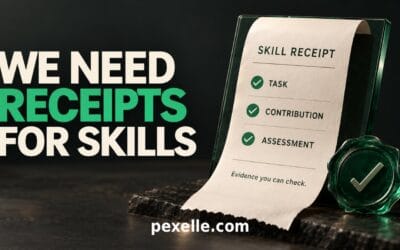

Why the future of work needs proof of capabilities inside the job
A job title is a remarkably small container for a remarkably complicated person.
“Product manager.” “Software engineer.” “Marketing specialist.”
Each label compresses dozens of activities, different kinds of judgment, and years of accumulated experience into a few words. It helps an organization assign responsibility. It gives recruiters something to search for. It gives professionals a recognizable identity.
But it leaves a crucial question unanswered:
What can this person actually do, under which conditions, and how do we know?
As organizations explore agentic AI, that question becomes harder to ignore. When parts of a workflow can be delegated to software, the boundaries of a job become open to redesign.
The employee is still a person. The job, however, can be examined as a changing bundle of capabilities.
For Pexelle, this creates a clear principle:
Don’t verify the job. Verify the capabilities inside the job.
A job has always been a bundle
Consider a customer support specialist.
The role might involve understanding a request, finding relevant information, interpreting policy, recognizing exceptions, explaining a decision, calming a frustrated customer, and escalating a case.
Those activities require different capabilities.
Finding a policy document is different from interpreting an ambiguous rule. Writing a polite reply is different from recognizing that the proposed reply would make an inappropriate promise.
A title does not tell us how well someone performs each part. Neither does the length of time they have held it.
Two people with identical titles may have very different strengths. One may handle routine cases efficiently. Another may be exceptional at difficult conversations. A third may recognize recurring problems and redesign the process.
The bundle is useful, but it hides the differences.
Why agentic AI makes the bundle visible
The Conference Board’s September 2026 report, A Framework for Agentic AI and Work Redesign, connects agentic AI adoption with skills-based work. Its public executive summary argues that deploying agents requires organizations to break work down into tasks and skills, and that work redesign and AI adoption should be treated as a connected transformation.
The research draws on interviews, focus groups, and other activities involving senior HR, talent, and AI leaders. It offers a framework for organizational redesign, rather than proof that every occupation will fragment in the same way.
Source: https://www.conference-board.org/publications/framework-for-agentic-AI-and-work-redesign
The implication explored here goes one step further: once organizations describe work more precisely, they also need more precise evidence about who can perform it.
Before assigning part of a workflow to an agent, a team needs to understand its inputs, expected outcomes, permissions, dependencies, and failure conditions.
That exercise can expose what the original job description left implicit.
A responsibility such as “manage customer accounts” might contain research, record maintenance, communication, negotiation, exception handling, and approval decisions. These components need not all be performed by the same actor.
Some may remain human responsibilities. Some may be assisted by AI. Some may be delegated within defined controls.
The allocation depends on the actual work and its risks. A broad title cannot settle it.
Tasks, skills, and capabilities are different
A task is something that needs to be done.
A skill is an ability used to do it.
For this article, a capability means the demonstrated ability to achieve a relevant outcome under specified conditions.
The distinction matters.
“Prepare a monthly report” describes a task.
“Data analysis” describes a broad skill.
“Identify a discrepancy between two source systems, explain its cause, and produce a validated report using approved tools” describes a capability that can be assessed.
Capabilities connect an activity to a standard, a context, and evidence.
They also capture limits. Someone may perform reliably with supervision but struggle independently. Someone may succeed with familiar data but fail when the source format changes.
These are meaningful differences. Verification should preserve them.
Output alone cannot settle the question
Imagine two candidates submitting an excellent market analysis.
One understands the assumptions, can explain the source choices, and can revise the conclusion when new evidence appears.
The other cannot identify where the figures came from or defend the recommendation.
The finished documents may look similar. The demonstrated capabilities are different.
AI assistance makes it especially important to establish what was assessed. That does not mean AI-supported work is less valuable. Directing tools, checking their results, and recognizing their limits can themselves be substantial capabilities.
The assessment should distinguish between producing an output, validating it, adapting it, and taking responsibility for its use.
A useful evidence record might specify whether the work was completed independently, with approved AI tools, under supervision, or as part of a team.
A credible claim describes both the outcome and the conditions that made it possible.
What capability verification should contain
A useful capability claim needs enough detail to support a decision. It should answer six questions:
- What was demonstrated? Describe an observable outcome.
- In what context? Identify the domain, complexity, and relevant constraints.
- To what standard? Make the success criteria explicit.
- With what assistance? Record tools, AI support, supervision, and collaborators.
- What evidence supports it? Include suitable work samples, observations, or assessments.
- How current is the evidence? Record when the capability was demonstrated and when review may be needed.
For example, “project management” tells a hiring team very little.
“Coordinated a cross-functional release, identified dependencies, resolved a scheduling conflict, and documented stakeholder approval” offers a clearer basis for discussion.
Even that claim needs supporting evidence. A detailed label without verification is still a claim.
Nor should one successful example imply universal competence. Evidence can support a defined scope without proving performance in every environment.
Smaller capabilities can reveal overlooked talent
Role-based hiring can make career transitions difficult.
A person may possess relevant abilities without having held the exact title a recruiter expects. A support professional might demonstrate strong incident investigation. An operations coordinator might demonstrate process design and stakeholder negotiation.
Capability evidence gives an employer a way to examine those overlaps.
It can also make internal development more specific.
Instead of telling someone to “become more senior,” a manager can identify the next capability to build: diagnose an unfamiliar problem independently, evaluate competing options, or lead a difficult decision involving several teams.
That turns an abstract promotion requirement into an observable development goal.
This is a potential benefit, not an automatic outcome. Assessments must be accessible and relevant. Otherwise, capability verification can become another expensive gate that rewards people with more time, money, or opportunities to assemble evidence.
Unbundling still requires integration
A team cannot be built by collecting isolated skills and assuming they will fit together.
Someone must connect the parts.
A software change can satisfy its immediate specification while creating maintenance problems elsewhere. A support response can follow policy while revealing that the policy itself needs revision.
These situations require judgment across boundaries.
Integration is a capability too: understanding dependencies, balancing tradeoffs, coordinating people and tools, and remaining accountable for the final outcome.
This is why unbundling should improve the description of work without erasing ownership.
Tasks can be distributed. Responsibility must remain clear.
A role may continue to provide that responsibility even as the capabilities inside it change.
The employee must remain more than a checklist
The phrase “unbundling the employee” carries a danger.
It can suggest that a person is merely an inventory of interchangeable units.
That would be a poor foundation for work redesign.
People contribute continuity, relationships, institutional knowledge, care, and judgment that may be difficult to capture in a short assessment. They also need opportunities to learn through experience.
If organizations delegate introductory tasks without creating new learning routes, they may weaken the development of future expertise.
Capability systems should therefore support growth as well as selection. They should help people understand what they have demonstrated, what remains uncertain, and how they can progress.
They should also allow people to challenge inaccurate records and protect confidential evidence.
The objective is a more faithful account of human contribution, not a permanent score attached to a person.
What this means for Pexelle
The strategic opportunity for Pexelle is to make professional claims more specific, understandable, and grounded in evidence.
A job title can remain useful context. It should not carry the entire burden of trust.
A capability-centered approach would help answer practical questions:
Can this person perform the relevant work? What supports that conclusion? What tools were involved? Where are the limits of the evidence?
Skill cards and badges are most useful when they make those answers visible. A badge labeled “Leadership” remains vague unless it explains what behavior was assessed and what the assessment supports.
This is a direction for Pexelle’s philosophy, not a claim that a particular verification feature already exists.
The principle is simple:
Professional identity tells us how someone is described. Capability evidence helps us decide what to trust them to do.
The next question after the title
Job titles will continue to organize teams, responsibilities, and careers.
But as work is redesigned around humans and agents, the title may become the beginning of a professional conversation rather than its conclusion.
The next questions will be more precise:
What can you deliver?
Under what conditions?
What happens when the task changes?
And what evidence supports your answer?
The unbundling of work creates an opportunity to make capabilities visible without losing sight of the people who hold them.
For Pexelle, that is where the article’s argument leads:
Don’t verify the job. Verify the capabilities inside the job.
Source : Medium.com