
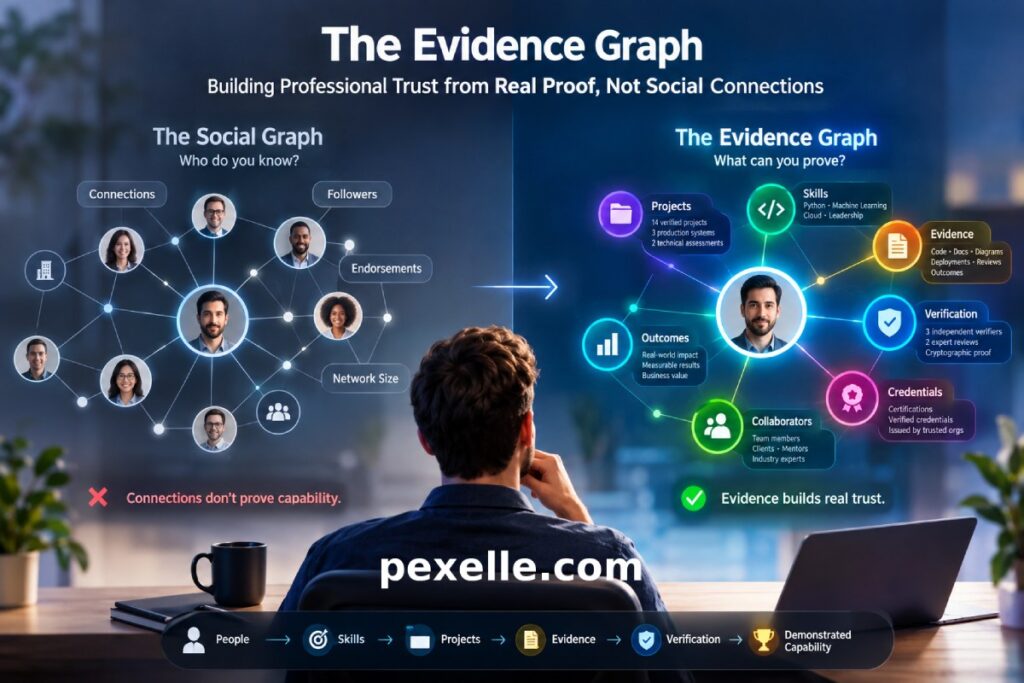
For nearly two decades, the professional internet has been built around one dominant structure:
The Social Graph.
- Who do you know?
- Who follows you?
- Who are you connected to?
- Who works at the same company?
- Who endorsed you?
- Who interacted with your profile?
These relationships have become part of how professional platforms measure visibility, influence, and sometimes even credibility.
But there is a fundamental problem.
Knowing someone is not evidence of capability.
A connection does not prove competence.
A follower does not prove experience.
An endorsement does not necessarily prove that someone has observed the work behind the skill.
And a large professional network does not automatically make someone more capable than a person with a small network.
The next generation of professional infrastructure may therefore need a different kind of graph.
Not a graph of people connected to people.
A graph of:
People connected to evidence.
Skills connected to proof.
Claims connected to verification.
Projects connected to outcomes.
Experience connected to artifacts.
This is the idea of the Evidence Graph.
And it could fundamentally change how professional trust is built on the internet.
1. The Professional Internet Was Built Around Relationships
Social graphs solved an important problem.
They helped digital platforms understand relationships between people.
A simplified professional social graph might look like this:
Person A → connected to → Person B
Person B → works at → Company X
Person A → follows → Company X
Person C → endorses → Person A
This structure is useful for discovery.
It helps platforms answer questions such as:
Who might you know?
Who should you follow?
Which recruiter might be relevant?
Which professionals belong to the same industry?
Which content should appear in your feed?
But discovery and trust are not the same problem.
A social graph can tell us that two people are connected.
It cannot automatically tell us whether one of them can design a secure distributed system, manage a construction project, perform advanced financial modelling, lead a sales organization, or build production-grade software.
The graph contains relationships.
What it often lacks is evidence.
2. Professional Profiles Are Mostly Collections of Claims
Consider a typical professional profile.
It may contain statements such as:
Senior Software Engineer
10 Years of Experience
Python
Machine Learning
Cloud Architecture
Cybersecurity
Team Leadership
Some of these claims may be accurate.
Some may be exaggerated.
Some may once have been accurate but are now outdated.
And some may be extremely difficult for an external observer to evaluate.
The problem is not necessarily dishonesty.
The deeper problem is architectural.
Most professional systems were designed to store claims, not continuously connect those claims to independently inspectable evidence.
A profile says:
I know Python.
An Evidence Graph would ask:
What evidence supports that claim?
A profile says:
I am an experienced product manager.
The graph asks:
Which products, decisions, outcomes, organizations, collaborators, or verified artifacts support that statement?
A profile says:
I understand cybersecurity.
The graph asks:
What has actually been demonstrated?
That is a very different model of professional identity.
3. From the Social Graph to the Evidence Graph
Imagine a developer named Alex.
In a traditional professional network, Alex might have:
3,200 connections
18,000 followers
75 skill endorsements
12 years of claimed experience
Those numbers may provide useful signals.
But now imagine another representation.
Alex
Skill: Python
Connected evidence:
→ 14 verified projects
→ 320 reviewed commits
→ 3 production systems
→ 2 technical assessments
→ 4 verified collaborators
→ 6 years of evidence history
Skill: Distributed Systems
Connected evidence:
→ architecture contribution to Project A
→ production deployment B
→ performance benchmark C
→ technical review by Expert D
→ incident-resolution record E
Skill: Technical Leadership
Connected evidence:
→ led Team A
→ delivered Project B
→ mentoring evidence
→ peer verification
→ project outcome records
Now the structure is fundamentally different.
Alex’s professional credibility is no longer primarily represented by how many people are connected to Alex.
It is represented by how many credible pieces of evidence are connected to Alex’s claims.
That is an Evidence Graph.
4. The Nodes Change
In a social graph, the most important nodes are usually:
- People
- Companies
- Groups
- Organizations
- Pages
In an Evidence Graph, the node structure becomes much richer.
Possible nodes could include:
- Person
- Skill
- Project
- Role
- Company
- Credential
- Artifact
- Assessment
- Contribution
- Publication
- Repository
- Transaction
- Outcome
- Verification
- Verifier
- Badge
- Proof
The professional identity of a person could then emerge from the relationships between these nodes.
For example:
Person
↓
demonstrated
↓
Skill
↓
through
↓
Project
↓
verified by
↓
Expert
↓
produced
↓
Outcome
Instead of simply storing a statement, the system stores the structure surrounding that statement.
5. Claims Should Become Navigable
One of the most important characteristics of an Evidence Graph would be navigability.
Imagine seeing:
Senior React Developer
Instead of accepting that description as plain text, you could explore it.
You click:
React
Then see:
React
→ 11 verified projects
→ 4 production applications
→ 27 months of active evidence
→ 3 independent verifiers
→ 2 technical assessments
You open one project.
Now you see:
Project X
↓
Person’s role
↓
Frontend Architecture
↓
↓
Code contribution
↓
↓
Outcome
The professional claim becomes something you can investigate.
This changes a profile from a static document into a trust interface.
6. Evidence Is Not the Same as Endorsement
This distinction is critical.
An endorsement says:
Someone believes you have a skill.
Evidence says:
Something observable supports the claim that you have demonstrated the skill.
Both can be useful.
But they have different informational value.
For example:
50 endorsements for Python
may tell us that many people associate a person with Python.
But:
A verified production Python system
tells us something different.
And:
A verified production Python system + code contribution + independent technical review + successful deployment
creates an even stronger chain of evidence.
This does not mean social validation should disappear.
It means social validation should become one evidence type among many, rather than the foundation of professional trust.
7. Evidence Needs Context
Not every piece of evidence should have equal weight.
- A GitHub commit is not automatically proof of senior engineering capability.
- A certificate is not automatically proof of production experience.
- A project is not automatically successful.
- A recommendation is not automatically objective.
- An Evidence Graph therefore needs context.
For every piece of evidence, a system might ask:
Who produced it?
Who verified it?
When was it created?
What skill does it support?
How directly does it support the claim?
Can the source be authenticated?
Has the evidence expired or become outdated?
Was it independently verified?
Is the verifier credible in that domain?
Can the evidence be challenged?
This creates an important principle:
Evidence should not merely exist. Its provenance should be understandable.
8. Evidence Can Have Different Strengths
An Evidence Graph should not treat every signal as binary.
Instead, evidence could exist across different confidence levels.
For example:
Level 1: Self-Declared
The individual claims:
I know Kubernetes.
Useful as discovery data.
Weak as verification.
Level 2: Artifact-Backed
The individual connects:
documentation, code, architecture diagrams, deployments, or projects.
Now there is something inspectable.
Level 3: Third-Party Confirmed
A collaborator, employer, client, institution, or platform confirms the evidence.
Confidence increases.
Level 4: Expert Verified
A qualified verifier evaluates whether the evidence actually demonstrates the claimed capability.
Level 5: Repeated Demonstration
Multiple independent pieces of evidence across different periods and environments support the same capability.
At this point, professional trust becomes less dependent on a single credential or opinion.
It becomes cumulative.
9. Time Matters
Capabilities change.
Someone who demonstrated expertise in a technology eight years ago may not have used it recently.
Someone who was junior three years ago may now be highly capable.
Traditional resumes often compress this evolution into a few lines.
An Evidence Graph could preserve it.
Imagine:
Machine Learning
2022
→ first verified project
2023
→ production contribution
2024
→ advanced assessment
2025
→ architecture responsibility
2026
→ expert-level project verification
Now professional capability becomes visible as a trajectory.
Not just:
Does this person have this skill?
But:
How did this capability develop?
That could be enormously valuable for employers, teams, marketplaces, and AI systems evaluating talent.
10. Verification Infrastructure Is Becoming More Practical
The technical foundations for stronger digital verification are also evolving.
The W3C Verifiable Credentials Data Model 2.0 provides a standardized model for expressing claims through credentials that can be cryptographically secured and machine verified. The model includes relationships between issuers, holders, and verifiers, and it explicitly supports evidence that can provide additional information behind a credential.
This does not automatically create an Evidence Graph.
But it demonstrates an important direction:
digital claims can increasingly be structured, portable, verifiable, and machine-readable.
An Evidence Graph could build on this broader movement by connecting professional claims to multiple sources of trustworthy evidence.
11. The Evidence Graph Should Not Become a Surveillance Graph
There is an important danger here.
A system designed to prove capability could easily become a system that attempts to record everything a person does.
That would be a mistake.
Professional verification should not require total professional surveillance.
An Evidence Graph should therefore be designed around principles such as:
Selective disclosure
People should be able to choose which evidence they expose.
Purpose limitation
Evidence shared for employment should not automatically become available for unrelated purposes.
Minimal disclosure
A person may sometimes need to prove a capability without revealing the entire underlying dataset.
Consent
Third-party evidence should respect the rights of everyone represented in it.
Revocation
Incorrect, compromised, or invalid evidence needs mechanisms for correction or revocation.
Privacy by design
The graph should prove what is necessary without exposing everything that is possible.
The objective is not:
Collect more data about humans.
The objective is:
Create stronger trust from better evidence.
12. AI Makes the Evidence Graph More Important
AI dramatically increases the importance of this problem.
Generative AI makes professional claims cheaper to produce.
It can write resumes.
Generate portfolios.
Create polished cover letters.
Improve personal branding.
Generate code samples.
Prepare interview answers.
Produce professional-looking documents.
This does not make those tools bad.
But it does reduce the cost of creating the appearance of competence.
As the cost of generating claims approaches zero, the value of independently verifiable evidence increases.
In other words:
AI makes presentation abundant. Evidence remains scarce.
That scarcity could make evidence one of the most important professional assets of the AI economy.
13. AI Agents Will Need Evidence Too
The Evidence Graph may not only be useful for humans.
AI agents will increasingly need to evaluate people.
Imagine an AI recruitment agent searching for:
A cybersecurity engineer with cloud security experience who has demonstrated incident-response capability.
A traditional system might search:
keywords
job titles
connections
profile descriptions
endorsements
An evidence-aware agent could search differently:
Skill
Cloud Security
↓
supported by
↓
Verified Projects
↓
containing
↓
Incident Response Evidence
↓
validated by
↓
Trusted Verifiers
↓
within
↓
Last 24 Months
The difference is profound.
The AI would not merely search what people say about themselves.
It could reason over what they have demonstrated.
14. Search Could Move from People to Capabilities
Today we often search professional networks for people.
Tomorrow we may search evidence networks for capabilities.
Instead of:
Find me a senior AI engineer.
We could ask:
Find people who have demonstrated the ability to deploy machine-learning systems into production environments with measurable reliability evidence.
Instead of:
Find a blockchain developer.
We could ask:
Find developers with independently verified smart-contract security experience and evidence from production deployments.
Instead of searching titles, we search proof structures.
This could significantly reduce professional discovery noise.
15. Reputation Could Become Evidence-Backed
Professional reputation today is often influenced by visibility.
Followers.
Connections.
Content.
Brand recognition.
Company prestige.
These signals are not meaningless.
But they are incomplete.
An Evidence Graph could introduce another layer:
Evidence-backed reputation.
Reputation could emerge from:
- quality of evidence
- diversity of evidence
- recency of evidence
- independence of verification
- reliability of verifiers
- consistency across projects
- difficulty of demonstrated work
- real-world outcomes
The goal should not necessarily be to reduce everything to a single score.
In fact, one universal reputation score could oversimplify human capability.
A better system might allow reputation to remain multidimensional.
Someone could have strong evidence in:
Backend Engineering
moderate evidence in:
Technical Leadership
and limited evidence in:
Machine Learning
That representation is much more useful than declaring that the person has a universal professional score of 87.
16. Trust Could Become Portable
One of the biggest opportunities is portability.
Today, professional reputation is often trapped inside platforms.
You build followers on one platform.
Reviews on another.
Code history somewhere else.
Freelancing reputation elsewhere.
Credentials in another system.
Certificates in PDFs.
Employment history on a resume.
The result is fragmented professional trust.
An Evidence Graph could potentially connect these fragments.
Not by forcing everything into one centralized database, but by allowing evidence from multiple systems to participate in a common trust structure.
Your professional credibility would no longer belong entirely to a platform.
It could increasingly belong to you.
17. The Resume Could Become a View of the Graph
This leads to an interesting possibility.
The Evidence Graph does not necessarily replace the resume.
It could become the infrastructure underneath it.
A resume would simply be one representation of the graph.
For a software engineering role, you might expose:
Engineering Evidence
Projects
Technical Skills
Production Experience
For a leadership role:
Team Leadership
Delivery Outcomes
Organizational Experience
Peer Verification
For consulting:
Industry Experience
Client Outcomes
Domain Credentials
Case Evidence
The underlying professional identity remains the same.
But different views reveal different parts of the graph.
The resume becomes dynamic.
18. The Evidence Graph Could Change Hiring
Hiring currently involves substantial uncertainty.
Employers try to estimate future performance from incomplete signals:
- resume
- interviews
- references
- education
- job titles
- company names
- assessments
An Evidence Graph would not eliminate uncertainty.
Human capability is too complex for that.
But it could improve the quality of the information available before a decision.
Instead of asking only:
Where did this person work?
we could ask:
What did this person actually demonstrate there?
Instead of:
What skills are listed?
we could ask:
Which claims have evidence?
Instead of:
Who recommends this person?
we could ask:
What exactly did those people observe?
This changes hiring from profile interpretation toward evidence evaluation.
19. The Evidence Graph Could Become Economic Infrastructure
The implications extend beyond recruitment.
Evidence-backed capability could influence:
freelancing
consulting
professional marketplaces
team formation
education
credentialing
insurance
licensing
AI delegation
expert networks
remote work
global talent discovery
Consider a global project that needs five specialists.
Instead of selecting people primarily through location, network, employer prestige, or personal referrals, software could search a global Evidence Graph for the exact capability combinations required.
The result could be a more open professional economy.
People without elite networks could compete through demonstrated capability.
People from smaller markets could become discoverable through evidence.
And organizations could reduce dependence on weak proxies for talent.
20. Proof Could Become More Valuable Than Reach
The social internet taught professionals to accumulate:
followers
connections
likes
engagement
The evidence internet may encourage something different:
projects
proof
verified outcomes
demonstrated skills
credible contributions
trusted verification
This does not mean social networks disappear.
Relationships will always matter.
Human trust will always contain social dimensions.
But the professional internet may evolve from:
Who do you know?
toward:
What can you prove?
And eventually toward an even more important question:
What does the network of evidence around you tell us about what you can actually do?
Conclusion: From Social Capital to Evidence Capital
The Social Graph transformed the internet by mapping relationships between people.
The Evidence Graph could transform the professional internet by mapping relationships between claims and proof.
The distinction is fundamental.
A Social Graph tells us:
who is connected to whom.
An Evidence Graph could tell us:
what has been demonstrated, how it was demonstrated, who verified it, when it happened, and how much confidence we should place in the claim.
That could create a new form of professional capital.
Not merely Social Capital.
But Evidence Capital.
In a world where AI can generate increasingly convincing profiles, content, portfolios, applications, and professional narratives, the ability to create claims will become less scarce.
The ability to support those claims with credible evidence will become more valuable.
The professional networks of the future may therefore look very different from the networks we use today.
- They may still contain people.
- They may still contain companies.
- They may still contain relationships.
But underneath them could exist something much more important:
a living graph of what people have actually demonstrated.
Because the future of professional trust may not be built around the size of your network.
It may be built around the strength of your evidence.
Source : Medium.com