
Why Companies May Stop Hiring for Job Titles and Start Hiring People Who Can Solve Real Problems
The Traditional Job Market Is Built Around Yesterday’s Problems
For decades, the employment market has operated around a relatively simple model: companies define positions, publish job descriptions, evaluate candidates, and hire people to fill predefined roles.
A company needs a marketing manager, a software engineer, a financial analyst, or a project coordinator. Candidates apply, submit their CVs, attend interviews, and compete for the available position.
This system has helped organize the global workforce, but its foundations are becoming increasingly disconnected from how modern businesses operate.
Companies are facing problems that do not always fit neatly into existing job titles. They need someone who can reduce operational costs, improve customer retention, redesign a complicated process, secure their digital infrastructure, or develop a new product.
Sometimes, the person who can solve the problem is not someone with the expected job title. They might be an independent specialist, a professional from another industry, a small team, or someone whose experience has never been formally recognized.
The question is changing.
Instead of asking, “Who should we hire for this position?”, companies may increasingly ask, “Who can solve this problem?”
The Shift From Job Positions to Business Challenges
Traditional recruitment starts with an organizational structure. A company identifies a vacant position and searches for someone who matches its requirements.
A problem-oriented employment model starts somewhere different: with the actual challenge.
Imagine a company struggling with customer retention. Instead of immediately recruiting a customer success manager, it publishes a clearly defined challenge:
Problem: Customer retention has declined significantly over the last six months.
Objective: Identify the underlying causes and develop a practical strategy to improve retention.
Requirements: Experience in customer behavior analysis, product development, customer experience, or business strategy.
Expected outcome: A measurable improvement in customer retention.
Now, instead of receiving applications exclusively from people with a particular job title, the company can attract individuals with different backgrounds and complementary capabilities.
A data analyst might identify behavioral patterns. A product designer might discover usability problems. A marketing specialist might identify weaknesses in customer communication.
The company is no longer restricted to a single professional category. It is searching for the combination of capabilities that can produce the desired result.
This changes recruitment from a process of matching people to positions into a process of matching capabilities to problems.
The Rise of the Problem Marketplace
A marketplace of problems could become a new layer of the global employment ecosystem.
In this model, organizations publish business challenges, and professionals discover opportunities based on their demonstrated abilities, experience, and interests.
These challenges could range from small, clearly defined tasks to complex, long-term business initiatives.
For example:
- A startup needs someone to validate a new business idea.
- A construction company needs to reduce material waste.
- A healthcare organization needs to improve its administrative workflow.
- A technology company needs to identify security vulnerabilities.
- A retailer needs to understand why customers abandon their purchases.
- A manufacturing business needs to improve production efficiency.
Each problem represents an opportunity for someone with relevant capabilities.
Importantly, not every challenge requires a full-time employee. Some may need a specialist for two weeks, while others may require a multidisciplinary team for several months.
Some solutions may eventually create permanent positions, but the starting point is the problem itself rather than an assumption about the organizational structure.
The result could be a more flexible employment ecosystem in which opportunities emerge directly from business needs.
Skills Will Matter More Than Job Titles
One of the biggest limitations of traditional recruitment is its dependence on job titles.
A job title provides a convenient description of someone’s professional identity, but it does not necessarily explain what that person can actually accomplish.
Two people with identical job titles may have completely different capabilities. Meanwhile, two professionals with entirely different career histories may possess the exact skills required to solve the same problem.
Consider a professional who has spent five years managing logistics operations. Their official title might be Operations Manager, but their real capabilities could include:
- Process optimization.
- Supply chain analysis.
- Cost reduction.
- Operational risk management.
- Data-driven decision-making.
- Vendor negotiation.
If a company publishes a challenge involving inefficient supply chain operations, this individual may be a better candidate than someone whose job title appears more closely aligned with the vacancy.
The future employment market will need to recognize this distinction.
Professional identity should not be limited to what someone is called at work. It should reflect what they know, what they can do, and what they have demonstrated in real situations.
This is where capability-based professional profiles become essential.
Evidence Will Become the Foundation of Trust
If companies begin selecting people based on their ability to solve problems, they will need a reliable way to evaluate those abilities.
A traditional CV tells employers what candidates claim to have done. A university degree demonstrates educational achievement. A certificate indicates that someone has completed a particular learning or assessment process.
However, none of these automatically proves that someone can solve a specific business problem.
A problem marketplace requires stronger signals of professional credibility.
Imagine two candidates applying to solve a cybersecurity challenge.
The first candidate lists several cybersecurity certificates and describes years of experience.
The second candidate presents verified project contributions, documented security assessments, relevant technical demonstrations, and evidence of previously solved problems.
The second candidate provides employers with a more direct understanding of their capabilities.
This does not mean that degrees, certificates, or professional experience will become irrelevant. Instead, they will become part of a broader evidence system.
A stronger professional identity could connect four essential elements:
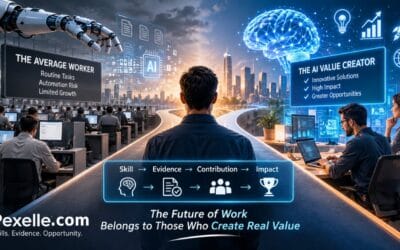
Skill → Evidence → Contribution → Impact
- Skill: What can this person do?
- Evidence: How can that capability be verified?
- Contribution: Where has the person applied it?
- Impact: What measurable result did the contribution produce?
This creates a more meaningful way to evaluate professional potential.
The important question is no longer simply whether someone has experience. It is whether there is credible evidence that their experience translates into useful outcomes.
AI Will Accelerate the Transition
Artificial intelligence could make problem-based employment significantly more practical.
Today, identifying the right professional for a complex challenge can be difficult. A company may not know which combination of skills is necessary, and candidates may not recognize that their experience is relevant to an opportunity outside their usual industry.
AI systems could help bridge this gap.
An organization could describe a business problem in natural language. An AI system could analyze the challenge, identify the capabilities required, break the problem into smaller components, and recommend relevant professionals.
For example, a business looking to modernize its internal operations might need expertise in workflow automation, data engineering, process design, cybersecurity, and change management.
Instead of searching for one person with an unrealistic list of qualifications, an intelligent matching system could identify a group of professionals whose combined capabilities address the challenge.
AI could also help professionals discover opportunities that traditional recruitment systems might overlook.
A professional with experience in financial modeling might be recommended for a business forecasting challenge, even if their previous job title has never included business intelligence.
However, AI should support the matching process, not become the final authority on human capability.
Automated recommendations must be transparent, explainable, and open to human evaluation. Otherwise, the same problems found in traditional recruitment could simply be reproduced through algorithms.
Technology can identify potential matches. Evidence and real-world performance must establish trust.
Small Teams Could Compete With Large Organizations
A marketplace of problems could also change who gets access to meaningful business opportunities.
Traditionally, large organizations have had access to extensive talent pools, while smaller businesses have often struggled to recruit specialists for specific challenges.
At the same time, highly capable independent professionals have frequently depended on personal networks, recruitment agencies, or freelance platforms to find work.
A problem marketplace could reduce some of these barriers.
A small company could publish a technical challenge and attract specialists from different parts of the world without immediately committing to permanent employment.
A group of independent professionals could collaborate to deliver a solution that would previously have required an entire department.
This creates opportunities for specialized teams, independent experts, consultants, and people building careers through multiple projects rather than a single employer.
It could also encourage a more entrepreneurial workforce, where professionals build their reputations through the problems they solve.
The competitive advantage may increasingly belong to those who can assemble the right capabilities at the right time.
The New Professional Economy Will Be Built Around Reputation
When employment becomes more project-oriented and problem-driven, professional reputation will become increasingly important.
In traditional employment, reputation is often associated with previous employers, job titles, educational institutions, and personal references.
In a problem marketplace, reputation could be built through a continuous record of demonstrated performance.
Consider a professional who has solved 15 different business challenges across five industries.
Their professional profile could show the types of problems they have addressed, the skills they applied, the contributions they made, and the outcomes they achieved.
Over time, this creates a professional history that is much more informative than a list of previous positions.
It also creates a new form of career progression.
Instead of measuring professional growth exclusively through promotions or salary increases, individuals could demonstrate progress through increasingly complex problems, broader responsibilities, stronger contributions, and verified results.
Reputation would become something people build through evidence rather than something they simply inherit from their employment history.
Of course, this requires fair evaluation. Not every successful outcome can be attributed to one individual, and complex projects often involve multiple contributors. A credible system must recognize collaboration, contextual factors, and the actual contribution of each participant.
What Happens to Traditional Employment?
The emergence of a problem marketplace does not necessarily mean the end of permanent employment.
Many organizations will continue to need stable teams, long-term institutional knowledge, ongoing operational responsibilities, and people who maintain critical systems.
However, the boundaries between employment, consulting, contracting, freelancing, and project-based collaboration may become less rigid.
A company might employ a permanent core team while publishing specific challenges to an external network of specialists.
Another organization might operate with a small permanent workforce and assemble temporary teams around individual initiatives.
Some professionals may prefer stable employment, while others may choose to work across multiple organizations and projects.
The future is unlikely to be one universal employment model.
Instead, organizations may have access to a broader range of ways to engage talent, depending on the complexity, duration, and importance of each problem.
The real transformation is not necessarily how people are employed. It is how organizations identify, evaluate, and access human capabilities.
The Challenges of a Problem-Based Workforce
Despite its potential, a marketplace of problems also introduces important challenges.
Defining the right problem
Not every business challenge can be described clearly. Organizations may struggle to distinguish between symptoms and underlying causes. Poorly defined challenges can attract unsuitable proposals and waste everyone’s time.
Evaluating solutions fairly
A successful outcome is not always immediately measurable. Some contributions produce long-term value, while others prevent problems that would otherwise have occurred. Evaluation systems must account for context and complexity.
Protecting intellectual property
Companies may hesitate to publish sensitive challenges if doing so exposes confidential information, strategic plans, customer data, or proprietary technology. Secure collaboration and clearly defined intellectual property agreements will be essential.
Preventing exploitation
A marketplace should not become a system where professionals are expected to provide unlimited unpaid work in the hope of winning a contract. Clear scopes, transparent compensation, and fair participation rules are necessary.
Building reliable trust
Without verified professional identities and credible evidence, a problem marketplace could become another platform filled with exaggerated claims, misleading portfolios, and unreliable participants.
These challenges demonstrate why simply creating a website where companies publish tasks and people submit proposals is not enough.
The infrastructure behind the marketplace matters just as much as the marketplace itself.
The Infrastructure Needed for the Future of Work
A mature problem-based employment ecosystem will require more than job listings and professional profiles.
It will need an interconnected system capable of understanding both sides of the market.
On the organizational side, companies need tools to describe problems, define expected outcomes, identify required capabilities, and evaluate contributions.
On the professional side, individuals need a way to represent their skills, provide verifiable evidence, document their contributions, and build a trustworthy professional reputation.
Between these two sides, intelligent matching systems can connect real business needs with relevant human capabilities.
This creates an entirely different approach to professional networking and recruitment.
Instead of asking professionals to repeatedly apply for positions, opportunities can emerge when their demonstrated capabilities match an organization’s actual needs.
This is particularly important in a world where professional skills are constantly evolving and traditional job categories cannot always keep pace.
The next generation of employment platforms may therefore look less like digital job boards and more like capability networks connected to a continuously changing marketplace of problems.
Pexelle: Connecting Human Capability to Real-World Problems
At Pexelle, we believe the future of professional identity should extend beyond job titles, traditional CVs, and static qualifications.
Human capability deserves a more meaningful representation.
A professional should be able to demonstrate what they know, provide evidence of what they can do, and build a verifiable history of their contributions.
Likewise, organizations should have better ways to discover people based on their actual capabilities rather than relying exclusively on predefined job categories.
This is the foundation of a more evidence-driven professional ecosystem.
By connecting skills, evidence, professional contributions, and real opportunities, Pexelle explores a future in which people can be discovered for what they are genuinely capable of achieving.
The goal is not simply to help people find another job.
It is to make human capabilities more visible, verifiable, and accessible.
Because the next opportunity may not begin with a job advertisement.
It may begin with a problem that needs solving.
The Future Will Reward Those Who Solve Problems
The employment market is approaching a fundamental shift in how it understands professional value.
Job titles will continue to exist. Degrees and qualifications will remain important. Permanent employment will continue to serve essential purposes.
But these traditional structures may no longer be sufficient to describe the full range of human capabilities available in the global workforce.
As businesses become more dynamic, their need for specific capabilities will increasingly emerge from real-world challenges rather than fixed organizational charts.
The professionals who succeed will not necessarily be those with the most impressive titles or the longest lists of qualifications.
They will be the people who can identify problems, apply their knowledge, collaborate effectively, and demonstrate meaningful results.
The future of work may not be a competition for available positions. It may be a marketplace where the world’s problems create the world’s opportunities.
And in that marketplace, the most valuable professional question will no longer be:
What is your job title?
It will be:
What problems can you solve, and what evidence can you show?
Source : Medium.com