
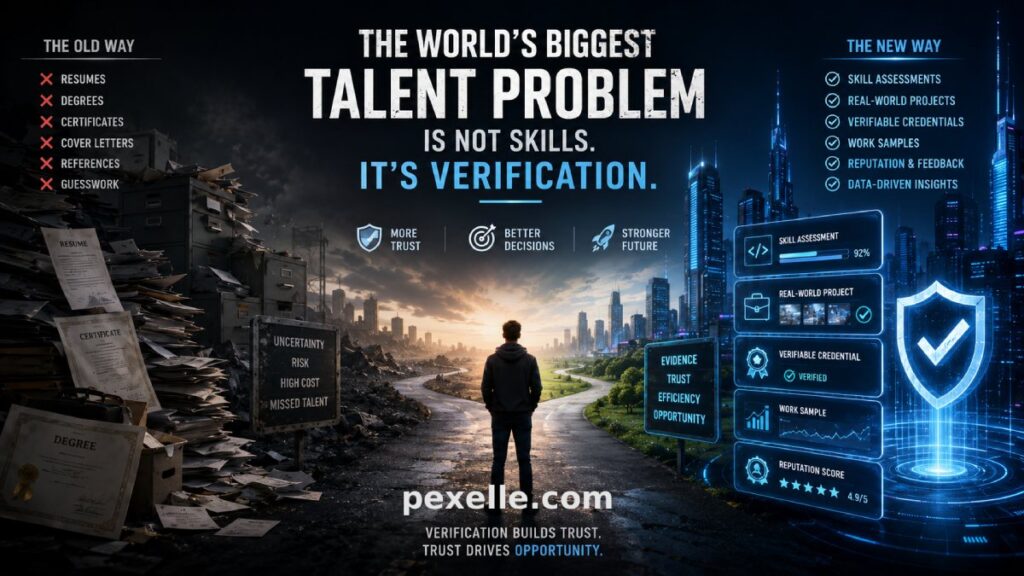
For decades, organizations have approached hiring with a simple assumption:
The biggest challenge is finding skilled people.
As a result, companies have invested billions of dollars into education, training programs, certifications, online courses, talent acquisition platforms, and recruitment technologies.
Yet despite these investments, the global talent crisis continues to grow.
Employers struggle to find qualified candidates.
Professionals struggle to prove their value.
Recruiters spend countless hours filtering applications.
And hiring mistakes remain extremely expensive.
But what if the problem is not actually a shortage of skills?
What if the real problem is our inability to verify them?
The Hidden Crisis Behind Modern Hiring
Today’s job market is flooded with information.
A single position can attract hundreds or even thousands of applicants.
Most candidates submit:
- Resumes
- Cover letters
- Certifications
- Portfolios
- LinkedIn profiles
- References
At first glance, this seems like more than enough information.
In reality, it creates a different problem.
Information is abundant.
Trust is scarce.
Hiring managers are not evaluating skills directly.
They are evaluating signals that are supposed to represent skills.
The difference is enormous.
- A resume is not skill.
- A degree is not skill.
- A certificate is not skill.
- A recommendation letter is not skill.
They are merely indicators that may or may not reflect actual capability.
The entire hiring process is built on proxies.
And proxies are increasingly unreliable.
The Resume Economy Is Breaking Down
For years, resumes have acted as the primary gateway to employment.
But resumes were designed for a world where information traveled slowly and professional identities were relatively simple.
That world no longer exists.
Today:
- AI can generate perfect resumes in seconds.
- Candidates can optimize applications for Applicant Tracking Systems.
- Certifications can be collected without deep mastery.
- Portfolios can be heavily assisted by AI tools.
- Professional profiles can be polished beyond reality.
As a result, employers face a growing challenge:
Distinguishing genuine expertise from impressive presentation.
The consequence is not merely inefficiency.
It is uncertainty.
And uncertainty is expensive.
Employers Are Buying Confidence, Not Talent
Every hiring decision is fundamentally a prediction.
An employer is making a bet that a candidate will perform successfully in the future.
The problem is that most hiring systems provide very limited evidence.
Imagine purchasing a high-performance machine worth hundreds of thousands of dollars without seeing it operate.
Instead, you only receive:
- A summary document
- A list of previous owners
- A few references
- A certificate claiming quality
Most organizations would never accept that level of uncertainty for a physical asset.
Yet they accept it every day when hiring people.
This is why organizations often prioritize confidence over capability.
Not because they want to.
Because confidence is easier to evaluate than competence.
The Global Cost of Poor Verification
The consequences extend far beyond individual hiring mistakes.
Poor verification creates systemic inefficiencies across the entire economy.
Organizations spend enormous resources on:
- Recruitment
- Screening
- Interviews
- Background checks
- Training
- Probation periods
Meanwhile, highly capable individuals are frequently overlooked because they lack traditional credentials.
This creates a paradox.
Talented people remain invisible.
Less capable people become visible through stronger signaling.
The result is a market that rewards presentation more effectively than performance.
Why Skills Are Becoming Easier to Acquire
Historically, expertise was rare because access to knowledge was limited.
Today, knowledge is everywhere.
Anyone with an internet connection can learn:
- Programming
- Design
- Marketing
- Data analysis
- Project management
- Artificial intelligence
Learning resources are growing exponentially.
AI tutors can explain concepts instantly.
Interactive platforms provide hands-on practice.
Educational content is available at unprecedented scale.
The barrier to acquiring skills continues to fall.
But the barrier to proving those skills remains surprisingly high.
That is where the real bottleneck now exists.
Verification Is the New Infrastructure
The next generation of talent systems will not focus primarily on teaching people.
They will focus on validating them.
The future belongs to systems that can answer questions like:
- Can this person actually perform the task?
- Under what conditions?
- At what level of quality?
- How consistently?
- Compared to whom?
Verification creates trust.
Trust reduces uncertainty.
Reduced uncertainty improves decision-making.
And better decisions create economic value.
This shift is already visible in emerging trends:
- Skill-based hiring
- Real-world assessments
- Project-based evaluations
- Continuous credentialing
- AI-powered competency measurement
- Reputation systems
- Verifiable digital achievements
The common theme is simple:
Moving from claimed capability to demonstrated capability.
The Rise of Verifiable Talent
In the coming decade, professional identity will evolve dramatically.
Instead of static resumes, individuals will increasingly build dynamic records of demonstrated work.
Employers will gain access to richer evidence.
Candidates will spend less time describing what they can do and more time showing it.
The most valuable professionals will not necessarily be those with the most credentials.
They will be those with the most verifiable evidence of performance.
This represents a fundamental shift in how trust is created.
The winners of the future labor market will not simply be the most skilled individuals.
They will be the most verifiable individuals.
A Future Beyond Resumes
The future of work is not about collecting more information.
It is about creating more certainty.
Organizations do not need another thousand resumes.
They need better evidence.
Professionals do not need more ways to describe their abilities.
They need better ways to prove them.
The world’s biggest talent problem is not a shortage of skills.
Humanity has never had more access to knowledge, learning, and opportunity.
The real challenge is verification.
Because in a world where anyone can claim expertise, trust becomes the most valuable currency of all.
And trust begins with proof.
Source : Medium.com