
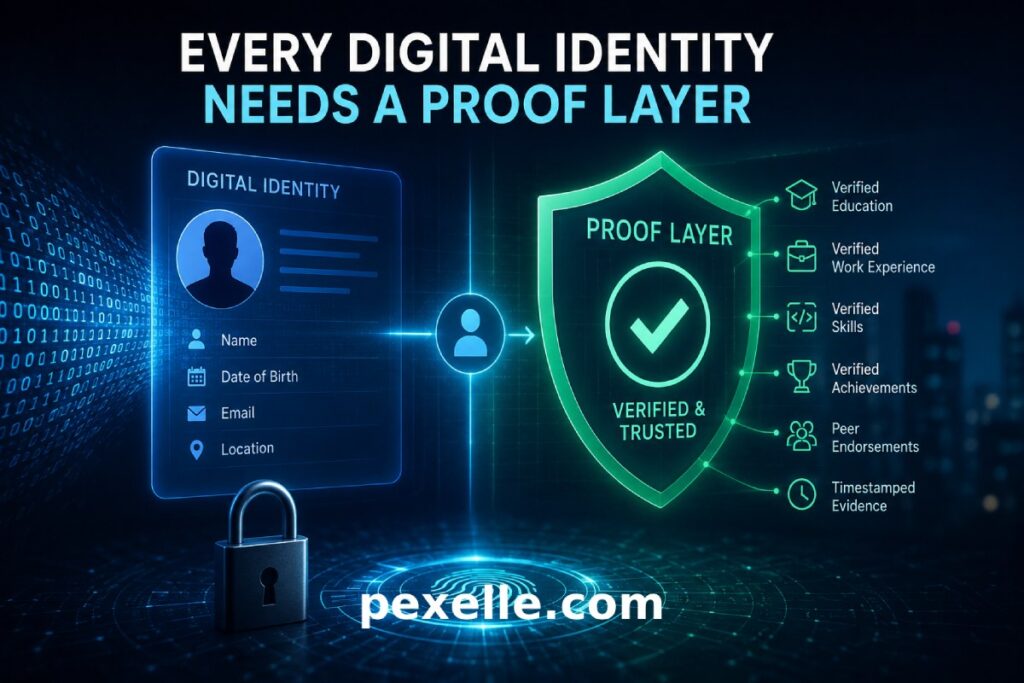
The Missing Foundation of the Digital World
For decades, the internet has been remarkably successful at answering one question:
“Who are you?”
It has become increasingly good at authenticating identities through passwords, biometrics, passkeys, multi-factor authentication, and government-issued digital IDs.
Yet it still struggles with a far more important question:
“Can you prove what you claim?”
This distinction is becoming one of the defining challenges of the AI era.
As artificial intelligence generates realistic resumes, portfolios, certificates, videos, code, voices, and even entire professional histories, identity alone is no longer enough. Being able to log into an account does not prove that the information behind that account is genuine.
The future of the digital economy depends on adding a new layer to every digital identity:
A Proof Layer.
Identity Is Authentication. Proof Is Trust.
Most digital identity systems answer questions like:
- Is this really the account owner?
- Did the user authenticate successfully?
- Is this person authorized to access the system?
Those are important security problems.
But businesses, employers, universities, financial institutions, and online communities increasingly need answers to different questions:
- Did this person actually earn this certification?
- Was this project really completed by them?
- Have these skills been independently verified?
- Has this experience been confirmed by someone who observed it?
- Is this portfolio authentic?
- Was this contribution genuinely made by this individual?
Authentication verifies access.
Proof verifies reality.
These are fundamentally different problems.
AI Has Changed the Meaning of Evidence
Before generative AI, creating fake evidence required significant effort.
Today, convincing evidence can be generated within minutes.
AI can produce:
- Professional resumes
- Software projects
- Marketing campaigns
- Design portfolios
- Academic papers
- Recommendation letters
- Certificates
- Business documentation
- Videos
- Voice recordings
The quality continues to improve.
Soon, synthetic evidence will become cheaper than collecting real evidence.
This changes everything.
If digital platforms cannot distinguish authentic achievements from AI-generated claims, trust becomes increasingly difficult to establish.
Digital Identity Without Proof Is Incomplete
Imagine two developers.
Both have:
- LinkedIn profiles
- GitHub accounts
- University degrees
- Five years of experience
- Excellent portfolios
On paper, they appear identical.
Yet one has:
- Independently verified projects
- Confirmed contributions
- Peer endorsements tied to real work
- Timestamped achievements
- Verified skill assessments
The other simply assembled convincing content using AI.
Without a Proof Layer, both profiles appear equally credible.
With a Proof Layer, the difference becomes immediately visible.
The Internet Already Uses Proof Everywhere Else
Interestingly, digital infrastructure already relies heavily on proof.
Banks verify financial transactions.
Blockchain networks verify ownership.
Websites verify encrypted communications.
Package delivery systems verify shipments.
Software verifies digital signatures.
Cloud platforms verify system integrity.
Payment networks verify transactions before settlement.
Every critical infrastructure relies on verification.
Yet when it comes to people, we often accept unverifiable claims.
That inconsistency will not survive the AI era.
Proof Should Be Continuous
Traditional verification often happens once.
A degree is checked.
An identity document is uploaded.
A background check is completed.
Then the process ends.
Future trust systems will work differently.
Proof should evolve continuously as people learn, contribute, collaborate, and create value.
Every verified action becomes another trust signal.
Examples include:
- Completing verified projects
- Receiving validated peer feedback
- Demonstrating measurable skills
- Passing assessments
- Contributing to open-source software
- Completing professional training
- Publishing verified research
- Building products with confirmed outcomes
Instead of relying on static credentials, digital identities will accumulate living evidence over time.
Trust Should Be Portable
One major problem with today’s internet is fragmented reputation.
Every platform builds trust independently.
- Your professional reputation stays on LinkedIn.
- Your coding reputation lives on GitHub.
- Your design reputation exists on Behance.
- Your freelance reputation belongs to Upwork.
- Your academic reputation remains with universities.
These trust signals rarely communicate with one another.
A Proof Layer changes this.
Verified achievements become portable.
People carry their verified capabilities across platforms instead of rebuilding credibility every time they join a new ecosystem.
Trust becomes an asset owned by the individual, not by the platform.
Proof Creates Better AI
Interestingly, Proof Layers are not only valuable for humans.
AI systems also benefit.
Modern AI models struggle because they often receive information without confidence measurements.
Everything appears equally plausible.
If AI systems could consume verified evidence rather than unverified claims, they could:
- Rank sources more intelligently
- Reduce hallucinations
- Prioritize trustworthy information
- Improve decision quality
- Explain confidence levels more accurately
Proof strengthens both human trust and machine reasoning.
The Future Internet Will Measure Verifiable Reality
For years, digital identity focused primarily on authentication.
The next decade will focus on verification.
Success online will increasingly depend on measurable evidence rather than persuasive storytelling.
Instead of asking:
“Who says this?”
Platforms will ask:
“What evidence supports it?”
Instead of rewarding polished profiles, they will reward proven capability.
Instead of displaying claims, they will display verification.
The Rise of Proof Infrastructure
Just as cloud infrastructure became essential for software, Proof Infrastructure will become essential for digital identity.
Organizations will require it for hiring.
Educational institutions will use it for credentials.
Communities will use it for reputation.
Marketplaces will use it for trust.
Governments will use it for public services.
AI agents will use it before making autonomous decisions.
Proof will become a foundational service across the internet.
Conclusion
Digital identity solved the problem of recognition.
The next challenge is credibility.
In a world where artificial intelligence can generate convincing claims at scale, trust can no longer depend solely on appearance or reputation.
Every profile, credential, portfolio, and achievement needs evidence that can be independently verified.
Every digital identity needs a Proof Layer.
Because in the future, identity will tell the world who you are, but proof will determine whether the world can trust what you say.
Source : Medium.com